Ocean composition, layers and circulation
What this lesson covers
- What makes seawater salty, and the processes that raise or lower surface salinity.
- How temperature, salinity and pressure set density, and how they form the mixed layer, thermocline, halocline and pycnocline.
- Why the thermocline near New Zealand changes with the seasons.
- How wind drives surface currents and gyres, and how the Coriolis effect turns them (Ekman transport).
- Coastal upwelling and downwelling, and why upwelling makes the sea so productive.
- Thermohaline circulation: how sea ice formation off Antarctica sends dense water around the deep ocean.
What is in seawater
- Seawater averages about 35 g of dissolved salts in every kilogram (a salinity of 35), mostly chloride and sodium ions, with sulfate, magnesium, calcium and potassium.
- The ions come from rock weathering carried in by rivers and from hydrothermal vents and volcanic gases; the proportions of the main ions are almost the same everywhere, only the total changes.
- Surface salinity rises where water is removed (evaporation, sea ice forming) and falls where fresh water is added (rain, rivers, melting ice).
- Seawater also holds dissolved gases: oxygen and carbon dioxide dissolve best in cold water, which matters for the carbon cycle and for life.
| Process | Surface salinity | Where it dominates |
|---|---|---|
| Evaporation | Rises | Subtropics near 25° to 30°, under dry high pressure |
| Rain | Falls | Equator and mid-latitude westerlies |
| River run-off | Falls | Near coasts and river mouths |
| Sea ice forming | Rises | Around Antarctica in winter |
| Ice melting | Falls | Polar seas in summer |
Temperature, salinity, pressure and density
- Seawater density is usually 1020 to 1030 kg m⁻³. Colder water is denser because its particles move less and pack closer; saltier water is denser because more dissolved mass is packed into the same volume.
- Unlike fresh water, which is densest at 4 °C, seawater of normal salinity keeps getting denser as it cools, right down to its freezing point of about −1.9 °C, so the coldest seawater sinks.
- Pressure increases by about 1 atmosphere (101 kPa) for every 10 m of depth, from the weight of water above: P = ρgh plus the air pressure at the surface.
- Water arranges itself by density: the least dense water floats at the surface and the densest fills the bottom of the ocean basins, so the deep ocean is cold, dark and stable.
Example: pressure in the deep ocean
- Take seawater density as 1025 kg m⁻³, g = 9.8 N kg⁻¹ and air pressure as 1.01 × 10⁵ Pa.
- Find the total pressure at 1000 m, and at the bottom of the Kermadec Trench, about 10 047 m deep, north-east of New Zealand.
- water at 1000 m: P = ρgh = 1025 × 9.8 × 1000 = 1.0045 × 10⁷ Pa
- total = 1.0045 × 10⁷ + 1.01 × 10⁵ = 1.01 × 10⁷ Paadd the air pressing on the surface
- 1.01 × 10⁷ ÷ 1.01 × 10⁵ = 100 atmospheres
- Kermadec Trench: 1025 × 9.8 × 10 047 = 1.01 × 10⁸ Pathe air adds only 0.1% here
- 1.01 × 10⁷ Pa at 1000 m; 1.01 × 10⁸ Pa (about 1000 atmospheres) in the trench
Try it: pressure and depth
Three layers, and the gradients between them
- The surface mixed layer is heated by the Sun and stirred by wind and waves, so its temperature and salinity are nearly the same from top to bottom.
- Below it, the transition layer has the steepest changes: a thermocline (temperature falls fast with depth), often with a halocline (salinity changes fast), together forming a pycnocline (density rises fast).
- The deep layer, below about 1000 m, is cold (about 0 to 4 °C), dense and barely changes; it holds most of the ocean's water.
- A strong pycnocline acts as a barrier: it takes a lot of energy to mix light surface water down through it, so nutrients from the deep stay below and heat and gases from the surface stay above.
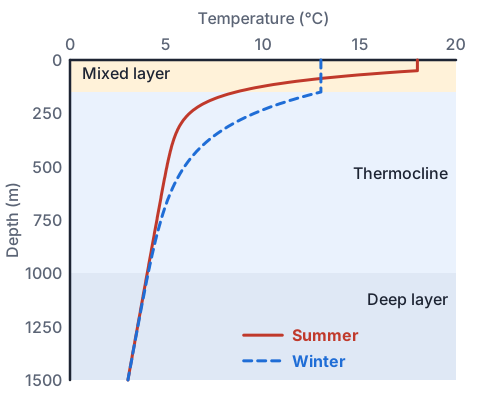
Why the thermocline changes with the seasons near New Zealand
- In the tropics the surface is warm all year, so there is a permanent strong thermocline; in polar seas the surface is as cold as the deep water, so there is almost none.
- At New Zealand's mid-latitudes, summer brings strong sunshine and generally lighter winds: the surface warms, a thin warm mixed layer forms, and a sharp, shallow thermocline develops.
- In winter, less solar energy and stronger, stormier westerlies cool the surface and stir it deeper, so the mixed layer thickens and the thermocline becomes weaker and deeper.
- Because density depends mostly on temperature here, the pycnocline follows: strong and shallow in summer, weak in winter, when deep mixing brings nutrients up and spring sunshine then triggers a phytoplankton bloom.
Wind-driven surface currents
- Wind drags on the sea surface, setting the top layer moving; that layer drags the one below, and so on, each a little slower and turned a little further by the Coriolis effect: the Ekman spiral.
- Averaged over the top 100 m or so, the net water movement (Ekman transport) is at right angles to the wind: to the left of the wind in the Southern Hemisphere, to the right in the Northern.
- The trade winds and westerlies, turned by the Coriolis effect and blocked by continents, drive huge circular gyres; the South Pacific gyre turns anticlockwise.
- Around New Zealand, warm subtropical water arrives from the north-west via the East Auckland Current, and the cold Antarctic Circumpolar Current flows eastwards to the south; they meet along the Subtropical Front, which runs along the Chatham Rise.
The Coriolis effect
- The Earth spins eastwards, and a point on the equator moves at about 1670 km h⁻¹ while a point near a pole barely moves.
- Anything moving freely across the surface keeps its own motion while the ground turns beneath it, so seen from the Earth its path curves: to the left in the Southern Hemisphere and to the right in the Northern.
- The effect is zero at the equator and strongest at the poles, and it only changes direction, not speed; it matters for large, long-lived flows such as ocean currents and winds, not for draining sinks.
- That leftward turn in the Southern Hemisphere sets the anticlockwise South Pacific gyre and the direction of Ekman transport, which decides where upwelling happens.
Example: upwelling off the West Coast
- The West Coast of the South Island runs from south-west to north-east, with the Tasman Sea to the north-west.
- In summer, south-westerly winds often blow along it. Explain why cold water then appears at the surface near the coast, and what happens to sea life.
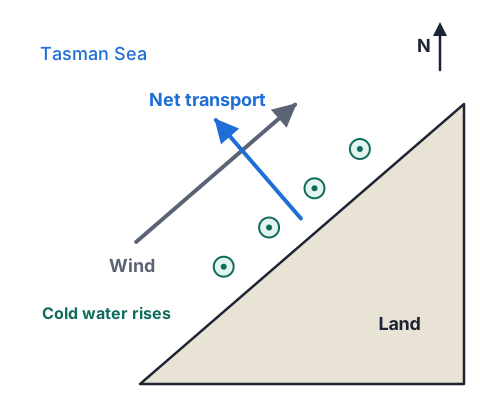
- wind from the south-west blows towards the north-east, along the coast
- Ekman transport is 90° to the left of the wind: towards the north-westSouthern Hemisphere
- north-west is offshore, so surface water moves away from the coast
- cold water from below the pycnocline rises to replace it: upwelling
- the deep water carries nutrients (nitrate, phosphate) from decaying sinking matter
- upwelling brings cold, nutrient-rich water up, so phytoplankton bloom and the food web booms
Thermohaline circulation
- Thermohaline circulation is the slow, deep part of ocean circulation, driven by differences in density from temperature (thermo) and salinity (haline).
- In the Weddell and Ross Seas, winter winds blowing off Antarctica freeze the sea surface; sea ice holds very little salt, so the brine left behind makes the water below saltier as well as near freezing.
- This very cold, salty, dense water sinks down the continental slope and spreads north along the sea floor as Antarctic Bottom Water, the densest water in the ocean; dense North Atlantic Deep Water forms in a similar way near Greenland.
- The deep water slowly warms and mixes upwards, and the Antarctic Circumpolar Current links all the ocean basins, so a parcel of water can take around a thousand years to complete the loop; east of New Zealand a deep current carries this bottom water north.
Try it: density-driven circulation
What Achieved, Merit and Excellence look like
- Achieved describes a process correctly; Merit explains how and why, linking two processes; Excellence discusses how several processes connect into one system for the context given.
| Grade | A model answer |
|---|---|
| Achieved | The water in the Ross Sea is very cold and salty, so it is dense and sinks to the bottom. |
| Merit | In winter, sea ice forms on the Ross Sea. Ice holds little salt, so brine is left in the water beneath, raising its salinity. The water is also near −1.9 °C, so it is both cold and salty and becomes denser than the water around it, so it sinks. |
| Excellence | Strong winds off Antarctica push new sea ice away from the coast, keeping open water that keeps freezing all winter. Each time ice forms, brine is rejected, so the shelf water becomes steadily saltier while staying at its freezing point. Because seawater gets denser all the way to freezing, this water becomes denser than any other, sinks down the slope and spreads north as Antarctic Bottom Water, driving the deep part of the thermohaline circulation and carrying dissolved oxygen and carbon dioxide into the deep ocean. |
Common mistakes
- The Coriolis effect makes currents turn right in New Zealand.In the Southern Hemisphere moving water and air are deflected to the left.
- Ekman transport goes the same way as the wind.Net Ekman transport is at right angles to the wind, to the left in the Southern Hemisphere.
- Seawater is densest at 4 °C, so the deep ocean is at 4 °C.That is fresh water; normal seawater gets denser right down to about −1.9 °C, and deep water is about 0 to 4 °C.
- The thermocline is the warm layer at the top.The thermocline is the transition layer where temperature falls quickly with depth, between the mixed layer and the deep layer.
Make a pycnocline in a jar
You need: a clear glass jar or tall glass, salt, food colouring, a cup of cold water from the fridge, a cup of hot tap water, a spoon
- Stir 3 heaped teaspoons of salt into the cold water and add a few drops of blue food colouring.
- Pour it into the jar until it is half full.
- Add a few drops of red colouring to the hot tap water, then pour it very slowly over the back of the spoon held just above the cold water.
- Leave it for 10 minutes, then gently tilt the jar and look side-on at the boundary.
- Look for: the warm fresh water floats on the cold salty water with a sharp boundary that resists mixing, just like the pycnocline between the surface and deep ocean.
Safety: Use hot water only from the tap, not a kettle, and run it over your hand first to check it is not hot enough to scald.
Your turn
Find the total pressure 500 m down. Use ρ = 1025 kg m⁻³, g = 9.8 N kg⁻¹ and air pressure 1.01 × 10⁵ Pa.
In the Southern Hemisphere a wind blows from the south, towards the north. Which way is the net Ekman transport?
What happens to the salinity and density of surface water in the subtropics, where evaporation is strong?
Why does sea ice forming make the water beneath it denser?
Why is the thermocline near New Zealand stronger in summer than in winter?
Show answer
1. ρgh = 1025 × 9.8 × 500 = 5.02 × 10⁶ Pa; total = 5.02 × 10⁶ + 0.101 × 10⁶ = 5.12 × 10⁶ Pa. 2. 90° to the left of a northward wind: towards the west. 3. Both rise: evaporation removes water and leaves the salt behind. 4. Ice holds little salt, so brine is rejected into the water below, making it saltier as well as near freezing. 5. In summer stronger sunshine warms a thin surface layer and lighter winds mix less, so the temperature drop below it is sharp; in winter cooling and storms mix the surface deeper and the drop is gentler.
Exam-style question: West Coast upwelling
- Fishers on the West Coast notice that in some summers, when south-westerly winds blow for days, the sea near the shore turns cold and green and fish gather. When north-easterly winds blow, the sea stays warm and clear.
Describe how wind sets a surface current moving.
Explain how the south-westerly wind and the Coriolis effect cause upwelling along this coast.
Explain why upwelling makes the sea green and attracts fish.
Explain why north-easterly winds stop the upwelling.
Show answer
1. Friction between the wind and the sea surface drags the top layer along; it drags the layer below, so motion passes downwards, weakening with depth (Achieved). 2. The wind blows north-east along the coast. In the Southern Hemisphere the Coriolis effect deflects moving water to the left, so each layer turns further left (the Ekman spiral) and the net transport is 90° to the left of the wind: north-west, offshore. Surface water moves away from the coast and cold water from below the pycnocline rises to replace it (Merit for linking wind, Coriolis and transport). 3. The deep water is rich in nitrate and phosphate from decomposing matter that sank from above. Brought into the sunlit layer, these nutrients let phytoplankton photosynthesise and multiply, turning the water green; zooplankton and then fish feed on them (Merit). 4. A north-easterly blows south-west along the coast, so Ekman transport is to its left: south-east, onshore. Surface water piles up against the coast and sinks (downwelling), the warm low-nutrient layer thickens, and the pycnocline blocks nutrients, so productivity falls (Excellence links wind direction, Coriolis, transport and nutrients for both seasons).
Recap
- Cold, salty water is dense; the ocean is layered into a mixed layer, a transition layer (thermocline, halocline, pycnocline) and the deep layer.
- The thermocline near New Zealand is sharp and shallow in summer, weak and deep in winter.
- Wind drives surface currents; the Coriolis effect turns them left in the Southern Hemisphere, so Ekman transport is 90° left of the wind.
- Offshore transport causes upwelling of cold, nutrient-rich water; sea ice formation off Antarctica drives the deep thermohaline circulation.
| Formula or rule | Use it for |
|---|---|
| P = ρgh (+ air pressure) | pressure at depth |
| Ekman transport 90° left of the wind (SH) | which way surface water goes |
| Offshore transport → upwelling | cold, nutrient-rich, productive |
| Onshore transport → downwelling | warm, low nutrients |
Report a mistake
How is NCEA Level 3 maths going?
See the NCEA Level 3 maths guide