Dating geological events
What this lesson covers
- Relative dating: superposition, original horizontality, cross-cutting relationships, inclusions and unconformities.
- Fossils and faunal succession, and why index fossils give relative ages.
- Radiometric dating: half-life, choosing the right isotope system, and calculating an age.
- Tephra layers as time markers across New Zealand, and how they are identified.
- Cross-correlating several kinds of evidence into a timeline, and what that adds for Excellence.
What AS 91412 asks of you
- AS 91412 is a 4-credit internal. You investigate one geological event or a sequence of events, often a New Zealand one such as the Taupō eruption, Alpine Fault ruptures or the formation of a local landscape, and how they have been dated.
- Achieved: explain the event, and explain a range of evidence used to date it.
- Merit: explain in detail how each key piece of evidence helps us know when the event happened.
- Excellence: justify why each key piece of evidence is trustworthy and useful, and explain how matching up different kinds of evidence (cross-correlation) strengthens the dates.
Relative dating: putting events in order
- Relative dating puts events in order without giving an age in years.
- Superposition: in undisturbed layers, each layer is younger than the one below it. Original horizontality: sediments settle in flat layers, so tilted or folded layers were disturbed later.
- Cross-cutting relationships: a dike, fault or erosion surface is younger than every layer it cuts. Inclusions: pieces of one rock inside another are older than the rock that holds them.
- An unconformity is a buried erosion surface: a gap in the record where rock was removed or none was laid down, so time is missing between the layers above and below it.
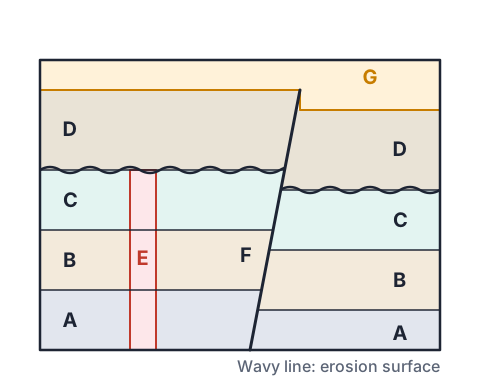
Example: reading the cross-section
- Use the cross-section above to list the events from oldest to youngest.
- A, then B, then Csuperposition: lowest is oldest
- dike E intrudesit cuts A, B and C, so it is younger than C
- uplift and erosion make the wavy surfaceit cuts the top of E, so erosion came after E
- D is laid down on the erosion surfacean unconformity: a time gap below D
- fault F movesit offsets A to D, so it is younger than D
- tephra G fallsG is not offset, so it came after the fault
- A, B, C, E, erosion, D, F, G
Try it: which principle?
Fossils and faunal succession
- Species appear, live for a time, and go extinct, always in the same order, so the fossils in a layer tell you its place in the sequence (faunal succession).
- The best index fossils lived for a short time but were widespread and common, so finding one dates a layer to a narrow window anywhere it occurs.
- New Zealand's geological timescale is divided into local stages defined by fossils, many of them foraminifera (tiny shelled plankton), which let geologists match marine layers from Northland to Southland.
- Fossils give relative ages; the ages in years come from radiometric dates on volcanic layers above and below the fossil-bearing beds.
Radiometric dating and half-life
- A radioactive parent isotope decays to a stable daughter at a fixed rate; which atom decays next is random, but half of any large sample decays every half-life, whatever the temperature or pressure.
- The clock starts when a mineral crystallises from magma and traps the parent but not the daughter, or when an organism dies and stops taking in carbon-14.
- Choose an isotope whose half-life suits the age: carbon-14 for the last 50 000 years or so, potassium-argon or argon-argon for volcanic rocks thousands to billions of years old, uranium-lead in zircon crystals for the oldest rocks.
- The age comes from N = N₀ × (½)^(t ÷ T½), so t = T½ × log₂(N₀ ÷ N), or with a daughter-to-parent ratio D ÷ P, t = T½ × log₂(1 + D ÷ P).
- Most sedimentary rocks cannot be dated directly, because their grains crystallised long before they were deposited; instead, date volcanic layers above and below them.
| Parent to daughter | Half-life | Dates |
|---|---|---|
| Carbon-14 to nitrogen-14 | 5730 years | Wood, charcoal, shell, bone |
| Potassium-40 to argon-40 | 1.25 billion years | Volcanic rock, lava, tephra |
| Uranium-238 to lead-206 | 4.47 billion years | Zircon in granite and tephra |
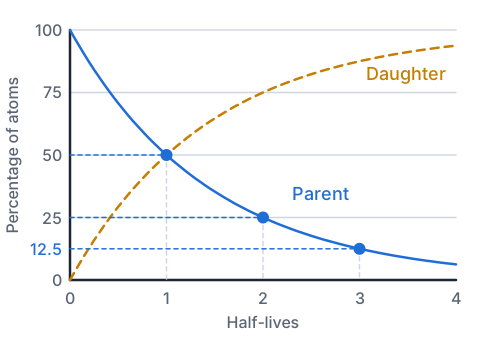
Try it: radioactive decay
Example: charcoal under the Taupō ignimbrite
- A tree trunk charred and buried by the Taupō eruption's ignimbrite has 80.5% of the carbon-14 of living wood when measured in 2026.
- Find how long ago the tree died, and the calendar year.
- N ÷ N₀ = 0.805, T½ = 5730 years
- t = 5730 × log₂(1 ÷ 0.805) = 5730 × ln(1.2422) ÷ ln 2
- t = 5730 × 0.2169 ÷ 0.6931 = 5730 × 0.3129 = 1793 years
- 2026 − 1793 = 233 CE
- less than one half-life, and more than 50% is left
- about 1790 years ago, around 230 CE
Example: uranium-lead in a zircon
- A zircon crystal from a granite has 0.0150 atoms of lead-206 for every atom of uranium-238. Assume all the lead-206 came from decay in the crystal.
- Find the age of the granite.
- t = T½ × log₂(1 + D ÷ P), T½ = 4.47 × 10⁹ years
- log₂(1.0150) = ln(1.0150) ÷ ln 2 = 0.014889 ÷ 0.69315 = 0.021480
- t = 4.47 × 10⁹ × 0.021480 = 9.60 × 10⁷ years
- a small D ÷ P means a small fraction of one half-life
- 96.0 million years
Tephra layers: New Zealand's time markers
- Tephra is the ash and pumice blasted out by an eruption. It falls over a huge area within days, so one tephra layer marks the same moment in time everywhere it is found: an isochron.
- Each eruption's glass has its own chemistry and its crystals their own minerals, so a tephra found in a lake core, a peat bog or a road cutting can be matched to its eruption by analysing it.
- Once one tephra is dated (by radiocarbon on charcoal or plant material, or by counting tree rings), that age applies to every site where the layer is found.
- The central North Island volcanoes have spread dozens of dated tephras over the North Island, so they are used to date lake sediments, archaeological sites and fault movements.
| Tephra | Volcano | Age |
|---|---|---|
| Tarawera | Mt Tarawera | 1886 CE |
| Kaharoa | Mt Tarawera | about 1314 CE |
| Taupō (Hatepe) | Taupō | about 232 CE |
| Waimihia | Taupō | about 3400 years ago |
| Oruanui (Kawakawa) | Taupō | about 25 500 years ago |
Example: matching tephras between two sites
- A lake core and a peat bog 40 km apart both contain three tephras whose glass chemistry matches Kaharoa, Taupō and Waimihia.
- In the bog, a buried soil with charcoal lies between the Taupō and Kaharoa tephras. What can you say about when the soil formed?
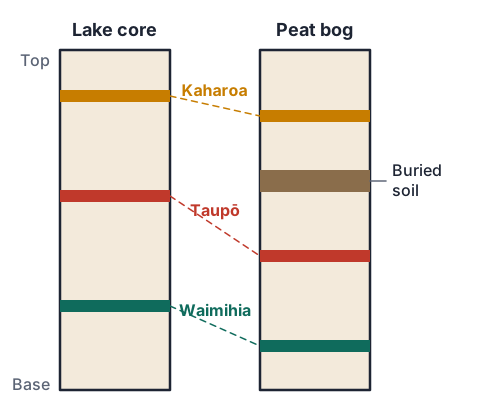
- the same three tephras in the same order at both sitessuperposition and chemistry agree
- soil is above Taupō, so younger than about 232 CE
- soil is below Kaharoa, so older than about 1314 CE
- a radiocarbon date on its charcoal must fall in this window
- the soil formed between about 232 CE and about 1314 CE
Cross-correlation: one timeline from many methods
- Each method has weaknesses: relative dating gives order but no years, radiocarbon needs calibration and only reaches about 50 000 years, and a reworked tephra or contaminated sample can give a false age.
- Confidence comes from independent methods agreeing. The Taupō eruption is dated by radiocarbon on charred trees, by matching tree-ring patterns in buried logs (wiggle-matching, giving 232 ± 5 CE), and by the eruption's place in the tephra sequence.
- Other records can join the timeline: sediment and ice cores, tree rings, stable oxygen isotopes, magnetism locked into lava and the rate of weathering and erosion.
- For Excellence, show how one line of evidence fixes a weakness in another: the tephra links distant sites, radiocarbon gives years, and superposition proves the order.
What Achieved, Merit and Excellence look like
- The same evidence, the Taupō tephra, written about at each grade.
| Grade | What the student wrote |
|---|---|
| Achieved | The Taupō eruption left a layer of tephra across the North Island. Charcoal buried by it was radiocarbon dated, which shows the eruption was about 1800 years ago. |
| Merit | Trees killed and buried by the eruption stopped taking in carbon-14, which then decayed with a half-life of 5730 years. Measuring the carbon-14 left gives the time since the trees died, about 1790 years, which dates the eruption to around 230 CE. |
| Excellence | Radiocarbon alone has an uncertainty of decades, but matching the tree-ring pattern in buried logs to a kauri calibration record narrows the date to 232 ± 5 CE. Because the Taupō tephra falls between the Waimihia and Kaharoa tephras everywhere it is found, and its glass chemistry identifies it in cores across the island, that date becomes a fixed marker: any layer above it is younger than 232 CE, so independent methods support one another. |
Common mistakes
- Carbon-14 dating shows the granite is 96 million years old.Carbon-14 only reaches about 50 000 years and dates once-living material; old igneous rocks need potassium-argon or uranium-lead.
- After two half-lives all the parent isotope has gone.Half remains after one half-life and a quarter after two; the amount halves each time and never quite reaches zero.
- The dike is older than the layers because it is underneath them.A dike that cuts through layers is younger than every layer it cuts.
- A sandstone can be dated by measuring argon in its grains.Its grains crystallised before being eroded and deposited, so date volcanic layers above and below it instead.
Model half-life with coins
You need: 100 coins (or 100 small buttons with one side marked), a large plastic container with a lid, paper and a pen
- Put all 100 coins in the container, close it, shake it well and tip the coins onto a table.
- Remove every coin showing tails: these atoms have decayed. Count and record the heads that remain.
- Put the remaining coins back and repeat, recording the count each round, until fewer than 3 are left.
- Plot coins remaining against the number of shakes, and mark where the curve crosses 50, 25 and 12.5.
- Look for: about half go each shake, so each shake is one half-life, but no one can predict which coin goes next.
Safety: Keep the coins away from small children, because coins are a choking hazard.
Your turn
Charcoal has 25.0% of its original carbon-14. How old is it?
Bone has 60.0% of its original carbon-14. How old is it?
In a cliff, a dike cuts layers 1 to 3 and is itself offset by a fault. Which happened first, the dike or the fault?
A peat layer lies between the Taupō tephra and the Kaharoa tephra. What is its age range?
Why can a sandstone not be dated by potassium-argon on its own grains?
Show answer
1. 25.0% is two half-lives: 2 × 5730 = 11,460 years. 2. t = 5730 × log₂(1 ÷ 0.600) = 5730 × 0.737 = 4220 years. 3. The dike: the fault cuts it, so the fault is younger. 4. Between about 232 CE and about 1314 CE. 5. The grains crystallised in an older rock before they were eroded and deposited, so their clocks date the source rock, not the sandstone.
Recap
- Relative dating gives order: superposition, cross-cutting, inclusions, unconformities and fossils.
- Radiometric dating gives years: t = T½ × log₂(N₀ ÷ N), with an isotope suited to the age and material.
- Tephras are isochrons that link sites; one dated tephra dates the layer everywhere.
- Excellence justifies each piece of evidence and shows how independent methods agree.
| Parent left | Half-lives | Age |
|---|---|---|
| 50% | 1 | 1 × T½ |
| 25% | 2 | 2 × T½ |
| 12.5% | 3 | 3 × T½ |
| Any fraction f | log₂(1 ÷ f) | T½ × log₂(1 ÷ f) |
The maths behind it
Report a mistake
How is NCEA Level 3 maths going?
See the NCEA Level 3 maths guide