Physics applied to a context: fibre-optic broadband
What this lesson covers
- What the internal asks for, and how to choose a context with enough Level 8 physics in it.
- Refraction, refractive index and total internal reflection, and why a fibre's core needs a higher index than its cladding.
- Light as an electromagnetic wave and as photons, and why fibre networks use infrared wavelengths.
- Dispersion and attenuation, and why long-distance links use single-mode fibre.
- Finding, judging and citing sources, and linking ideas into one coherent explanation for Excellence.
How this internal works
- You research a context of your choice (technological, biological or astronomical) and present the physics in it, usually as a written report or a poster with notes.
- Achieved relates the key physics ideas to the context: what principle is at work and where.
- Merit explains how or why each idea applies, with cause and effect and the relevant equations used correctly.
- Excellence links the ideas together into one coherent account, so the reader sees how each piece of physics depends on the others to make the whole thing work.
- The physics must be different from what you use for the socio-scientific issue standard (AS 91527), so plan both contexts together.
Choosing a technology or context
- Choose something you are curious about that rests on at least three connected Level 8 ideas, so there is enough to link for Excellence.
- Check that good sources exist at your level: a manufacturer's datasheet, a university page or a textbook beats a single news story.
- Avoid contexts that are mostly engineering or economics with little physics, or ones so broad (all of renewable energy) that you cannot go deep.
| Context | Physics it rests on |
|---|---|
| Fibre-optic broadband | Refraction, total internal reflection, EM waves, photons |
| Ultrasound scanning | Reflection at boundaries, wave speed, Doppler effect |
| Noise-cancelling headphones | Superposition, phase, destructive interference |
| Induction cooktop | Changing magnetic fields, induced currents, resistance heating |
| Solar panel | Photon energy, the photoelectric idea, energy levels |
Inside an optical fibre
- The Ultra-Fast Broadband rollout ran fibre past about 87% of New Zealanders by the end of 2022, with the signal carried as rapid pulses of laser light that stand for the 1s and 0s of digital data.
- A single-mode fibre has a glass core about 9 µm across inside a glass cladding 125 µm across, wrapped in a plastic coating.
- The core is doped to have a slightly higher refractive index than the cladding, so light meeting the boundary at a large angle is totally reflected and stays in the core.
- Because the reflection is total, almost no light leaks out, which is why a signal can cross kilometres of fibre while copper phone lines lose a broadband signal within a few kilometres.
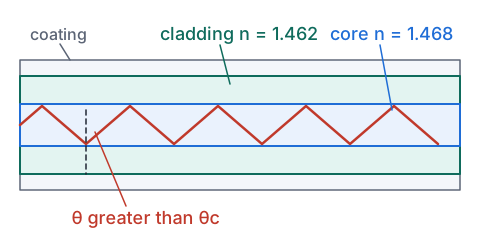
Refraction and total internal reflection
- Light slows down in glass: the refractive index is n = c ÷ v, so in a core of n = 1.468 light travels at 3.00 × 10⁸ ÷ 1.468 = 2.04 × 10⁸ m s⁻¹.
- At a boundary, n₁ sin θ₁ = n₂ sin θ₂, with angles measured from the normal; going into a lower index, the ray bends away from the normal.
- At the critical angle θc the refracted ray would travel along the boundary (θ₂ = 90°), so sin θc = n₂ ÷ n₁.
- For any angle bigger than θc no refracted ray is possible and all the light reflects: total internal reflection, which only happens going from a higher index into a lower one.
Light and waves
Example: the critical angle in a fibre
- A fibre's core has n = 1.468 and its cladding n = 1.462.
- Find the critical angle at the core and cladding boundary, the largest angle a ray in the core can make with the fibre's axis and still be trapped, and how long light takes to travel 10.0 km.
- sin θc = n₂ ÷ n₁ = 1.462 ÷ 1.468 = 0.99591
- θc = 84.8°measured from the normal to the boundary
- largest angle to the axis = 90° − 84.8° = 5.2°the boundary runs along the axis, so the normal is at 90° to it
- v = c ÷ n = 3.00 × 10⁸ ÷ 1.468 = 2.044 × 10⁸ m s⁻¹
- t = d ÷ v = 1.00 × 10⁴ ÷ 2.044 × 10⁸ = 4.89 × 10⁻⁵ s
- θc = 84.8°, rays within 5.2° of the axis are trapped, t = 48.9 µs
Why infrared light
- Home fibre (GPON) sends data to the house at 1490 nm and back at 1310 nm, both in the near infrared, just beyond the red end of visible light (about 400 to 700 nm).
- Glass loses light by Rayleigh scattering from tiny variations in its structure, which grows as 1/λ⁴, so longer wavelengths scatter far less: light at 1550 nm scatters about 24 times less than at 700 nm.
- Beyond about 1600 nm the glass itself starts absorbing infrared, so the lowest-loss window sits around 1300 to 1600 nm.
- Each pulse is made of photons of energy E = hf = hc/λ, about 1.3 × 10⁻¹⁹ J at 1490 nm; a laser diode makes them when electrons drop across an energy gap of the same size, and a photodiode detects them when each photon frees an electron.
Try it: where infrared sits
Dispersion: why single-mode fibre
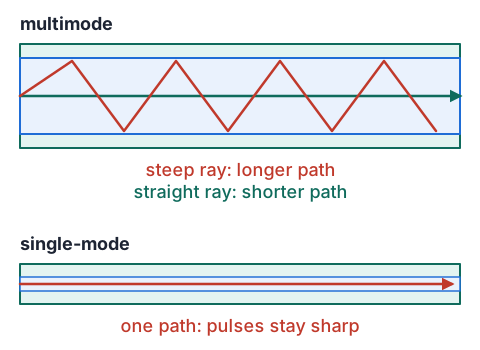
- In a wide multimode core, rays at different angles take different path lengths, so parts of one pulse arrive at different times and the pulse spreads out (modal dispersion).
- If pulses spread into each other, the receiver cannot tell a 1 from a 0, which limits how many pulses per second (bits per second) the link can carry over a given distance.
- A single-mode core is only a few wavelengths wide, so the light can only travel as one mode along the axis and modal dispersion disappears.
- A little spreading remains because the refractive index depends slightly on wavelength (chromatic dispersion), which is one reason lasers with a very narrow range of wavelengths are used.
Researching and evaluating sources
- Use at least three sources of different kinds and record each one fully (author or organisation, title, date, URL) as you go, not at the end.
- Judge each source: who wrote it and why, how recent it is, whether its numbers agree with other sources, and whether the physics is explained or just asserted.
- Rewrite everything in your own words and explain it; copying a diagram or a paragraph shows you found the idea, not that you understand it.
| Source | Strength | Check for |
|---|---|---|
| Fibre manufacturer's datasheet | Exact measured values (index, loss per km) | Gives numbers, not explanations |
| Physics textbook or university page | Correct, explained physics | May be general, not about your device |
| Network company website | Local facts about the New Zealand network | Written to sell, so check claims |
| Encyclopaedia or video | Quick overview and leads | Check every number against a primary source |
Try it: what each source is good for
Example: one idea at three depths
- The same idea, why light stays in the core, written at each grade.
- Notice how Excellence links refraction, the index difference, the narrow core and the infrared wavelength, rather than listing them.
| Grade | What the student wrote |
|---|---|
| Achieved | Light stays in the fibre by total internal reflection, because the core has a higher refractive index than the cladding. |
| Merit | Light slows less in the cladding (n = 1.462) than in the core (n = 1.468), so a ray hitting the boundary bends away from the normal. Beyond the critical angle of 84.8° no refracted ray can exist, so all the light reflects back into the core. |
| Excellence | As Merit, linked on: because the index difference is tiny, only rays within 5.2° of the axis are trapped, which suits a laser's narrow beam. Keeping the core only 9 µm wide forces one path, so pulses do not spread, and using 1310 to 1550 nm infrared keeps scattering low, so pulses stay sharp and strong over many kilometres. |
Common mistakes
- Total internal reflection happens when light goes from the cladding into the core.It only happens going from higher index to lower, so from the core into the cladding.
- The critical angle is measured from the surface of the boundary.Angles in Snell's law are measured from the normal, so θc = 84.8° means the ray almost grazes the boundary.
- Light travels through the fibre at 3.00 × 10⁸ m s⁻¹.That is its speed in a vacuum; in the core it is c ÷ n = 2.04 × 10⁸ m s⁻¹.
- My report lists refraction, photons and dispersion, so it is comprehensive.Excellence needs the ideas linked: say how each one depends on or affects the others in the device.
Make a mirror out of a water surface
You need: a clear straight-sided plastic cup or container, water, a coin, a phone torch
- Fill the container about two thirds with water and stand it on a table at eye level.
- Look up at the underside of the water surface through the side of the container: from a low enough angle it shines like silver.
- Put the coin under the container, then slowly lower your eye while looking through the side; at some point the coin vanishes.
- Shine the phone torch up through the side towards the surface at different angles and see when the beam stops leaving through the top.
- Look for: once the angle in the water is steeper than about 49° from the normal (the water and air critical angle), all the light reflects back down, just like in a fibre's core.
Safety: Keep the water well away from the phone and any power points, and wipe up spills so nobody slips.
Your turn
Find the critical angle for light going from glass (n = 1.50) into water (n = 1.33).
Find the speed of light in glass with n = 1.50.
Find the energy of a photon of wavelength 1310 nm. Use h = 6.63 × 10⁻³⁴ J s.
Explain why a fibre's cladding must have a lower refractive index than its core.
How long does light take to travel 25.0 km along a fibre core with n = 1.468?
Show answer
1. sin θc = 1.33 ÷ 1.50 = 0.8867, so θc = 62.5°. 2. v = c ÷ n = 3.00 × 10⁸ ÷ 1.50 = 2.00 × 10⁸ m s⁻¹. 3. E = hc/λ = (6.63 × 10⁻³⁴ × 3.00 × 10⁸) ÷ (1310 × 10⁻⁹) = 1.52 × 10⁻¹⁹ J. 4. Total internal reflection only happens when light meets a boundary into a lower refractive index at more than the critical angle, so a lower-index cladding keeps the light in the core. 5. v = 3.00 × 10⁸ ÷ 1.468 = 2.044 × 10⁸ m s⁻¹, t = 25.0 × 10³ ÷ 2.044 × 10⁸ = 1.22 × 10⁻⁴ s, which is 122 µs.
Recap
- Pick a context with at least three connected Level 8 ideas and good sources you can check.
- Achieved relates the physics to the context, Merit explains how and why, Excellence links the ideas into one picture.
- Fibre: total internal reflection from core to lower-index cladding, sin θc = n₂/n₁.
- Infrared at 1310 to 1550 nm keeps scattering and absorption low; single-mode cores stop pulses spreading.
- Record and judge every source as you go, and explain in your own words.
| Formula | Use it for |
|---|---|
| n = c ÷ v | speed of light in a material |
| n₁ sin θ₁ = n₂ sin θ₂ | refraction at a boundary |
| sin θc = n₂ ÷ n₁ | critical angle |
| E = hf = hc/λ | photon energy |
Report a mistake
How is NCEA Level 3 maths going?
See the NCEA Level 3 maths guide