Standing waves, harmonics, resonance and beats
What this lesson covers
- How two identical waves travelling in opposite directions superpose to form a standing wave with nodes and antinodes.
- Strings fixed at both ends: λ = 2L/n, f = nv/2L, and how tension and mass per unit length set the wave speed.
- Pipes open at both ends (all harmonics) and closed at one end (odd harmonics only), with displacement nodes at closed ends.
- Resonance: a driving frequency that matches a natural frequency builds up a large amplitude.
- Beats: two close frequencies give a loudness that rises and falls at f_beat = |f₁ − f₂|.
How a standing wave forms
- A wave sent along a string reflects at the fixed end and travels back, so two identical waves move through each other in opposite directions.
- Where they always cancel, the string never moves: a node. Halfway between, they add to the largest swing: an antinode.
- Nodes are half a wavelength apart, and so are antinodes; a node and the next antinode are a quarter wavelength apart.
- All the points between two neighbouring nodes move in phase, and the next loop moves in antiphase; the pattern stays in place, so no energy travels along it.
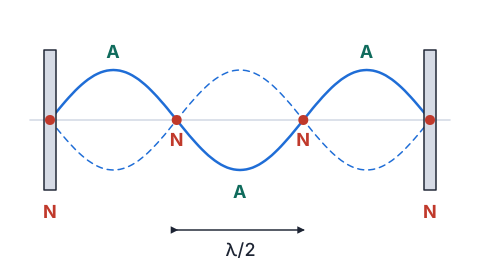
Standing waves on strings
- Both ends of a string are fixed, so both are nodes, and only standing waves with a whole number of loops fit: L = nλ/2, so λ = 2L/n.
- The frequencies are f = v/λ = nv/2L: the first harmonic (fundamental) is f₁ = v/2L and the others are whole-number multiples, 2f₁, 3f₁ and so on.
- The wave speed depends on the string: v = √(T/μ), where T is the tension and μ the mass per unit length (kg m⁻¹).
- So a tighter, lighter or shorter string plays a higher note; pressing a finger on a fret shortens L and raises every harmonic.
Try it: harmonics on a 10 m string
Example: a guitar's top string
- A guitar's high E string is 0.648 m long between its fixed ends and has a fundamental of 329.6 Hz. Its mass per unit length is 4.01 × 10⁻⁴ kg m⁻¹.
- Find the wave speed on the string, the frequency of its third harmonic, and the tension.
- λ₁ = 2L = 2 × 0.648 = 1.296 mone loop: half a wavelength fills the string
- v = fλ = 329.6 × 1.296 = 427.2 m s⁻¹
- f₃ = 3 × 329.6 = 988.8 Hzharmonics are whole-number multiples of f₁
- T = μv² = 4.01 × 10⁻⁴ × 427.2² = 73.2 Nrearrange v = √(T/μ)
- v = 427 m s⁻¹, f₃ = 989 Hz, T = 73.2 N
Open and closed pipes
- In a pipe the standing wave is in the air. Air cannot move at a closed end, so it is a displacement node; air moves freely at an open end, so it is a displacement antinode.
- Open at both ends: antinodes at each end, so L = nλ/2 and f = nv/2L, with every harmonic present, just like a string.
- Closed at one end: a node at one end and an antinode at the other, so L = λ/4, 3λ/4, 5λ/4..., giving f = nv/4L with n odd only.
- So a closed pipe plays an octave lower than an open pipe of the same length (f₁ = v/4L instead of v/2L) and is missing the even harmonics, which changes its tone.
- The antinode actually sits a little beyond the open end, so real pipes behave as if slightly longer (the end correction).
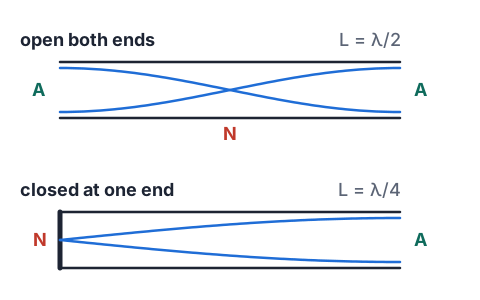
Example: the same tube, open and closed
- A tube 0.400 m long is played first with both ends open, then with one end closed. Take sound's speed as 343 m s⁻¹ and ignore end corrections.
- Find the first three frequencies that can sound in each case.
- open: f₁ = v ÷ 2L = 343 ÷ 0.800 = 428.75 Hz
- open: 429 Hz, 858 Hz, 1286 Hz (n = 1, 2, 3)
- closed: f₁ = v ÷ 4L = 343 ÷ 1.600 = 214.4 Hz
- closed: 214 Hz, 643 Hz, 1072 Hz (n = 1, 3, 5)
- closed f₁ is half of open f₁, and 2f₁ = 429 Hz is missing from the closed pipe
Harmonics and the sound of an instrument
- A plucked string or blown pipe vibrates in several harmonics at once; the fundamental sets the pitch you hear.
- The mix of harmonics, how strong each one is, gives the instrument its tone (timbre), which is why a clarinet and a flute playing the same note sound different.
- A clarinet behaves roughly like a pipe closed at the reed end, so its low notes are strong in odd harmonics; a flute is open at both ends and has all harmonics.
- Touching a string lightly at its midpoint forces a node there, which kills the odd harmonics and leaves 2f₁, 4f₁...: a guitarist's harmonic.
Resonance
- Every object that can vibrate has natural frequencies: for a string or pipe, its harmonics.
- If something drives it at one of those frequencies, each push arrives in step with the motion, energy builds up, and the amplitude grows large: resonance.
- A guitar body resonates with the strings to make them loud; a singer can shatter a wine glass by matching its natural frequency.
- Resonance can be harmful: buildings with a natural frequency close to the shaking of an earthquake sway the most, which is why New Zealand engineers design for the ground conditions under each site.
- A resonance tube finds the speed of sound: hold a tuning fork over a tube in water and raise it until the air column booms, which first happens at L = λ/4.
Example: speed of sound from a resonance tube
- A 512 Hz tuning fork is held over a tube whose bottom end stands in water. Loud resonances are heard at air column lengths of 16.0 cm and 49.5 cm.
- Find the wavelength, the speed of sound and the end correction.
- the resonances are λ/4 and 3λ/4 from the antinode, so they are λ/2 apartthe end correction cancels in the difference
- λ/2 = 49.5 − 16.0 = 33.5 cm, so λ = 67.0 cm = 0.670 m
- v = fλ = 512 × 0.670 = 343 m s⁻¹
- λ/4 = 16.75 cm, but the first resonance was at 16.0 cm
- end correction = 16.75 − 16.0 = 0.75 cmthe antinode sits just above the tube's open end
Beats
- Two notes of slightly different frequency drift in and out of phase with each other.
- When they are in phase they interfere constructively and the sound is loud; half a beat later they are 180° out of phase, interfere destructively, and the sound is quiet.
- The loudness rises and falls at the beat frequency f_beat = |f₁ − f₂|, while the pitch you hear is about the average of the two.
- Musicians tune by beats: as two frequencies get closer the beats slow down, and they stop completely when the notes match; above about 15 Hz difference the ear hears two separate notes instead.
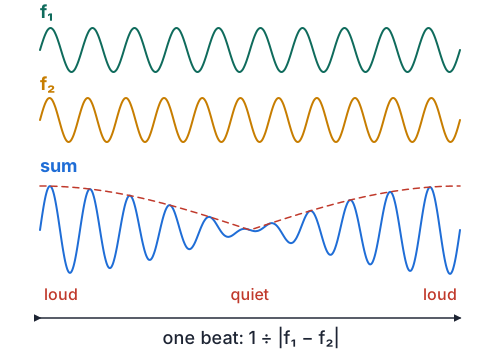
Try it: two close frequencies
Example: tuning a string to a 440 Hz fork
- A guitarist plays a string with a 440 Hz tuning fork and hears 4 beats per second. Tightening the string slightly makes the beats faster, 6 per second.
- Find the string's original frequency and say what the guitarist should do.
- f_string = 440 ± 4 Hz, so 436 Hz or 444 Hz
- tightening raises T, so v = √(T/μ) and f rise
- if it were 436 Hz, rising would bring it closer to 440 Hz and slow the beats
- the beats got faster, so it started at 444 Hz and is now 446 Hz
- original 444 Hz; loosen the string until the beats stop
What Achieved, Merit and Excellence look like
- Achieved names the feature (node at the closed end, odd harmonics); Merit gives the reason; Excellence links the boundary conditions to the wavelengths that fit and then to the frequencies.
- Draw the displacement pattern: a labelled diagram is often the clearest evidence.
| Grade | A model answer |
|---|---|
| Achieved | A closed pipe has a node at the closed end and an antinode at the open end. |
| Merit | With a node at one end and an antinode at the other, the pipe must hold an odd number of quarter wavelengths: L = λ/4, 3λ/4, 5λ/4. |
| Excellence | The air cannot move at the closed end (node) but moves freely at the open end (antinode), so L can only be an odd number of quarter wavelengths, λ = 4L/n with n odd. Since f = v/λ = nv/4L, the frequencies are f₁, 3f₁, 5f₁: the even multiples would need a node or antinode at both ends, which this pipe cannot have. |
Common mistakes
- Nodes on a string are one wavelength apart.Neighbouring nodes are λ/2 apart, so one loop is half a wavelength.
- A closed pipe's next harmonic after f₁ is 2f₁.Only odd harmonics fit a closed pipe, so the next one is 3f₁.
- Two notes of 256 Hz and 260 Hz give a beat frequency of 258 Hz.The beat frequency is the difference, 4 Hz; about 258 Hz is the pitch you hear.
- Doubling the tension doubles the frequency.f is proportional to v = √(T/μ), so doubling T multiplies f by √2; quadrupling T doubles it.
Tune a bottle with water
You need: an empty glass or plastic bottle, a jug of water, a ruler, a phone with a free tuner or frequency app
- Blow gently across the top of the empty bottle until it sounds a steady note, and read the frequency on the tuner app.
- Measure the length of the air column from the water level (or the bottom) to the top of the neck.
- Add water in steps to shorten the air column, measuring the length and the frequency each time.
- For each step, work out v = 4Lf, treating the bottle as a pipe closed at the water surface.
- Look for: shorter air columns give higher notes, and 4Lf comes closest to 343 m s⁻¹ once the water is up in the narrow neck; with a wide body of air under a narrow neck the bottle resonates differently and 4Lf comes out well below 343 m s⁻¹.
Safety: Do not blow so hard or so long that you feel dizzy, and if you use a glass bottle keep it on a towel so it cannot roll off and break.
Your turn
A string 0.500 m long carries waves at 200 m s⁻¹. Find its fundamental frequency.
Find the wavelength of the 4th harmonic on that string.
A pipe 0.250 m long is closed at one end. Using v = 340 m s⁻¹, find the next frequency it can play above its fundamental.
Two tuning forks of 256 Hz and 260 Hz are struck together. Find the beat frequency.
The tension in a string is quadrupled. What happens to its fundamental frequency?
Show answer
1. f₁ = v ÷ 2L = 200 ÷ 1.00 = 200 Hz. 2. λ = 2L ÷ n = 1.00 ÷ 4 = 0.250 m. 3. f₁ = v ÷ 4L = 340 ÷ 1.00 = 340 Hz; the next harmonic is the 3rd, 3 × 340 = 1020 Hz. 4. f_beat = 260 − 256 = 4 Hz. 5. v = √(T/μ) doubles when T is multiplied by 4, and f = v/2L, so the fundamental doubles.
Exam-style question: a pan flute
- Wiremu makes a pan flute from plastic tubes, each closed at the bottom. Take sound's speed as 343 m s⁻¹ and ignore end corrections.
Calculate the fundamental frequency of a tube 0.180 m long.
Describe the displacement pattern of the next harmonic this tube can produce and calculate its frequency.
He plays the tube next to a 480 Hz tuning fork. Calculate the beat frequency and explain how the beats form.
On a hot day the speed of sound rises to 349 m s⁻¹. Explain what happens to the tube's fundamental and to the beats with the fork.
Show answer
1. f₁ = v ÷ 4L = 343 ÷ 0.720 = 476 Hz (Achieved). 2. A node at the closed bottom and an antinode at the open top, with one more node and antinode between: L = 3λ/4. f₃ = 3 × 476.4 = 1429 Hz, about 1430 Hz (Merit for the pattern and frequency). 3. f_beat = 480 − 476.4 = 3.6 Hz. The two sounds drift in and out of phase; in phase they interfere constructively and the sound is loud, 180° out of phase they interfere destructively and it is quiet, so the loudness pulses 3.6 times a second (Merit for the explanation). 4. The tube length is fixed, so λ = 4L = 0.720 m stays the same; f = v/λ rises to 349 ÷ 0.720 = 484.7 Hz. It is now above the fork, so the beat frequency is 484.7 − 480 = 4.7 Hz: the beats first slowed and stopped as the note passed 480 Hz, then sped up again (Excellence for linking fixed λ, v and f to the beats).
Wave on a String
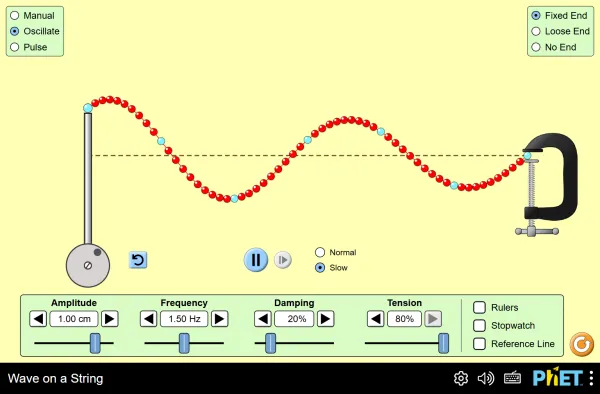
Full screen · PhET Interactive Simulations, University of Colorado Boulder, CC BY 4.0
Recap
- Standing waves: nodes and antinodes λ/2 apart; no energy flows along them.
- Strings and open pipes: L = nλ/2, every harmonic; closed pipes: L = nλ/4 with n odd.
- v = √(T/μ) on a string; f = v/λ always.
- Resonance: driving at a natural frequency builds a large amplitude.
- Beats: f_beat = |f₁ − f₂|, loud when in phase, quiet when 180° out.
| System | Ends | Harmonics |
|---|---|---|
| String | node, node | f = nv/2L, all n |
| Open pipe | antinode, antinode | f = nv/2L, all n |
| Closed pipe | node, antinode | f = nv/4L, odd n |
Report a mistake
How is NCEA Level 3 maths going?
See the NCEA Level 3 maths guide