The Doppler effect
What this lesson covers
- Why a moving source shortens the wavelength ahead of it and lengthens it behind, while the wave speed in the medium stays the same.
- The Doppler formula for a moving source and a stationary observer, f′ = f v/(v − vs) approaching and f v/(v + vs) receding.
- Why the change in pitch is gradual for an observer beside the path, and why the frequency is unshifted at the closest point.
- Doppler shifts of light: red shift and blue shift, and uses from radar to galaxies.
- How exam answers about the Doppler effect are built up from Achieved to Excellence.
Why the pitch changes
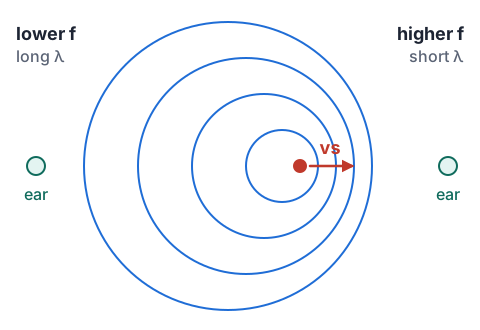
- A source emits one wavefront every period T = 1/f, and each spreads out from wherever the source was when it was emitted.
- If the source moves, it chases its own wavefronts ahead of it, so they are bunched together: the wavelength in front is shorter. Behind it they are spread out: the wavelength is longer.
- The waves still travel at the speed set by the medium (about 343 m s⁻¹ in air at 20 °C), whatever the source does.
- So an observer in front receives the shorter wavelengths at the same speed, more of them each second, and hears a higher frequency; an observer behind hears a lower one.
- The source itself does not change its frequency: the driver of the ambulance hears the siren's true note the whole time.
The Doppler formula
- In one period T the wavefront ahead moves vT and the source moves vsT after it, so the gap between wavefronts is λ′ = (v − vs)T = (v − vs)/f.
- The observer hears f′ = v/λ′ = f v/(v − vs) for a source approaching.
- For a source moving away, the gap is (v + vs)/f, so f′ = f v/(v + vs).
- Check the sign by sense: approaching must give f′ bigger than f, so the bottom must be smaller than v; receding gives f′ smaller than f.
- In NCEA Level 3 the observer is stationary and v is the speed of the wave in the medium, not the speed of light or of the source.
Try it: frequency heard against source speed
Example: an ambulance passing
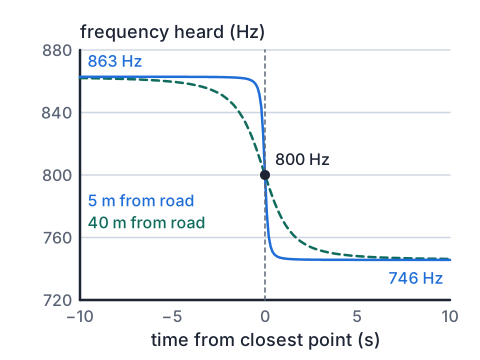
- An ambulance siren emits 800 Hz. The ambulance drives at 25.0 m s⁻¹ straight towards a pedestrian standing ahead of it on its path, then past and away. Take the speed of sound as 343 m s⁻¹.
- Find the frequency heard as it approaches and as it moves away, and the wavelength in front of it.
- approaching: f′ = f v ÷ (v − vs) = 800 × 343 ÷ (343 − 25.0)
- f′ = 274 400 ÷ 318 = 862.9 Hz
- receding: f′ = 800 × 343 ÷ (343 + 25.0) = 274 400 ÷ 368 = 745.7 Hz
- λ′ in front = (v − vs) ÷ f = 318 ÷ 800 = 0.398 mshorter than the 343 ÷ 800 = 0.429 m it would be at rest
- 863 Hz approaching, 746 Hz receding, λ′ = 0.398 m
- 862.9 = 343 ÷ 0.3975, the same as v ÷ λ′
Example: finding the source's speed
- A train's horn emits 500 Hz. A person waiting at a level crossing ahead of the train hears 530 Hz. Take the speed of sound as 343 m s⁻¹.
- Find the speed of the train.
- f′ = f v ÷ (v − vs), so v − vs = f v ÷ f′the frequency is higher, so the train is approaching
- 343 − vs = 500 × 343 ÷ 530 = 323.6 m s⁻¹
- vs = 343 − 323.6 = 19.4 m s⁻¹
- 500 × 343 ÷ (343 − 19.4) = 530 Hz
Standing beside the road
- Only the part of the source's velocity directly towards or away from you causes a shift, so vs in the formula is that component.
- Far away, the car is heading almost straight at you, so you hear nearly the full approaching shift.
- As it gets closer, more of its velocity is across your line of sight, so the frequency falls smoothly; at the closest point it moves neither towards nor away, and you hear the true 800 Hz.
- It then falls on towards the full receding value. The closer you stand to the road, the faster the angle changes near the closest point, so the drop is sharper.
- That is why a passing car makes a smooth falling 'neeeooow', not a sudden jump.
Doppler shifts of light
- Light shows the same effect: a source moving away has its spectral lines shifted to longer wavelengths (red shift), and one approaching is shifted to shorter wavelengths (blue shift).
- For speeds much less than c, the fractional shift is Δλ/λ ≈ v/c, where v is the speed along the line of sight.
- Light needs no medium, so the exact formula for light differs from the sound one, but at everyday speeds the two agree.
- Uses: police radar and speed cameras measure the frequency shift of reflected microwaves, Doppler weather radar measures how fast rain is moving inside a storm, ultrasound scanners measure blood flow, and astronomers use red shifts to show that distant galaxies are moving away from us.
Try it: higher, lower or the same?
Example: a galaxy's red shift
- Hydrogen's red line has a wavelength of 656.3 nm in the laboratory. In the light from a galaxy it is measured at 662.9 nm.
- Is the galaxy approaching or moving away, and how fast?
- Δλ = 662.9 − 656.3 = 6.6 nm, longer, so red shiftedmoving away
- v ≈ c Δλ ÷ λ = 3.00 × 10⁸ × 6.6 ÷ 656.3
- v = 3.0 × 10⁶ m s⁻¹ away from us
- 3.0 × 10⁶ is 1% of c, so the approximation is fine
What Achieved, Merit and Excellence look like
- Achieved gives one correct idea (the frequency is higher, or the wavelength is shorter); Merit links two; Excellence links all three, wavelength, constant wave speed and v = fλ, to the frequency heard.
- For a passing source, explain each stage: approaching, closest point, moving away.
| Grade | A model answer |
|---|---|
| Achieved | The bike moves towards her, so the waves are squashed together and she hears a higher frequency. |
| Merit | The bike moves after each wavefront it has just sent, so the wavefronts ahead of it are closer together: the wavelength reaching Hana is shorter, so the frequency is higher. |
| Excellence | The bike moves towards Hana between sending one wavefront and the next, so the wavefronts ahead are closer together and the wavelength reaching her is shorter. The speed of sound is set by the air and does not change. Since v = fλ, a shorter wavelength at the same speed means more waves reach her each second, so she hears a higher frequency. |
Common mistakes
- The source is approaching, so I used v + vs on the bottom.Approaching must raise the frequency, so the bottom is v − vs, which is smaller than v.
- The siren itself gets higher as the ambulance speeds up.The source frequency is unchanged; only the wavelength reaching the observer, and so the frequency heard, changes.
- The sound travels faster in front of the moving ambulance.The wave speed is set by the air; the source's speed changes the wavelength, not the wave speed.
- At the moment the car passes me I hear the lowest pitch.At the closest point the car moves neither towards nor away, so you hear the true frequency; the lowest comes as it moves off.
Measure a passing car's speed by ear
You need: a phone with a free spectrum or tuner app that can record, a footpath beside a straight road with steady traffic, a calculator
- Stand well back on the footpath beside a straight stretch of road, and record the sound of a single car or bus passing at a steady speed.
- Replay the recording in the app and read a clear tone (engine or tyre note) before the vehicle reaches you and after it has gone.
- Divide the two frequencies: f_approach ÷ f_recede = (v + vs) ÷ (v − vs), with v = 343 m s⁻¹.
- Solve for vs: vs = v (r − 1) ÷ (r + 1), where r is the ratio, and convert to km h⁻¹ by multiplying by 3.6.
- Look for: a ratio a little above 1 (about 1.10 at 60 km h⁻¹), and a speed close to the road's speed limit.
Safety: Stay on the footpath well back from the kerb and never step onto the road to record, because drivers do not expect someone standing at the edge.
Your turn
A 600 Hz source moves at 20.0 m s⁻¹ towards a stationary listener. Using v = 340 m s⁻¹, find the frequency heard.
The same source moves away from the listener at 20.0 m s⁻¹. Find the frequency heard.
Find the wavelength of the sound in front of the source in question 1.
A galaxy's 486.1 nm hydrogen line is measured at 484.2 nm. Is it approaching or moving away, and how fast?
A car drives in a circle around you at constant speed, sounding a 400 Hz horn. What frequency do you hear?
Show answer
1. f′ = 600 × 340 ÷ (340 − 20.0) = 204 000 ÷ 320 = 637.5 Hz, about 638 Hz. 2. f′ = 600 × 340 ÷ 360 = 566.7 Hz, about 567 Hz. 3. λ′ = (v − vs) ÷ f = 320 ÷ 600 = 0.533 m. 4. Δλ = 484.2 − 486.1 = −1.9 nm, shorter, so blue shifted and approaching; v = 3.00 × 10⁸ × 1.9 ÷ 486.1 = 1.2 × 10⁶ m s⁻¹ towards us. 5. The car's velocity is always across your line of sight, never towards or away, so there is no shift: you hear 400 Hz.
Exam-style question: a jet boat on the river
- A jet boat on the Waikato River sounds a 750 Hz horn while travelling at 22.0 m s⁻¹ straight towards Mere, who is standing on a jetty in its path. Take the speed of sound in air as 343 m s⁻¹.
Calculate the frequency Mere hears.
Explain why Mere hears a different frequency from the one the horn emits.
The boat swerves past the jetty and travels directly away at the same speed. Calculate the frequency she now hears.
An underwater microphone ahead of the boat picks up its 400 Hz engine note as 406.0 Hz while the boat approaches at 22.0 m s⁻¹. Calculate the speed of sound in the water.
Show answer
1. f′ = 750 × 343 ÷ (343 − 22.0) = 257 250 ÷ 321 = 801.4 Hz, about 801 Hz (Achieved). 2. The boat moves forward between emitting one wavefront and the next, so the wavefronts ahead are closer together and the wavelength reaching Mere is shorter; the speed of sound is set by the air and is unchanged, so by v = fλ she receives more waves each second and hears a higher frequency (Merit for two linked ideas, Excellence for wavelength, constant speed and v = fλ together). 3. f′ = 750 × 343 ÷ (343 + 22.0) = 257 250 ÷ 365 = 704.8 Hz, about 705 Hz (Achieved). 4. 406.0 = 400 × v ÷ (v − 22.0), so 406.0v − 8932 = 400v, 6.0v = 8932, v = 1489 m s⁻¹, about 1490 m s⁻¹ (Merit for the correct substitution, Excellence for the correct rearrangement and answer).
Recap
- A moving source shortens the wavelength ahead and lengthens it behind; the wave speed is set by the medium.
- f′ = f v/(v − vs) approaching, f v/(v + vs) receding; check that approaching gives a higher frequency.
- Only the velocity component along the line of sight counts, so the pitch falls smoothly as a source passes.
- Light: red shift means moving away, blue shift approaching, with Δλ/λ ≈ v/c.
| Formula | Use it for |
|---|---|
| f′ = f v/(v − vs) | source approaching |
| f′ = f v/(v + vs) | source moving away |
| λ′ = (v ∓ vs)/f | wavelength ahead or behind |
| Δλ/λ ≈ v/c | light, v much less than c |
Report a mistake
How is NCEA Level 3 maths going?
See the NCEA Level 3 maths guide