A physics issue: how should New Zealand make its electricity?
What this lesson covers
- What the internal asks for: explaining the physics of an issue, then a personal position and actions justified with that physics.
- Choosing a New Zealand socio-scientific issue with real physics in it, such as renewable electricity, cell towers or nuclear power.
- The physics of electricity generation: energy transformations, efficiency, wind power and the cube of wind speed, hydro power and transmission losses.
- Perspectives on an issue, and judging sources for validity and bias.
- Building a response that prioritises the physics and weighs how effective each action would be.
How this internal works
- You research an issue where physics matters and people disagree, then write a report (or give a presentation) that explains the physics and develops your own response.
- Achieved explains the key physics ideas, states a personal position and proposes actions, for you personally or for society, using physics.
- Merit explains how or why the physics relates to the issue, and justifies why you chose that position and those actions using the physics.
- Excellence links the physics into one coherent picture and analyses it to justify the response: comparing effects on individuals and society, judging how well each action would work, and commenting on the sources and how different groups use the science.
Choosing an issue
- A good issue has a real decision attached (build it or not, allow it or not), people on more than one side, and physics at its centre rather than at the edge.
- It should be a different area of physics from your AS 91522 context, so plan both together.
- This lesson works through renewable electricity, but the same method fits any of the issues below.
| Issue | Physics at its centre |
|---|---|
| More wind and solar instead of gas and coal | Energy transformation, power, efficiency, intermittency |
| Cell towers near schools | Electromagnetic radiation, intensity and the inverse square law, ionising and non-ionising |
| Nuclear power for New Zealand | Fission, binding energy, half-life, radiation shielding |
| Solar panels on every roof | Photon energy, the photovoltaic effect, power and energy storage |
Where our electricity comes from
- In 2024 New Zealand generated 43 879 GWh of electricity, and 85.5% of it came from renewable sources.
- Hydro gave just over half, but 2024 was dry and hydro fell to its lowest level since 2013, so more coal and gas were burned to fill the gap.
- Geothermal and wind both reached record highs, and solar is small but growing fast.
- The issue in one line: renewables are already most of our electricity, but the last 10 to 15% is hard, because hydro lakes can run low and wind and sun come and go.
| Source | 2024 (GWh) | Share |
|---|---|---|
| Hydro | 23 490 | 53.5% |
| Geothermal | 8 741 | 19.9% |
| Wind | 3 919 | 8.9% |
| Solar | 601 | 1.4% |
| Coal | 2 243 | 5.1% |
| Gas, bioenergy and other | 4 885 | 11.1% |
| Total | 43 879 | 100% |
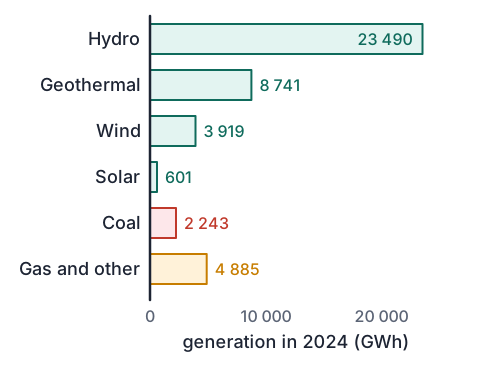
Try it: New Zealand's electricity in 2024 (GWh)
The physics behind every power station
- Almost all generators work the same way: a turbine spins a coil in a magnetic field, and the changing magnetic flux induces a voltage (Faraday's law). What differs is what spins the turbine.
- Hydro turns the gravitational potential energy of water into kinetic energy; geothermal, coal and gas boil water to steam that drives the turbine; wind uses the kinetic energy of moving air. Solar panels have no turbine: photons free electrons in silicon.
- Efficiency = useful output ÷ input: hydro turbines are about 90% efficient, while thermal stations lose about half or more of their fuel's energy as waste heat, which is why coal and gas also cost far more fuel per unit of electricity.
- Power is the rate of energy transfer, P = E/t, in watts; the energy sold is in kilowatt hours, 1 kWh = 3.6 × 10⁶ J, and a GWh is a million kWh.
Example: why wind speed matters so much
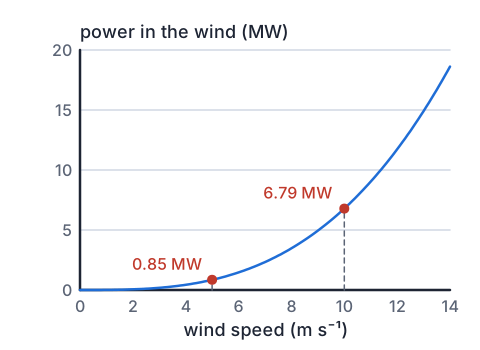
- The power in wind passing through a turbine's swept area A is P = ½ρAv³, where ρ is the density of air (about 1.20 kg m⁻³) and v is the wind speed.
- A turbine has blades 60.0 m long. Find the power in the wind at 10.0 m s⁻¹ and at 5.0 m s⁻¹, and the electrical output at 10.0 m s⁻¹ if the turbine is 40% efficient.
- A = πr² = π × 60.0² = 1.131 × 10⁴ m²
- at 10.0 m s⁻¹: P = 0.5 × 1.20 × 1.131 × 10⁴ × 10.0³ = 6.79 × 10⁶ W
- electrical output = 0.40 × 6.79 MW = 2.71 MW
- at 5.0 m s⁻¹: P = 6.79 MW × (5.0 ÷ 10.0)³ = 6.79 ÷ 8 = 0.85 MWhalf the speed, an eighth of the power
- no turbine can capture more than 59% of the wind's power (the Betz limit), because the air must keep moving to leave
Try it: blade length and wind speed
Example: power from a hydro station
- Water flows through a station's turbines at 300 m³ s⁻¹, falling 50.0 m. The station is 90% efficient. The density of water is 1000 kg m⁻³.
- Find the electrical power output.
- mass per second = 1000 × 300 = 3.00 × 10⁵ kg s⁻¹
- Ep per second = mgh = 3.00 × 10⁵ × 9.81 × 50.0 = 1.47 × 10⁸ Wenergy per second is power
- output = 0.90 × 1.47 × 10⁸ = 1.32 × 10⁸ W = 132 MW
- a dry year means less water to release, not a smaller drop, so the power available over the winter falls
Dry years, storage and getting power to Auckland
- Hydro lakes act as a battery that stores gravitational potential energy, but our lakes hold only a few weeks of winter demand, so a dry autumn forces thermal stations to run.
- Wind and solar cannot be turned up on demand, so a grid with more of them needs storage (lakes, batteries, pumped hydro) or flexible backup, and more transmission to move power from where it is made to where it is used.
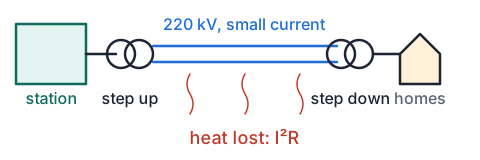
- Lines have resistance, so they waste power as heat: P_loss = I²R. Sending the same power P = VI at a higher voltage needs a smaller current, and halving the current cuts the loss to a quarter.
- That is why the main AC grid runs at 220 kV, and why South Island hydro reaches the North Island through the HVDC link under Cook Strait.
Perspectives and evidence
- Different groups weigh the same physics differently. A good report names each group, what it values and which evidence it relies on.
- Separate a claim backed by measurement (a turbine's output at a given wind speed) from a value judgement (wind farms spoil the view): both matter, but only one is settled by physics.
- Judge each source: its date, whether its numbers were measured or modelled, whether it was peer reviewed, who funded it, and whether it agrees with independent data such as MBIE's statistics.
| Group | What it tends to stress |
|---|---|
| Electricity generators | Reliable supply in dry years, cost of new plant |
| Households and businesses | Price of power and security of supply |
| Iwi and hapū | Kaitiakitanga of rivers, lakes and whenua; rights in water and land |
| Local communities | Landscape, noise, and jobs from new projects |
| Climate and environmental groups | Cutting emissions from coal and gas quickly |
Try it: measured fact or value judgement?
Example: one response at three grades
- The position: New Zealand should build more wind and solar and keep a small amount of gas for dry years, rather than keeping coal at Huntly.
- Notice how Excellence uses the physics to rank the actions and admits what they cannot do.
| Grade | What the student wrote |
|---|---|
| Achieved | I think we should build more wind farms, because wind is renewable and does not release carbon dioxide. I will also turn off appliances I am not using. |
| Merit | Wind turbines turn the kinetic energy of air into electricity with no fuel, so they cut emissions. But wind power depends on v³, so output varies a lot, which is why I would keep some gas for calm, dry weeks rather than relying on wind alone. |
| Excellence | As Merit, plus: because P ∝ v³, turbines belong on our windiest sites, where a 10% faster average wind gives about 33% more energy. Storing water in the hydro lakes while the wind blows lets hydro cover calm spells, so wind and hydro together are more effective than either alone. MBIE's 2024 data show coal made about 5% of our electricity in a dry year, and coal releases roughly twice the carbon dioxide of gas per kWh, so the most effective first step is replacing coal, not gas. A generator's report claiming wind is unreliable is partly right but ignores this pairing. |
Common mistakes
- Wind is free, so doubling the number of turbines doubles our electricity whatever the weather.Output depends on wind speed cubed, so in calm weather extra turbines add almost nothing; storage or backup is still needed.
- My position is that renewables are good, and my action is to tell people to use less power.State a specific position and actions, and use the physics (P = ½ρAv³, I²R losses) to justify why each would work.
- This website says wind farms are unreliable, so they are.Check who wrote it, when, and whether measured data such as MBIE's statistics support the claim.
- Transmission loss is P = V²/R with the line's full voltage, so higher voltage loses more.The loss depends on the current through the lines, P = I²R; higher voltage means a smaller current and less loss.
How much wind does your house need?
You need: your household's latest power bill or online usage page, a calculator, paper and a pen
- Find how many kWh your household used last month on the bill or your power company's usage page, and divide by the number of days to get kWh per day.
- Convert to an average power: divide kWh per day by 24 h to get kW.
- The 60 m turbine in the example makes about 2.7 MW at 10 m s⁻¹. Find how many households like yours it could supply at that wind speed.
- Repeat at 5 m s⁻¹, where it makes an eighth as much, and compare.
- Look for: a typical home using about 20 kWh a day averages under 1 kW, so one big turbine supplies thousands of homes in a good wind, but only a few hundred in a light one.
Safety: Read the meter or bill only; never open the meter box or switchboard, because the wiring inside is at mains voltage.
Your turn
The wind speed rises from 5 m s⁻¹ to 10 m s⁻¹. By what factor does the power in the wind change?
Find the power in the wind through a turbine with 40.0 m blades in a 12.0 m s⁻¹ wind, using ρ = 1.20 kg m⁻³.
A line with resistance 5.00 Ω carries 400 A. Find the power lost as heat.
The same power is sent at twice the voltage. Find the new power lost.
Use the 2024 table to find hydro's share of New Zealand's electricity.
Show answer
1. P ∝ v³ and 10 ÷ 5 = 2, so the power is multiplied by 2³ = 8. 2. A = π × 40.0² = 5027 m², P = 0.5 × 1.20 × 5027 × 12.0³ = 5.21 × 10⁶ W, which is 5.21 MW. 3. P = I²R = 400² × 5.00 = 8.00 × 10⁵ W, which is 800 kW. 4. Twice the voltage halves the current to 200 A, so P = 200² × 5.00 = 2.00 × 10⁵ W, which is 200 kW, a quarter of before. 5. 23 490 ÷ 43 879 = 0.535, so 53.5%.
Recap
- Pick an issue with a real decision, several sides and physics at its centre, different from your AS 91522 context.
- Explain the physics first: energy transformations, efficiency, P = ½ρAv³, P = I²R.
- State a specific position and actions, then justify each with that physics.
- For Excellence, link the ideas, rank actions by how well they would work, and judge your sources.
- New Zealand 2024: 85.5% renewable electricity; dry years and calm spells are the hard part.
| Formula | Use it for |
|---|---|
| P = ½ρAv³ | power in the wind |
| P = mgh ÷ t | power from falling water |
| efficiency = useful out ÷ in | how much becomes electricity |
| P_loss = I²R | heat lost in lines |
| 1 kWh = 3.6 × 10⁶ J | units of energy sold |
Report a mistake
How is NCEA Level 3 maths going?
See the NCEA Level 3 maths guide