A quantitative chemistry investigation: titration analysis
What this lesson covers
- Planning a titration investigation around a trend: a purpose, the variable you change, what you measure and what you keep the same.
- Primary standards and how to make a standard solution, and why a titrant is standardised before it is used.
- Accurate titration technique: rinsing, reading the meniscus, rough and concordant titres, and at least 5 mL titres.
- Calculations from a balanced equation: moles, concentration, mass per volume and percentage purity, with units and significant figures.
- Accuracy, precision, random and systematic error, and how to evaluate an investigation for Merit and Excellence.
What this internal asks you to do
- You investigate how the amount of a substance changes across a set of samples, so the question is always about a trend or pattern, not a single number.
- The technique is usually an acid-base or redox titration (sometimes colorimetry), and your teacher may give you the method, which you then adapt and refine.
- You keep a logbook from the first day: how your purpose developed, trial runs, every raw reading, and every calculation.
- The report states the purpose, describes how the samples were prepared and analysed, summarises raw and processed data, and reaches a conclusion from the processed data.
Planning a titration investigation
- Start from a question with a trend in it: does the vitamin C in kiwifruit juice fall over 48 hours at room temperature, or does the ethanoic acid content differ between vinegar brands?
- Name the independent variable (storage time), the dependent variable (vitamin C concentration, found from the titre), and the controlled variables (same batch of fruit, same temperature, same volume of juice, same iodine solution, same end point colour).
- Write the balanced equation for the titration reaction first, because the mole ratio drives every calculation; for vitamin C and iodine it is C₆H₈O₆ + I₂ → C₆H₆O₆ + 2H⁺ + 2I⁻, a 1 : 1 ratio.
- Run trial titrations to choose dilutions so each titre is at least 5 mL and ideally 10 to 25 mL; a tiny titre makes the reading uncertainty a large fraction of the result.
Standard solutions and standardising
- A standard solution has an accurately known concentration, made by dissolving an accurately weighed mass of a primary standard and making it up to the mark in a volumetric flask.
- A primary standard is very pure, stable in air, does not absorb water or carbon dioxide, and has a known formula: anhydrous sodium carbonate and potassium hydrogen phthalate are common choices.
- Iodine solution and sodium hydroxide are not primary standards (iodine evaporates from solution, and NaOH absorbs water and CO₂), so their concentration drifts and you standardise them against a standard solution on the day you use them.
- Weigh by difference, rinse every crystal from the weighing boat into the flask, dissolve before filling to the mark, then stopper and invert many times so the solution is the same throughout.
Accurate titration technique
- Rinse the burette with the titrant and the pipette with the solution it will deliver, so leftover water cannot dilute them; rinse the conical flask with distilled water only, because the number of moles in it is set by the pipette.
- Read the burette at eye level to the bottom of the meniscus, to two decimal places ending in 0 or 5 (for example 13.20 mL), and remove the funnel before reading.
- Do a fast rough titration first, then add titrant dropwise near the end point while swirling, with a white tile underneath so the first lasting colour change is easy to see.
- Repeat until you have three concordant titres (within 0.20 mL of each other), and average only those; for vitamin C the end point is the first permanent blue-black colour from the starch.
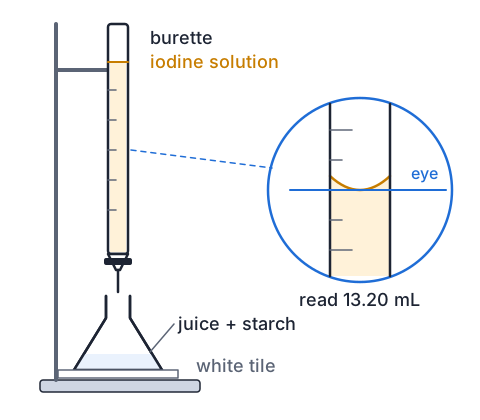
Try it: the end point of a titration
Example: standardising the iodine solution
- A student dissolves 0.500 g of pure ascorbic acid (vitamin C, C₆H₈O₆, M = 176.0 g mol⁻¹) and makes it up to 250.0 mL.
- 20.00 mL portions of this standard solution need a mean concordant titre of 18.45 mL of iodine solution. Find the iodine concentration.
- n(C₆H₈O₆) = m ÷ M = 0.500 ÷ 176.0 = 2.841 × 10⁻³ mol
- c = n ÷ V = 2.841 × 10⁻³ ÷ 0.2500 = 1.136 × 10⁻² mol L⁻¹250.0 mL is 0.2500 L
- n in 20.00 mL = 1.136 × 10⁻² × 0.02000 = 2.273 × 10⁻⁴ mol
- n(I₂) = 2.273 × 10⁻⁴ molthe reaction is 1 : 1
- c(I₂) = 2.273 × 10⁻⁴ ÷ 0.01845 = 0.01232 mol L⁻¹
- keep the unrounded value in the calculator for the next step; quote 0.0123 mol L⁻¹ (3 significant figures, set by the 0.500 g)
Try it: moles and concentration
Example: the kiwifruit juice results
- A Year 13 class juiced one batch of gold kiwifruit, strained it, and stored covered beakers at 20 °C. At each time they pipetted 25.00 mL of juice, added starch, and titrated with the 0.01232 mol L⁻¹ iodine.
- At 24 hours the 11.45 mL titre is not within 0.20 mL of the others, so only 11.05 and 11.15 mL are averaged.
- Process the 0 hour titre, then describe the trend.
| Time (h) | Titres (mL) | Mean concordant titre (mL) | Vitamin C (mg per 100 mL) |
|---|---|---|---|
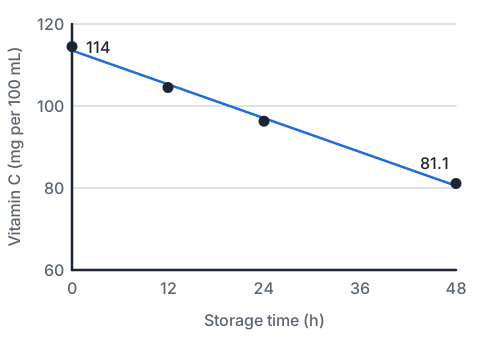
| 0 | 13.25, 13.15, 13.20 | 13.20 | 114 |
| 12 | 12.10, 12.00, 12.05 | 12.05 | 105 |
| 24 | 11.45, 11.05, 11.15 | 11.10 | 96.3 |
| 48 | 9.30, 9.40, 9.35 | 9.35 | 81.1 |
- n(I₂) = 0.01232 × 0.01320 = 1.626 × 10⁻⁴ mol
- n(C₆H₈O₆) = 1.626 × 10⁻⁴ mol in 25.00 mL1 : 1 ratio
- m = n × M = 1.626 × 10⁻⁴ × 176.0 = 0.02862 g = 28.62 mg in 25.00 mL
- per 100 mL: 28.62 × (100 ÷ 25.00) = 114.5 mg, quoted as 114 mg per 100 mL
- fall over 48 h: (114.5 − 81.1) ÷ 114.5 × 100 = 29%nearly 30% of the vitamin C is lost, at a fairly steady rate
Example: percentage purity of a vitamin C tablet
- A 0.850 g vitamin C tablet labelled 500 mg is dissolved and made up to 100.0 mL. A 10.00 mL portion needs 22.80 mL of 0.01232 mol L⁻¹ iodine.
- Find the percentage by mass of ascorbic acid in the tablet, and compare the result with the label.
- n(I₂) = 0.01232 × 0.02280 = 2.809 × 10⁻⁴ mol = n(C₆H₈O₆) in 10.00 mL
- n in 100.0 mL = 2.809 × 10⁻⁴ × 10 = 2.809 × 10⁻³ molscale up by the dilution factor, 100.0 ÷ 10.00
- m = 2.809 × 10⁻³ × 176.0 = 0.4944 g
- percentage purity = 0.4944 ÷ 0.850 × 100 = 58.2%
- against the label: 494 mg ÷ 500 mg × 100 = 98.9%, so the tablet holds what it claims; the rest is filler and binder
Accuracy, precision and error
- Accuracy is how close a result is to the true value; precision is how close repeat results are to each other, which concordant titres show.
- Random errors scatter results either way (judging the end point, reading the meniscus) and are reduced by repeats; systematic errors push every result the same way (an unstandardised titrant, vitamin C oxidising in air while you work) and repeats cannot remove them.
- Each piece of glassware has a tolerance, and the percentage uncertainty is the tolerance divided by the reading, so bigger volumes and masses give smaller percentage uncertainties.
- The largest percentage uncertainty usually comes from the titre, which is why titres must be large enough.
| Measurement | Typical uncertainty | In this investigation | Percentage uncertainty |
|---|---|---|---|
| Balance (3 decimal places) | ± 0.001 g | 0.500 g | 0.2% |
| 250 mL volumetric flask | ± 0.15 mL | 250.0 mL | 0.06% |
| 25 mL pipette | ± 0.03 mL | 25.00 mL | 0.12% |
| Burette (two readings) | ± 0.10 mL | 13.20 mL | 0.76% |
What lifts the report to Merit and Excellence
- Achieved collects enough titre data to reach a conclusion, processes it, and reports purpose, method, data and conclusion.
- Merit standardises the titrant, controls the important variables, shows every calculation step, gives enough method detail for someone else to repeat it, links the conclusion to the purpose, and explains how the method gave good data.
- Excellence uses correct significant figures and units throughout, justifies each step in terms of the chemistry, and evaluates: sources of error and their direction, how well the data support the conclusion, and links to chemical ideas or real life.
| Grade | What the student wrote |
|---|---|
| Achieved | The vitamin C content fell from 114 to 81.1 mg per 100 mL over 48 hours, so storing juice lowers its vitamin C. |
| Merit | I standardised the iodine on the day because iodine is lost from solution over time. Using one batch of fruit, a fixed 25.00 mL volume and 20 °C storage meant time was the only variable changed, so the 29% fall can be put down to storage time. |
| Excellence | Vitamin C is a reducing agent and is oxidised by oxygen from the air, so the juice was covered and each sample titrated straight after pipetting. Any oxidation during the titration would make titres low at every time, a systematic error that shifts the curve down but not its slope, so the trend still holds. The steady loss fits a slow reaction with dissolved oxygen, which is why fresh juice is the better source. |
Common mistakes
- I rinsed the conical flask with the juice so it would not be diluted.Rinse the flask with distilled water only; extra juice clinging to it would add moles beyond the 25.00 mL pipetted.
- My titres were 13.25, 13.15 and 13.80 mL, so the mean titre is 13.40 mL.Average only concordant titres: 13.80 mL is not within 0.20 mL, so the mean is 13.20 mL.
- The 10.00 mL portion contained 2.809 × 10⁻⁴ mol, so the tablet contained 0.0494 g.Scale up by the dilution: the 100.0 mL flask held ten times as much, 2.809 × 10⁻³ mol, which is 0.494 g.
- My results were very precise, so they must be accurate.Precise means repeatable; a systematic error such as an unstandardised titrant shifts every titre the same way and leaves them inaccurate.
A drop titration of two vinegars
You need: 2 red cabbage leaves, hot tap water, baking soda, a teaspoon, white vinegar and another vinegar or lemon juice, an eye dropper or a drinking straw, 4 small clear glasses
- Tear the cabbage leaves into a jug, cover with hot tap water for 10 minutes, then pour off the purple indicator.
- Dissolve one level teaspoon of baking soda in a cup of water, and put 2 tablespoons of this solution and a splash of indicator in each glass: it turns blue-green.
- Add white vinegar one drop at a time, swirling, and count the drops until the colour turns purple-pink and stays; repeat in a second glass until two counts agree within 2 drops.
- Do the same with the second vinegar or lemon juice and compare the mean drop counts.
- Look for: the acid needing fewer drops is the more concentrated one, and getting two counts to agree is exactly what concordant titres are for.
Safety: Vinegar and lemon juice sting badly in the eyes, so keep the dropper low over the glass and wipe up splashes straight away.
Your turn
1.325 g of anhydrous sodium carbonate (M = 106.0 g mol⁻¹) is made up to 250.0 mL. What is its concentration?
20.00 mL of that solution needs 21.60 mL of hydrochloric acid: Na₂CO₃ + 2HCl → 2NaCl + H₂O + CO₂. What is the acid's concentration?
Titres of 18.35, 18.70, 18.40 and 18.30 mL were recorded. What mean titre should be used?
A 2.00 g sample of impure ascorbic acid contains 1.76 g of C₆H₈O₆. What is its percentage purity?
A student forgot to rinse the burette with iodine solution, leaving it wet with water. Would the vitamin C results come out too high or too low?
Show answer
1. n = 1.325 ÷ 106.0 = 0.01250 mol; c = 0.01250 ÷ 0.2500 = 0.0500 mol L⁻¹. 2. n(Na₂CO₃) = 0.0500 × 0.02000 = 1.000 × 10⁻³ mol, so n(HCl) = 2 × 1.000 × 10⁻³ = 2.000 × 10⁻³ mol; c = 2.000 × 10⁻³ ÷ 0.02160 = 0.0926 mol L⁻¹. 3. 18.70 mL is not concordant; the mean of 18.35, 18.40 and 18.30 is 18.35 mL. 4. 1.76 ÷ 2.00 × 100 = 88.0%. 5. Too high: the water dilutes the iodine, so a bigger titre is needed, and the calculation (using the standardised concentration) gives more moles of vitamin C than were really there.
Molarity
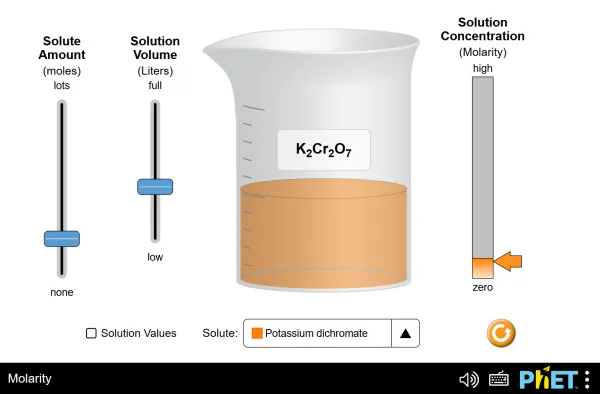
Full screen · PhET Interactive Simulations, University of Colorado Boulder, CC BY 4.0
Recap
- Investigate a trend across samples, with one variable changed and the rest controlled, and keep a logbook throughout.
- Make standard solutions from weighed primary standards, and standardise any titrant that is not one.
- Rinse correctly, read the meniscus at eye level, and average three concordant titres of at least 5 mL.
- Moles from the titre, the mole ratio, scale up for dilutions, then mass, concentration or percentage purity, rounded only at the end.
- Evaluate: random versus systematic errors, percentage uncertainties, and whether the data really support the conclusion.
| Step | Formula |
|---|---|
| Moles from mass | n = m ÷ M |
| Moles from a solution | n = c × V (V in litres) |
| Mole ratio | from the balanced equation |
| Percentage purity | mass of pure substance ÷ mass of sample × 100 |
| Percentage uncertainty | uncertainty ÷ reading × 100 |
Report a mistake
How is NCEA Level 3 maths going?
See the NCEA Level 3 maths guide