Human manipulation of genetic transfer
What this lesson covers
- Selective breeding and artificial selection, including inbreeding, outbreeding and embryo selection.
- Genetic engineering tools: restriction enzymes, ligase, plasmid vectors and transgenesis.
- Gene editing with CRISPR-Cas9, and how it differs from transgenesis.
- Whole organism cloning in plants and animals, and somatic cell nuclear transfer.
- Somatic gene therapy, and why germline editing is treated differently.
- Biological implications for ecosystems, biodiversity, individuals, populations and evolution, with New Zealand's rules.
What this standard asks
- AS 91607 is assessed internally: you research one or more ways people manipulate the passing on of genes, then write a report on how the manipulation works and what it means biologically.
- The manipulations fall into four groups: selective breeding (including embryo selection), whole organism cloning, transgenesis (moving genes between species), and changing how existing genes are expressed, for example by gene editing or gene silencing.
- The implications that earn credit are biological: effects on ecosystems, on genetic diversity, on the health or survival of individuals, on the survival of populations, and on their evolution.
- Social, ethical and economic points can set the scene, but every one should be linked back to a biological effect to count.
Selective breeding
- In selective breeding (artificial selection), people choose which individuals breed, picking those with the traits they want, so the alleles behind those traits become more common each generation.
- Inbreeding (mating close relatives) fixes wanted traits but raises the chance of two copies of a harmful recessive allele; outbreeding (crossing unrelated lines) brings in new alleles and often gives hybrid vigour.
- New Zealand examples: the Perendale sheep was bred at Massey from Cheviot and Romney sheep for hill country; dairy cattle are bred by artificial insemination from bulls chosen by breeding values; and Plant & Food Research bred the SunGold (Gold3) kiwifruit.
- When Psa bacteria reached Bay of Plenty orchards in 2010, the Hort16A gold kiwifruit proved highly susceptible and was largely replaced by Gold3, which tolerates the disease better: breeding both caused and solved a genetic vulnerability.
- Embryo selection is selective breeding at its most precise: in IVF, a cell taken from each embryo can be tested so that only embryos without a serious allele, such as one for cystic fibrosis, are implanted.
Example: predicting the response to selection
- A breeder's herd averages 420 kg of milk solids per cow per season. She breeds only from cows averaging 480 kg. The heritability (h²) of milk solids is 0.30 (practice numbers).
- Predict the average of the daughters, using response R = h² × S, where S is the selection differential.
- S = 480 − 420 = 60 kghow far the chosen parents are above the herd
- R = 0.30 × 60 = 18 kgonly the heritable part is passed on
- daughters average 420 + 18 = 438 kg
- the gain is much less than 60 kg, because much of the difference was due to feed and environment
Genetic engineering: cutting, pasting and carrying genes
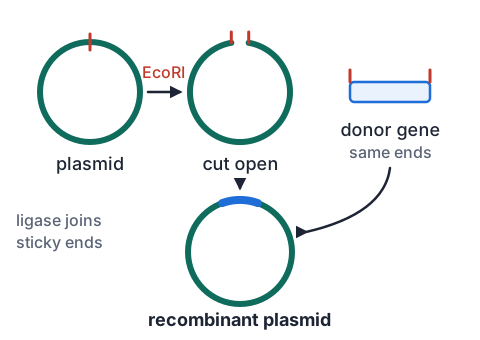
- Restriction enzymes, from bacteria, cut DNA at a specific base sequence (a recognition site); EcoRI cuts at GAATTC, between the G and the A, leaving short single-stranded sticky ends.
- If the donor DNA and a vector are cut with the same enzyme, their sticky ends match by base pairing, and DNA ligase seals the sugar-phosphate backbone to make recombinant DNA.
- Plasmids, small rings of bacterial DNA, are the usual vectors for bacteria; they often carry an antibiotic resistance gene as a marker, so only bacteria that took up the plasmid survive on an antibiotic plate.
- Plants are often transformed with Agrobacterium, a soil bacterium that naturally moves part of its plasmid into plant cells; animals and human cells are often reached with modified viruses.
- PCR copies a chosen stretch of DNA millions of times, and gel electrophoresis separates DNA fragments by size, so the result of each step can be checked.
Example: predicting restriction fragments
- EcoRI cuts between G and A in GAATTC. How many fragments does it give from this 40-base strand, and how long is each?
- ATCGG AATTC TTAGC CATGC AGAAT TCGGT ACCTA GTTAA
- first GAATTC starts at base 5, so cut after base 5the cut is just after the G
- second GAATTC starts at base 22, so cut after base 22
- fragments: 5, 22 − 5 = 17, and 40 − 22 = 18 bases
- 3 fragments: 5, 17 and 18 bases
- 5 + 17 + 18 = 40
- on a gel the 5-base fragment travels furthest, because the smallest DNA moves fastest
Transgenesis
- A transgenic organism carries a gene from another species, inserted by genetic engineering.
- Since the 1980s bacteria with the human insulin gene have made the insulin used by people with diabetes, replacing insulin taken from pigs and cattle.
- Bt crops carry a gene from the bacterium Bacillus thuringiensis for a protein toxic to certain insect larvae, so less spray is needed, but pests exposed to the toxin all the time are selected for resistance.
- Golden Rice carries genes that make beta-carotene in the grain, to reduce vitamin A deficiency.
- AgResearch has developed a high-energy ryegrass that grows faster and could cut greenhouse gas from grazing, but because of New Zealand's rules its field trials have been run in the United States.
Try it: which manipulation?
Gene editing with CRISPR-Cas9
- CRISPR-Cas9 uses a short guide RNA, about 20 bases long, that matches the target DNA, and the Cas9 enzyme, which cuts both strands where the guide binds next to a short PAM sequence.
- The cell repairs the cut: end-joining repair often adds or removes a few bases, which can knock a gene out; if a DNA template is supplied, repair can copy it in and make a precise change.
- Unlike transgenesis, an edit can leave no foreign DNA, so the result may be the same as a natural mutation.
- AgResearch edited a coat-colour gene in Holstein-Friesian calves to lighten their black patches, which could help cattle cope with hotter summers.
- Risks include off-target cuts at similar sequences elsewhere in the genome, and mosaic organisms in which only some cells carry the edit.
Try it: change one base and see the protein
Whole organism cloning
- A clone is genetically identical to its parent. Plants are cloned by cuttings, grafting and tissue culture; every Hayward kiwifruit vine, and every vine of a named apple variety, is a clone of one original plant.
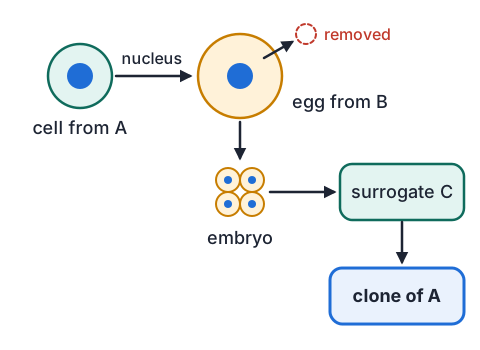
- Animals are cloned by splitting early embryos, or by somatic cell nuclear transfer (SCNT): the nucleus of a body cell is put into an egg whose own nucleus was removed, and the egg is stimulated to divide and placed in a surrogate.
- Dolly the sheep (1996) was the first mammal cloned from an adult cell; AgResearch at Ruakura cloned cattle, and like other groups found that many cloned pregnancies failed and some calves were unhealthy.
- Clones give uniform crops and copies of top animals, but a population of clones has no genetic diversity, so one disease or pest can affect them all, as Panama disease is doing to the Cavendish banana worldwide.
Gene therapy
- Gene therapy treats a genetic disorder by adding, replacing or editing genes in a patient's cells.
- Somatic gene therapy changes body cells only, so it affects only the patient; germline therapy would change eggs, sperm or embryos, so the change would pass to future generations.
- Vectors are usually harmless modified viruses: Luxturna uses one to deliver a working copy of a gene to retinal cells in people with an inherited form of blindness.
- Casgevy, approved in 2023, takes a patient's own blood stem cells, uses CRISPR to switch back on the production of fetal haemoglobin, and returns the cells, treating sickle cell disease and beta thalassaemia.
- Germline editing of humans is banned in many countries; in 2018 a scientist in China edited embryos that became twin girls and was imprisoned, because the risks to the children and their descendants were unknown.
New Zealand's rules
- Under the Hazardous Substances and New Organisms (HSNO) Act 1996, any genetically modified organism must be approved by the Environmental Protection Authority (EPA) before it is developed, field tested or released.
- In 2014 the High Court ruled that gene-edited organisms count as genetically modified even when no foreign DNA remains, so they need the same approvals; no genetically modified crops are grown commercially in New Zealand.
- Genetically modified foods must be approved by Food Standards Australia New Zealand and labelled, and gene therapy medicines also need Medsafe approval.
- The Gene Technology Bill, introduced in December 2024 and reported back by Parliament's Health Committee in October 2025, would replace these rules with a Gene Technology Regulator within the EPA and lighter rules for lower-risk edits; it had stalled in Parliament and was not law by late 2026, so check its status when you write your report.
- Decisions must take account of Māori interests: many iwi see genetic modification through whakapapa, mauri and kaitiakitanga, and the EPA has a Māori advisory committee, Ngā Kaihautū Tikanga Taiao.
Biological implications
- Link each implication to a mechanism: what happens to alleles, individuals or populations, and why.
| Area | Possible implication | Example |
|---|---|---|
| Ecosystems | Transgenes spread to wild relatives; effects on non-target species | Herbicide-resistance genes moving into weedy relatives by pollen |
| Genetic biodiversity | Fewer alleles when a few lines or clones dominate | Cavendish bananas, Hayward kiwifruit |
| Health of individuals | Less disease, or new health problems | Insulin from bacteria; unhealthy cloned calves |
| Survival of populations | One disease can hit a uniform population | Psa in Hort16A kiwifruit orchards |
| Evolution of populations | Selection on pests and pathogens changes | Insects evolving resistance to Bt toxin |
Example: one paragraph at each grade
- Achieved describes the manipulation and an implication; Merit explains how it works and why the implication follows; Excellence links the mechanism to several implications, weighs benefits against risks, and supports the judgement with evidence.
- Use specific examples, name the biological process each time (selection, gene flow, loss of diversity), and keep sources in a reference list.
| Grade | What the student wrote about cloned kiwifruit |
|---|---|
| Achieved | Kiwifruit vines are cloned by grafting a cutting onto a rootstock. All the vines are genetically identical, so they have no genetic diversity. |
| Merit | Grafting copies the genes of one chosen vine exactly, so growers get the same fruit every time. But because every vine has the same alleles, a pathogen that can infect one vine can infect them all, as happened when Psa spread through Hort16A orchards from 2010. |
| Excellence | Cloning gives uniform, high-value fruit, but removes the genetic variation that lets a population survive a new disease. With no resistant individuals among identical Hort16A vines, Psa spread rapidly and orchards had to be cut out. Recovery came from selective breeding, which used variation in other kiwifruit to produce the more tolerant Gold3, now itself cloned. The benefit of uniformity is real, but growing a single clone repeats the same risk, so keeping several cultivars and wild genetic resources protects the industry's survival. |
Common mistakes
- Selective breeding creates new genes for the traits we want.Selective breeding only changes how common existing alleles are; new alleles come from mutation.
- Gene therapy on a patient's blood cells will be passed on to their children.Somatic gene therapy changes body cells only; only germline changes reach eggs or sperm.
- A clone of a prize bull will look and perform exactly the same.A clone has the same genes, but environment, nutrition and epigenetic effects still change its phenotype.
- Gene editing is banned in New Zealand.It is regulated, not banned: under the HSNO Act any genetically modified organism needs EPA approval, including gene-edited ones.
Cut and paste a paper gene into a plasmid
You need: a strip of white paper about 30 cm long, a strip of coloured paper about 20 cm long, scissors, sticky tape, a pen, a ruler
- On the white strip write two rows of bases, about 1 cm apart, with GAATTC once in the middle of the top row and its partner bases CTTAAG directly below; tape the ends into a ring: this is the plasmid.
- On the coloured strip write a donor gene the same way, with GAATTC near each end of the top row and CTTAAG below each one.
- Be EcoRI: at each GAATTC on the gene, cut down between G and A on the top row, along the gap, then down between A and G on the bottom row, so every cut is a step.
- Cut the plasmid ring open at its GAATTC in the same stepped way, then slot the gene into the gap and tape both joins: the tape is DNA ligase.
- Try to fit the gene into a gap you cut straight across or at a different sequence, and see whether the steps match.
- Look for: the AATT overhangs on the gene and the plasmid pair up only because the same enzyme cut both, which is why both are cut with one enzyme to make recombinant DNA.
Safety: Scissors are the only sharp tool here: cut on a table, away from your fingers, and keep them out of reach of small children.
Your turn
A sheep flock averages 4.0 kg of wool per sheep. Parents chosen average 5.0 kg, and h² = 0.40. Predict the offspring average.
EcoRI cuts this 35-base strand after the G in each GAATTC. Give the fragment lengths: CCTGA ATTCA GGCTA ATCGG CATGA ATTCA TGGCA
A gene from a bacterium is put into maize so the maize makes an insect toxin. Name this kind of manipulation.
Why does a field of cloned plants risk being wiped out by one new disease?
A patient's bone marrow cells are edited to treat sickle cell disease. Will the change pass to the patient's children?
Show answer
1. S = 5.0 − 4.0 = 1.0 kg; R = 0.40 × 1.0 = 0.40 kg; offspring average 4.0 + 0.40 = 4.4 kg. 2. GAATTC starts at base 4 and base 24, so cuts after bases 4 and 24: fragments of 4, 24 − 4 = 20 and 35 − 24 = 11 bases. 3. Transgenesis: a gene from another species is inserted. 4. All the plants carry the same alleles, so none has resistance the others lack; if the pathogen can infect one, it can infect all. 5. No: bone marrow cells are somatic cells, so the change is not in eggs or sperm.
Recap
- Selective breeding changes allele frequencies by choosing parents; it can narrow the gene pool.
- Restriction enzymes, ligase and vectors move genes between species; CRISPR edits genes in place.
- Clones are genetically identical, which gives uniformity but no defence in diversity.
- Report the biological implications (ecosystems, diversity, health, survival, evolution) and New Zealand's HSNO rules.
| Manipulation | What changes | New Zealand example |
|---|---|---|
| Selective breeding | Allele frequencies, over generations | Gold3 kiwifruit, Perendale sheep |
| Transgenesis | A gene from another species added | High-energy ryegrass (trialled overseas) |
| Gene editing | An existing gene changed in place | Lighter-coated dairy calves |
| Cloning | No change: exact copies | Hayward kiwifruit vines |
| Gene therapy | Genes in a patient's somatic cells | Casgevy, approved overseas in 2023 |
Report a mistake
How is NCEA Level 3 maths going?
See the NCEA Level 3 maths guide