Oxidation, reduction and elimination
What this lesson covers
- Oxidising primary and secondary alcohols with acidified permanganate or dichromate, the colour changes, and why tertiary alcohols do not react.
- Distillation to stop at the aldehyde, and heating under reflux to go on to the carboxylic acid.
- Tollens', Fehling's and Benedict's tests: what aldehydes do to them that ketones cannot.
- Reducing aldehydes and ketones back to alcohols with NaBH₄.
- Elimination from alcohols (concentrated H₂SO₄) and haloalkanes (KOH in alcohol), and the major and minor products from an asymmetric molecule.
What each alcohol oxidises to
- In organic oxidation the carbon carrying the OH loses a hydrogen atom and gains a bond to oxygen.
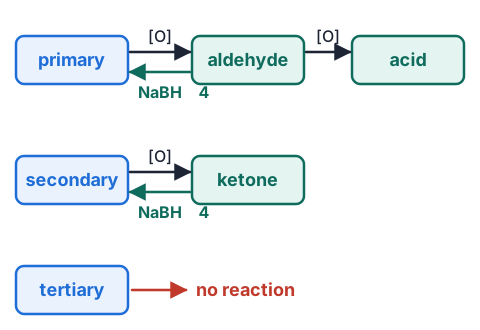
- A primary alcohol, RCH₂OH, oxidises first to an aldehyde, RCHO, and then on to a carboxylic acid, RCOOH.
- A secondary alcohol, R₂CHOH, oxidises to a ketone, R₂CO, and stops there.
- A tertiary alcohol, R₃COH, has no H on the carbon carrying the OH, so it is not oxidised by these reagents.
The oxidants and what you see
- The two oxidants are acidified potassium permanganate, MnO₄⁻/H⁺, and acidified potassium dichromate, Cr₂O₇²⁻/H⁺. Each is reduced as the organic compound is oxidised.
- Describe the colour change of the oxidant, because the organic compounds are colourless.
- If nothing is oxidised, the oxidant keeps its colour: orange dichromate stays orange with a tertiary alcohol or a ketone.
| Oxidant | Reduced to | Colour change |
|---|---|---|
| MnO₄⁻ / H⁺ | Mn²⁺ | purple to colourless |
| Cr₂O₇²⁻ / H⁺ | Cr³⁺ | orange to green |
Try it: warmed with acidified dichromate
Example: stopping at the aldehyde
- Propan-1-ol is warmed with acidified dichromate. Explain how to collect propanal, and what happens if the mixture is heated under reflux instead.
- Boiling points: propanal 48 °C, propan-1-ol 97 °C, propanoic acid 141 °C.
- propanal has the lowest boiling point, because it has no O-H to hydrogen bondonly dipole and dispersion forces
- distil as it forms: propanal boils off at about 48 °C and leaves the oxidant before it can react furtherthe condenser slopes down to a collecting flask
- distillation: propanal collected
- reflux: a vertical condenser returns all vapour to the flask, so propanal is oxidised againno product escapes
- reflux: propanoic acid forms; the orange solution turns green
Tests that tell aldehydes from ketones
- An aldehyde still has an H on its C=O carbon, so even mild oxidants oxidise it to a carboxylic acid (as its carboxylate ion in alkaline solutions). A ketone has no such H, so mild oxidants leave it alone.
- Tollens' reagent contains the diamminesilver ion, [Ag(NH₃)₂]⁺. Warmed with an aldehyde, the Ag⁺ is reduced to silver metal, which coats the clean glass as a silver mirror.
- Fehling's and Benedict's solutions contain blue Cu²⁺ complexes. Heated with an aldehyde, the Cu²⁺ is reduced to copper(I) oxide, Cu₂O, a brick-red precipitate.
- Glucose has an aldehyde group, which is why Benedict's solution was long used to test for sugar in urine.
| Test | Aldehyde | Ketone |
|---|---|---|
| Tollens', warm | colourless solution, silver mirror forms | no change |
| Fehling's or Benedict's, heat | blue solution, brick-red precipitate forms | stays blue |
| MnO₄⁻/H⁺ or Cr₂O₇²⁻/H⁺ | purple to colourless, or orange to green | no change |
Try it: silver mirror with Tollens'?
Example: identifying four colourless liquids
- Four bottles hold propanal, propanone, propan-2-ol and 2-methylpropan-2-ol. Use Tollens' reagent, acidified dichromate and SOCl₂, in a sensible order, to identify each.
- step 1, Tollens' to all four: a silver mirror forms with oneonly the aldehyde reduces Ag⁺
- that one is propanal
- step 2, Cr₂O₇²⁻/H⁺ to the other three, heat: one turns greenonly the secondary alcohol can be oxidised
- that one is propan-2-ol, oxidised to propanone
- the two left stay orange: propanone (a ketone) and 2-methylpropan-2-ol (tertiary)
- tell them apart with SOCl₂: only the alcohol gives steamy HCl fumes
- Tollens' goes first so that propanal is removed before the dichromate test, which it would also pass
Reduction with NaBH₄
- Sodium borohydride, NaBH₄, is a reductant that adds hydrogen across the C=O of aldehydes and ketones.
- An aldehyde is reduced to a primary alcohol: propanal → propan-1-ol. A ketone is reduced to a secondary alcohol: propanone → propan-2-ol.
- NaBH₄ does not reduce C=C bonds, carboxylic acids, esters or amides, so it changes only the aldehyde or ketone in a molecule with several groups.
- Reducing butanone gives butan-2-ol, which has an asymmetric carbon. Both enantiomers form equally, so the product is a racemic mixture that does not rotate plane-polarised light.
Elimination makes alkenes
- In elimination, an H and an OH (or an H and a halogen) are removed from neighbouring carbons, and a C=C forms between them.
- Alcohols eliminate water when heated with concentrated H₂SO₄: CH₃CH₂OH → CH₂=CH₂ + H₂O.
- Haloalkanes eliminate HX when heated with KOH dissolved in alcohol: CH₃CHBrCH₃ + KOH → CH₂=CHCH₃ + KBr + H₂O.
- The same haloalkane with KOH dissolved in water gives the alcohol by substitution instead, so the solvent decides the reaction.
- Prove an alkene formed with bromine water: the orange colour disappears quickly as Br₂ adds across the C=C.
Example: major and minor products
- Butan-2-ol is heated with concentrated H₂SO₄. Give all the organic products and say which are major.
- If the OH carbon has two different neighbouring carbons that carry H, there are two possible alkenes. The major one forms when the H is removed from the neighbour that has fewer H atoms.
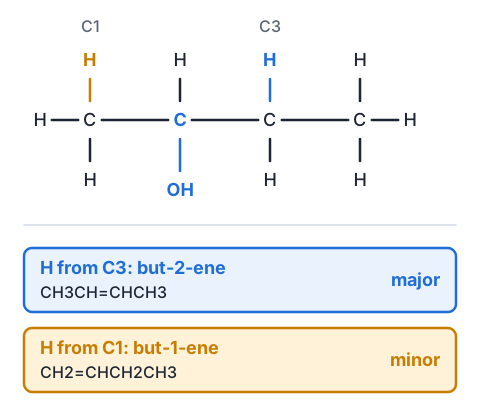
- neighbours of C2: C1 (a CH₃, three H) and C3 (a CH₂, two H)the OH is on C2
- H removed from C3: CH₃CH=CHCH₃, but-2-ene
- H removed from C1: CH₂=CHCH₂CH₃, but-1-ene
- major: but-2-ene, as both cis and trans isomers; minor: but-1-eneC3 has fewer H atoms
- three products in all: cis-but-2-ene, trans-but-2-ene and but-1-ene
Try it: alkenes from elimination
Using addition to tell the alkenes apart
- Both but-2-ene and but-1-ene decolourise bromine water, so that test shows an alkene but not which one.
- Adding HBr can tell them apart. But-2-ene is symmetrical, so it gives only 2-bromobutane.
- But-1-ene is asymmetric, so it gives two products: mostly 2-bromobutane (the H goes to the carbon that already has more H atoms) and a little 1-bromobutane.
What Achieved, Merit and Excellence look like
- Achieved names the products and states an observation. Merit links each observation to the functional group and the type of reaction. Excellence explains why the alternatives behave differently, with structures.
| Grade | A model answer |
|---|---|
| Achieved | Propanal gives a silver mirror and propanone does not change. |
| Merit | Propanal is an aldehyde, so it is oxidised to propanoic acid (as propanoate) and the Ag⁺ in Tollens' is reduced to silver, forming the mirror. Propanone is a ketone, which is not oxidised, so no change is seen. |
| Excellence | Propanal, CH₃CH₂CHO, has an H on its C=O carbon, so it can be oxidised by a mild oxidant: it is oxidised to the propanoate ion while [Ag(NH₃)₂]⁺ is reduced to Ag, which deposits as a silver mirror. Propanone, CH₃COCH₃, has its C=O carbon bonded to two carbons and no H; oxidising it would mean breaking a C-C bond, which Tollens' cannot do, so the solution stays colourless with no mirror. |
Common mistakes
- Heating propan-1-ol under reflux with dichromate is the way to make propanal.Reflux returns the propanal to be oxidised again, giving propanoic acid; distil it off as it forms to keep the aldehyde.
- With dichromate, the alcohol turns green.The alcohol is colourless; it is the orange Cr₂O₇²⁻ that is reduced to green Cr³⁺.
- Butan-2-ol gives but-2-ene only when it is dehydrated.It gives cis- and trans-but-2-ene as major products and but-1-ene as the minor product.
- NaBH₄ oxidises the ketone to an alcohol.NaBH₄ is a reductant: it adds hydrogen to the C=O, so the ketone is reduced to a secondary alcohol.
Stop an apple from browning
You need: an apple, a lemon or lemon juice, a cup of water, a plate, a teaspoon, a clock or timer
- Ask an adult to cut the apple into three similar slices and put them on the plate.
- Spoon lemon juice over the cut face of the first slice, water over the second, and leave the third alone.
- Check the slices every 10 minutes for 40 minutes and note how brown each cut face is.
- Look for: the plain slice browns fastest and the lemon slice stays pale. An enzyme in the apple uses oxygen from the air to oxidise compounds in the cut cells to brown products; vitamin C (ascorbic acid) in lemon juice is a reductant, so it is oxidised instead and turns the first products back before they go brown.
Safety: Only an adult should use the knife to cut the apple, and eat the slices only if the plate and spoon were clean.
Your turn
Name the organic product when propan-1-ol is heated under reflux with excess acidified permanganate.
Which gives a silver mirror with Tollens' reagent: propanal or propanone?
Name the product when butanone is reduced with NaBH₄.
Name the major product when 2-bromobutane is heated with KOH in ethanol.
What colour change is seen when 2-methylpropan-2-ol is warmed with acidified dichromate?
Show answer
1. Propanoic acid: under reflux the propanal formed is oxidised further. 2. Propanal, the aldehyde. 3. Butan-2-ol, a secondary alcohol (as a racemic mixture). 4. But-2-ene (cis and trans); but-1-ene is the minor product. 5. None: it stays orange, because a tertiary alcohol has no H on the C carrying the OH and is not oxidised.
Exam-style question: identifying compound P
- Compound P, C₄H₁₀O, is an alcohol that exists as enantiomers. P is warmed with acidified dichromate to give compound Q, which gives no silver mirror with Tollens' reagent. P is also heated with concentrated H₂SO₄, giving compounds R (major) and S (minor), both of which decolourise bromine water.
Name compound P.
Name Q and give the colour change seen as it forms.
Explain why Q gives no silver mirror.
Name R and S, and explain why R is the major product.
Q is reduced with NaBH₄. Explain why the product does not rotate plane-polarised light, although P from the bottle did.
Show answer
1. Butan-2-ol: the only C₄H₁₀O alcohol with a carbon bonded to four different groups (Achieved). 2. Q is butanone; orange to green as Cr₂O₇²⁻ is reduced to Cr³⁺ (Achieved; Merit for linking the colour to the oxidation of a secondary alcohol). 3. Butanone is a ketone: its C=O carbon carries no H, so the mild oxidant in Tollens' cannot oxidise it and Ag⁺ is not reduced (Merit). 4. R is but-2-ene, formed as cis and trans isomers; S is but-1-ene. Removing an H from C3, which has fewer H atoms than C1, gives the major product (Merit; Excellence for drawing both but-2-ene isomers and explaining why there are three products). 5. NaBH₄ adds hydrogen to the flat C=O from either side equally, so both enantiomers of butan-2-ol form in equal amounts. Their rotations cancel in this racemic mixture, whereas P from the bottle was a single enantiomer (Excellence).
Recap
- Primary alcohols oxidise to aldehydes (distil) then carboxylic acids (reflux); secondary to ketones; tertiary not at all.
- Aldehydes give a silver mirror with Tollens' and a brick-red precipitate with Fehling's or Benedict's; ketones give neither.
- NaBH₄ reduces aldehydes to primary alcohols and ketones to secondary alcohols.
- Elimination removes H and OH or H and X from neighbouring carbons; the major alkene comes from removing H from the neighbour with fewer H atoms.
| Reagent | Reaction | Seen |
|---|---|---|
| MnO₄⁻ / H⁺ | oxidation | purple to colourless |
| Cr₂O₇²⁻ / H⁺ | oxidation | orange to green |
| Tollens' | oxidises aldehydes only | silver mirror |
| Fehling's or Benedict's | oxidises aldehydes only | blue to brick-red precipitate |
| NaBH₄ | reduction of C=O | no colour change |
| conc. H₂SO₄ or KOH in alcohol | elimination | product decolourises bromine water |
Report a mistake
How is NCEA Level 3 maths going?
See the NCEA Level 3 maths guide