Polyesters, polyamides, proteins and fats
What this lesson covers
- Condensation polymerisation: monomers with two functional groups join, losing a small molecule such as H₂O or HCl at each link.
- Polyesters from diols and dicarboxylic acids (or one hydroxy acid), and polyamides from diamines and dicarboxylic acids or diacyl dichlorides.
- Drawing repeating units, and finding the monomers from a section of polymer.
- Amino acids, the peptide link, dipeptides and proteins, and their hydrolysis in acid and base.
- Triglycerides as esters of glycerol, and saponification to make soap.
Condensation polymerisation
- Addition polymers, from Level 2, form when alkene monomers join across their C=C and nothing is lost. Condensation polymers form differently.
- In condensation polymerisation each monomer has two reactive groups, one at each end, so it can link on both sides and the chain keeps growing.
- Every time two monomers join, a small molecule is released: water when an acid group reacts, or HCl when an acyl chloride group reacts.
- The links are the same ester and amide groups as in small molecules, so condensation polymers can also be hydrolysed back to their monomers.
Polyesters
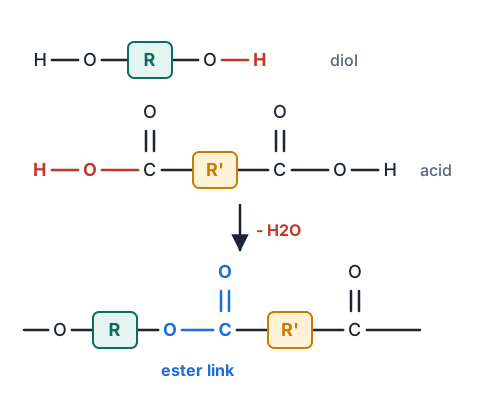
- A diol (two OH groups) and a dicarboxylic acid (two COOH groups) react at both ends to form ester links, losing one H₂O at each.
- PET, the plastic of most drink bottles (recycling code 1), is made from ethane-1,2-diol and benzene-1,4-dicarboxylic acid.
- A molecule with an OH at one end and a COOH at the other can form a polyester on its own. Polylactic acid (PLA), used for compostable cups and food packaging, is a condensation polymer of 2-hydroxypropanoic acid (lactic acid).
- Using a diacyl dichloride instead of the diacid is faster and releases HCl rather than water.
Polyamides
- A diamine and a dicarboxylic acid (or a diacyl dichloride) form amide links, -CONH-, losing H₂O (or HCl) at each.
- Nylon-6,6 is made from hexane-1,6-diamine, H₂N(CH₂)₆NH₂, and hexanedioic acid, HOOC(CH₂)₄COOH, or its dichloride. Each monomer has six carbons, hence the name.
- Hydrogen bonds form between the N-H of one chain and the C=O of the next, which is why nylon fibres are strong enough for ropes and fishing line.
- Proteins are also polyamides, built from amino acids.
Try it: what kind of polymer?
Example: repeating units and monomers
- Draw the repeating unit of (a) the polyester from ethane-1,2-diol and butanedioic acid and (b) nylon-6,6. Then (c) give the monomer of PLA, whose repeating unit is -O-CH(CH₃)-CO-.
- (a) HOCH₂CH₂OH + HOOCCH₂CH₂COOH: lose H from the diol and OH from the acid at each joinester links form
- (a) -O-CH₂CH₂-O-CO-CH₂CH₂-CO-
- (b) H₂N(CH₂)₆NH₂ + HOOC(CH₂)₄COOH: lose H from each NH₂ and OH from each COOHamide links form
- (b) -NH-(CH₂)₆-NH-CO-(CH₂)₄-CO-
- (c) put back H on the O and OH on the C=Oreverse the condensation
- (c) HO-CH(CH₃)-COOH, 2-hydroxypropanoic acid
- every repeating unit shows one of each monomer, with open bonds at both ends
Breaking polymers down
- Heating a polyester or polyamide under reflux with acid or base hydrolyses every link and returns the monomers, just as for a single ester or amide.
- In acid, the products are the dicarboxylic acid plus the diol (from a polyester) or the diammonium ion (from a polyamide).
- In base, the products are the dicarboxylate ion plus the diol or the free diamine.
- This is why polyesters and polyamides can break down slowly in the environment and can be chemically recycled, while addition polymers such as polythene, with only C-C bonds in the chain, cannot be hydrolysed.
Amino acids
- The amino acids in proteins are 2-amino acids: an NH₂ and a COOH on the same carbon, which also carries an H and a side group R. Glycine has R = H; alanine (2-aminopropanoic acid) has R = CH₃.
- Every amino acid except glycine has four different groups on C2, so it is chiral. Living things use almost only one enantiomer of each.
- An amino acid has an acidic group and a basic group, so in water it exists mainly as a zwitterion, ⁺H₃N-CH(R)-COO⁻. The ionic attractions between zwitterions give amino acids high melting points, and they dissolve well in water.
Peptides and proteins
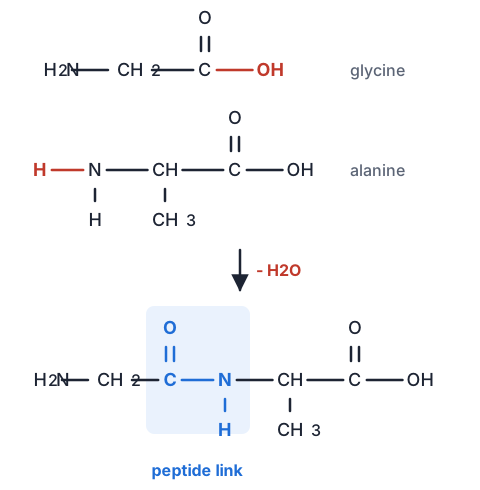
- The COOH of one amino acid and the NH₂ of another condense to form an amide link, called a peptide link in proteins, and water is lost.
- Two different amino acids can join in two orders, so glycine and alanine give two different dipeptides, Gly-Ala and Ala-Gly.
- Long chains of amino acids are polypeptides; proteins are one or more polypeptide chains folded into a particular shape. Keratin in merino wool and casein in milk are proteins.
- Hydrolysis breaks the peptide links. In acid the amino acids come out with NH₃⁺ groups; in base they come out with COO⁻ groups.
Example: making and breaking a dipeptide
- Draw the dipeptide Gly-Ala (glycine's COOH joined to alanine's NH₂), then give the products when it is heated under reflux with HCl(aq), and with NaOH(aq).
- H₂NCH₂COOH + H₂NCH(CH₃)COOH → H₂NCH₂CONHCH(CH₃)COOH + H₂Oglycine's OH and alanine's H form water
- Gly-Ala: H₂NCH₂CO-NHCH(CH₃)COOH
- in HCl: ⁺H₃NCH₂COOH and ⁺H₃NCH(CH₃)COOHthe amino groups take H⁺ from the acid
- in NaOH: H₂NCH₂COO⁻ and H₂NCH(CH₃)COO⁻the acid groups lose H⁺ to OH⁻
- acid: protonated amines; base: carboxylate ions, the same pattern as for amides
Try it: hydrolysed in acid or base?
Fats and oils are triglycerides
- A triglyceride is a triester: each of the three OH groups of propane-1,2,3-triol (glycerol) forms an ester link with a long-chain fatty acid.
- Saturated fatty acid chains are straight, pack closely, and give solid fats such as butter and the tallow from meat processing.
- Chains with cis C=C bonds have kinks, pack less well, and give liquid oils such as olive and canola oil.
- Triglycerides are non-polar overall, so they do not dissolve in water.
Saponification: making soap
- Heating a fat with NaOH(aq) hydrolyses all three ester links. This base hydrolysis is called saponification.
- The products are glycerol and three sodium carboxylates, such as sodium octadecanoate (sodium stearate), C₁₇H₃₅COO⁻Na⁺. These salts are soap.
- A soap ion has an ionic COO⁻ head that is attracted to water and a long hydrocarbon tail that dissolves in grease. The tails bury themselves in the grease and the heads face the water, so the grease is lifted away in tiny droplets.
- Acid hydrolysis of a fat gives glycerol and the free fatty acids instead, which are not soap.
What Achieved, Merit and Excellence look like
- Achieved names the reaction and the link or draws the products. Merit explains which bonds break or form and why the products differ in acid and base. Excellence gives the full structures and links them to the conditions, explaining each difference.
| Grade | A model answer |
|---|---|
| Achieved | Both are hydrolysis. The amide links break and the polymer turns back into its two monomers. |
| Merit | Water breaks each amide (C-N) bond. In HCl the products are hexanedioic acid and the hexane-1,6-diammonium ion, because the amine groups accept protons. In NaOH they are the hexanedioate ion and hexane-1,6-diamine, because OH⁻ removes the acid protons. |
| Excellence | Each -CO-NH- link is split by water, the C=O end becoming COOH and the NH end NH₂. In HCl(aq) the excess H₃O⁺ protonates the basic NH₂ groups, so the products are HOOC(CH₂)₄COOH and ⁺H₃N(CH₂)₆NH₃⁺. In NaOH(aq) the OH⁻ removes the acidic protons, so the products are ⁻OOC(CH₂)₄COO⁻ and H₂N(CH₂)₆NH₂. The same polymer gives different forms of the monomers because each group ends up in the form stable in that solution. |
Common mistakes
- The repeating unit of a polyester is just the ester link -COO-.A repeating unit contains one of each monomer, with an open bond at each end, so it shows both carbon chains and one link.
- Glycine and alanine can only make one dipeptide.They can join in either order, giving Gly-Ala and Ala-Gly, which are different compounds.
- Saponification of a fat gives glycerol and three fatty acids.In NaOH the acids end up as their sodium salts (soap); free fatty acids form only in acid hydrolysis.
- Condensation polymers form when C=C bonds break open.That is addition polymerisation; condensation joins two different functional groups and releases a small molecule.
Make casein plastic from milk
You need: 1 cup of milk, 4 teaspoons of white vinegar, a heatproof mug, a bowl of hot tap water, a sieve, paper towels, a spoon
- Pour the milk into the mug and stand the mug in the bowl of hot tap water for 10 minutes to warm it.
- Stir in the vinegar, one teaspoon at a time, and keep stirring for a minute.
- Pour the mixture through the sieve and press the white lumps together on paper towels to squeeze out the liquid.
- Mould the lump into a shape and leave it to dry for two days.
- Look for: the milk separates into white curds and a pale liquid. The acid makes casein, a protein, clump together; dried, it sets into a hard plastic. The casein chains are polyamides held by peptide links.
Safety: Use hot tap water only, never boiling water or the stove, and do not eat the curds once vinegar has been added and they have been handled.
Your turn
What small molecule is lost when ethane-1,2-diol and benzene-1,4-dicarboxylic acid form PET?
Give the products when nylon-6,6 is heated under reflux with HCl(aq).
How many different dipeptides can be made from one glycine and one alanine?
Give the products when glyceryl tristearate (a fat) is heated with NaOH(aq).
Which amino acid is not chiral?
Show answer
1. Water, H₂O. 2. Hexanedioic acid and the hexane-1,6-diammonium ion, ⁺H₃N(CH₂)₆NH₃⁺. 3. Two: Gly-Ala and Ala-Gly. 4. Glycerol (propane-1,2,3-triol) and sodium stearate (sodium octadecanoate), three per fat molecule. 5. Glycine: its C2 carries two H atoms, so it has no asymmetric carbon.
Exam-style question: PLA and nylon
- PLA cups are made from lactic acid, CH₃CH(OH)COOH. Nylon-6,6 can be made from hexane-1,6-diamine and hexanedioyl dichloride, ClOC(CH₂)₄COCl.
Name the type of polymerisation that forms PLA, and the type of link in it.
Explain why lactic acid exists as enantiomers.
Give the organic product when PLA is heated under reflux with NaOH(aq).
Name the small molecule released when nylon-6,6 is made from the dichloride.
Explain why the dichloride route is faster than using hexanedioic acid.
Show answer
1. Condensation polymerisation; ester links (Achieved). 2. C2 is bonded to four different groups, H, OH, CH₃ and COOH, so the molecule has two non-superimposable mirror images that rotate plane-polarised light in opposite directions (Merit). 3. The 2-hydroxypropanoate (lactate) ion, CH₃CH(OH)COO⁻, as sodium 2-hydroxypropanoate: every ester link is hydrolysed and OH⁻ removes the acid proton (Achieved for the product, Merit for the explanation). 4. HCl, hydrogen chloride (Achieved). 5. The C of -COCl is bonded to two electronegative atoms, O and Cl, so it is strongly δ+ and is attacked quickly by the N lone pair of the amine. The reaction is not reversible, so it goes to completion at room temperature; the acid reacts slowly and reversibly (Excellence).
Recap
- Condensation polymers form from monomers with two groups each, releasing H₂O or HCl at every link.
- Polyesters have -COO- links and polyamides, including proteins, have -CONH- links; a repeating unit shows one of each monomer.
- Hydrolysis in acid gives acids and protonated amines; in base it gives carboxylate ions and free amines or alcohols.
- Fats are triglycerides; saponification with NaOH gives glycerol and soap.
| Polymer | Monomers | Link |
|---|---|---|
| PET | ethane-1,2-diol + benzene-1,4-dicarboxylic acid | ester |
| PLA | 2-hydroxypropanoic acid | ester |
| Nylon-6,6 | hexane-1,6-diamine + hexanedioic acid | amide |
| Protein | 2-amino acids | peptide (amide) |
Report a mistake
How is NCEA Level 3 maths going?
See the NCEA Level 3 maths guide