Solubility and Ks
What this lesson covers
- A saturated solution of a sparingly soluble ionic solid is a dynamic equilibrium, described by the solubility product Ks.
- Writing Ks expressions and converting between Ks and solubility s for AB, A₂B and AB₂ solids.
- Why Ks values can be compared directly only for solids of the same type.
- The common ion effect, and how complex ion formation or acid reacting with a basic anion increases solubility.
- Predicting precipitation by comparing the ionic product Q with Ks, after allowing for dilution.
A saturated solution is an equilibrium
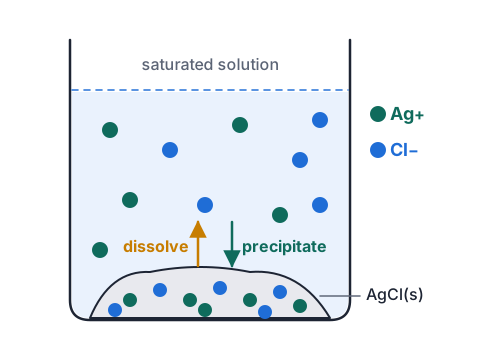
- A sparingly soluble solid such as silver chloride dissolves only a tiny amount. Once the solution is saturated, ions leave the solid and rejoin it at the same rate: AgCl(s) ⇌ Ag⁺(aq) + Cl⁻(aq).
- The equilibrium constant for this is the solubility product, Ks = [Ag⁺][Cl⁻]. The solid is left out of the expression, as solids always are.
- Ks depends only on temperature. A small Ks means very few ions in solution at equilibrium.
- Solubility, s, is the amount of solid that dissolves to make a saturated solution, in mol L⁻¹. It is not the same number as Ks, but each can be found from the other.
Ks in terms of s for three types of solid
- If s mol of solid dissolves per litre, the ion concentrations follow from the formula: AB gives s of each ion; A₂B gives 2s of A and s of B; AB₂ gives s of A and 2s of B.
- Substitute into Ks, remembering to square the concentration of the ion with the 2 in front: (2s)² = 4s².
- These relationships assume the ions do not react further with water, which is how Level 3 calculations treat them.
| Type | Example | Equation | Ks in terms of s |
|---|---|---|---|
| AB | AgCl | AgCl ⇌ Ag⁺ + Cl⁻ | Ks = s × s = s² |
| A₂B | Ag₂CrO₄ | Ag₂CrO₄ ⇌ 2Ag⁺ + CrO₄²⁻ | Ks = (2s)² × s = 4s³ |
| AB₂ | PbI₂ | PbI₂ ⇌ Pb²⁺ + 2I⁻ | Ks = s × (2s)² = 4s³ |
Example: solubility from Ks, and Ks from solubility
- At 25 °C, Ks(AgCl) = 1.8 × 10⁻¹⁰ and Ks(Ag₂CrO₄) = 1.1 × 10⁻¹². Calculate the solubility of each, and say which dissolves more.
- The solubility of PbI₂ at 25 °C is 1.35 × 10⁻³ mol L⁻¹. Calculate Ks(PbI₂).
- AgCl: s² = 1.8 × 10⁻¹⁰, so s = √(1.8 × 10⁻¹⁰)
- s(AgCl) = 1.3 × 10⁻⁵ mol L⁻¹
- Ag₂CrO₄: 4s³ = 1.1 × 10⁻¹², so s³ = 2.75 × 10⁻¹³[Ag⁺] = 2s and [CrO₄²⁻] = s
- s(Ag₂CrO₄) = ∛(2.75 × 10⁻¹³) = 6.5 × 10⁻⁵ mol L⁻¹
- Ag₂CrO₄ has the smaller Ks but is about five times more solubledifferent types, so compare s, not Ks
- PbI₂: [Pb²⁺] = s, [I⁻] = 2s, so Ks = 4s³ = 4 × (1.35 × 10⁻³)³
- Ks(PbI₂) = 9.84 × 10⁻⁹
Calculator: try the cube roots
The common ion effect
- If the water already contains one of the solid's ions, the solid dissolves less. Adding Cl⁻ to AgCl(s) ⇌ Ag⁺ + Cl⁻ shifts the equilibrium to the left, by Le Chatelier's principle, so less AgCl can dissolve.
- In the calculation, the added ion's concentration is used for that ion, because the tiny amount from the solid adds almost nothing to it.
- Ks does not change, because the temperature has not changed; only the solubility does.
Example: solubility with a common ion
- Calculate the solubility of AgCl in 0.010 mol L⁻¹ NaCl, and of Mg(OH)₂ in a solution of pH 12.00. Ks(AgCl) = 1.8 × 10⁻¹⁰ and Ks(Mg(OH)₂) = 5.6 × 10⁻¹².
- AgCl: [Cl⁻] = 0.010 mol L⁻¹, so s = [Ag⁺] = Ks ÷ [Cl⁻] = 1.8 × 10⁻¹⁰ ÷ 0.010Cl⁻ comes almost all from the NaCl
- s = 1.8 × 10⁻⁸ mol L⁻¹, about 750 times less than in water
- Mg(OH)₂: pH 12.00, so pOH = 2.00 and [OH⁻] = 1.0 × 10⁻² mol L⁻¹pH + pOH = 14
- s = [Mg²⁺] = Ks ÷ [OH⁻]² = 5.6 × 10⁻¹² ÷ (1.0 × 10⁻²)²
- s = 5.6 × 10⁻⁸ mol L⁻¹
Making a solid dissolve more
- Anything that removes one of the ions from solution shifts the equilibrium to the right, so more solid dissolves.
- Complex ions: AgCl dissolves in concentrated ammonia because Ag⁺ + 2NH₃ ⇌ [Ag(NH₃)₂]⁺ removes Ag⁺. Zinc hydroxide dissolves in excess NaOH because Zn²⁺ + 4OH⁻ ⇌ [Zn(OH)₄]²⁻ removes Zn²⁺.
- Acids: a basic anion such as OH⁻ or CO₃²⁻ reacts with H₃O⁺, so hydroxides and carbonates dissolve in acid. Mg(OH)₂ in antacid tablets dissolves in stomach acid as OH⁻ + H₃O⁺ → 2H₂O.
- At Waitomo, rainwater containing dissolved CO₂ is slightly acidic, so it dissolves limestone (CaCO₃) as the CO₃²⁻ is turned into HCO₃⁻. Inside the cave CO₂ escapes from the drips, the reaction reverses, and CaCO₃ precipitates as stalactites.
Try it: more or less soluble?
Will a precipitate form? Compare Q with Ks
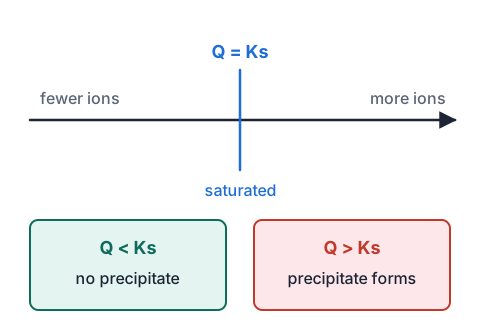
- The ionic product, Q, uses the same expression as Ks but with the concentrations just after mixing, before anything precipitates.
- Mixing two solutions dilutes both, so first find each ion's new concentration: c(new) = c(old) × V(old) ÷ V(total).
- If Q > Ks, the solution holds more ions than it can at equilibrium, so a precipitate forms until Q falls to Ks. If Q ≤ Ks, no precipitate forms.
- Show the comparison in your answer: write the value of Q, the value of Ks, and which is larger.
Example: mixing magnesium chloride and sodium hydroxide
- 50.0 mL of 0.010 mol L⁻¹ MgCl₂ is mixed with 50.0 mL of NaOH solution of pH 10.00. Will Mg(OH)₂ precipitate? Ks(Mg(OH)₂) = 5.6 × 10⁻¹².
- NaOH: pOH = 4.00, so [OH⁻] = 1.0 × 10⁻⁴ mol L⁻¹ before mixing
- total volume 100.0 mL, so each concentration halvesc × 50.0 ÷ 100.0
- [Mg²⁺] = 5.0 × 10⁻³ and [OH⁻] = 5.0 × 10⁻⁵ mol L⁻¹
- Q = [Mg²⁺][OH⁻]² = 5.0 × 10⁻³ × (5.0 × 10⁻⁵)² = 1.3 × 10⁻¹¹
- Q = 1.3 × 10⁻¹¹ > Ks = 5.6 × 10⁻¹², so a precipitate forms
- forgetting to halve the concentrations would give Q eight times too big
What Achieved, Merit and Excellence look like
- Achieved writes the equation and Ks expression and states the change. Merit explains the change with the equilibrium shift. Excellence links every species to the shift, with equations, and says what happens to s and to Ks.
| Grade | A model answer |
|---|---|
| Achieved | Mg(OH)₂(s) ⇌ Mg²⁺(aq) + 2OH⁻(aq). The acid makes more Mg(OH)₂ dissolve. |
| Merit | The H₃O⁺ from the acid reacts with OH⁻: H₃O⁺ + OH⁻ → 2H₂O. This lowers [OH⁻], so the equilibrium shifts to the right to replace it, and more Mg(OH)₂ dissolves. |
| Excellence | Mg(OH)₂(s) ⇌ Mg²⁺(aq) + 2OH⁻(aq). Added H₃O⁺ neutralises OH⁻ (H₃O⁺ + OH⁻ → 2H₂O), lowering [OH⁻] so that Q = [Mg²⁺][OH⁻]² falls below Ks. The equilibrium shifts right to restore Q = Ks, so more solid dissolves and [Mg²⁺] rises: the solubility increases. Ks is unchanged because the temperature is constant. |
Common mistakes
- For PbI₂, Ks = s × 2s = 2s².The iodide concentration is 2s and it is squared: Ks = s × (2s)² = 4s³.
- Ag₂CrO₄ has a smaller Ks than AgCl, so it must be less soluble.Ks values compare solubility only for solids of the same type; work out s for each.
- Adding NaCl to saturated AgCl lowers Ks.Only temperature changes Ks; the common ion lowers the solubility, s.
- Q is worked out from the concentrations of the two solutions before they are mixed.Mixing dilutes both, so find each ion's concentration in the total volume first.
Dissolve a sparingly soluble solid with acid
You need: 2 clean, dry eggshells, white vinegar, tap water, 2 clear glasses, a spoon
- Rinse the eggshells, peel off the thin inner skin, and break each into a few pieces.
- Put one shell's pieces in a glass of water and the other's in a glass of vinegar, each just covered.
- Look closely at both glasses for 5 minutes, then check again after a few hours and the next day.
- Look for: in water nothing seems to happen, because calcium carbonate is only sparingly soluble. In vinegar bubbles of CO₂ form on the shell and it slowly dissolves, because H₃O⁺ from the acid reacts with the CO₃²⁻ ions, so CaCO₃(s) ⇌ Ca²⁺ + CO₃²⁻ keeps shifting to the right.
Safety: Raw eggshell can carry salmonella, so wash your hands after handling it, and do not drink either liquid.
Your turn
Write the Ks expression for PbCl₂.
Ks(BaSO₄) = 1.1 × 10⁻¹⁰ at 25 °C. Calculate its solubility.
The solubility of CaF₂ is 2.1 × 10⁻⁴ mol L⁻¹. Calculate Ks(CaF₂).
What happens to the solubility of AgCl when concentrated ammonia is added, and why?
Equal volumes of 2.0 × 10⁻⁴ mol L⁻¹ AgNO₃ and 2.0 × 10⁻⁴ mol L⁻¹ NaCl are mixed. Does AgCl precipitate? Ks(AgCl) = 1.8 × 10⁻¹⁰.
Show answer
1. Ks = [Pb²⁺][Cl⁻]². 2. s = √(1.1 × 10⁻¹⁰) = 1.0 × 10⁻⁵ mol L⁻¹. 3. Ks = 4s³ = 4 × (2.1 × 10⁻⁴)³ = 3.7 × 10⁻¹¹. 4. It increases: Ag⁺ + 2NH₃ → [Ag(NH₃)₂]⁺ removes Ag⁺, so the equilibrium shifts right and more AgCl dissolves. 5. After mixing each ion is 1.0 × 10⁻⁴ mol L⁻¹, so Q = 1.0 × 10⁻⁸, which is greater than Ks = 1.8 × 10⁻¹⁰: yes, a precipitate forms.
Exam-style question: zinc hydroxide
- Zinc hydroxide, Zn(OH)₂, is a sparingly soluble white solid. Ks(Zn(OH)₂) = 3.0 × 10⁻¹⁷ at 25 °C.
Write the equation for the equilibrium in a saturated solution, and the Ks expression.
Calculate the solubility of Zn(OH)₂ in pure water.
Calculate its solubility in a solution of pH 12.00, and explain the difference.
When concentrated NaOH is added a little at a time, a white precipitate forms and then dissolves. Explain.
10.0 mL of 2.0 × 10⁻⁴ mol L⁻¹ ZnSO₄ is mixed with 10.0 mL of NaOH of pH 9.00. Will a precipitate form?
Show answer
1. Zn(OH)₂(s) ⇌ Zn²⁺(aq) + 2OH⁻(aq); Ks = [Zn²⁺][OH⁻]² (Achieved). 2. Ks = 4s³, so s = ∛(3.0 × 10⁻¹⁷ ÷ 4) = ∛(7.5 × 10⁻¹⁸) = 1.96 × 10⁻⁶ mol L⁻¹ (Merit). 3. [OH⁻] = 1.0 × 10⁻² mol L⁻¹, so s = 3.0 × 10⁻¹⁷ ÷ (1.0 × 10⁻²)² = 3.0 × 10⁻¹³ mol L⁻¹. The added OH⁻ is a common ion: it shifts the equilibrium to the left, so far less dissolves (Merit for the value with the reason). 4. At first, OH⁻ raises Q above Ks, so Zn(OH)₂ precipitates. With excess OH⁻, the complex ion forms, Zn²⁺ + 4OH⁻ → [Zn(OH)₄]²⁻, which removes Zn²⁺; Q falls below Ks, the equilibrium shifts to the right, and the precipitate dissolves (Excellence). 5. After mixing, [Zn²⁺] = 1.0 × 10⁻⁴ and [OH⁻] = 1.0 × 10⁻⁵ ÷ 2 = 5.0 × 10⁻⁶ mol L⁻¹, so Q = 1.0 × 10⁻⁴ × (5.0 × 10⁻⁶)² = 2.5 × 10⁻¹⁵. Q is greater than Ks = 3.0 × 10⁻¹⁷, so a precipitate forms (Excellence for the full calculation with dilution).
Recap
- A saturated solution is a dynamic equilibrium; Ks is the product of the ion concentrations, each raised to its coefficient.
- AB: Ks = s². A₂B and AB₂: Ks = 4s³. Compare solubilities with s, not Ks, when the types differ.
- A common ion lowers solubility; complex ions and acids reacting with basic anions raise it. Ks changes only with temperature.
- Precipitation happens when Q, worked out after dilution, is greater than Ks.
| Situation | Effect on solubility |
|---|---|
| Common ion added | decreases |
| Ion removed into a complex ion | increases |
| Acid added to a hydroxide or carbonate | increases |
| Q > Ks after mixing | precipitate forms |
Report a mistake
How is NCEA Level 3 maths going?
See the NCEA Level 3 maths guide