Composition, layers and energy balance of the atmosphere
What this lesson covers
- The gases of the atmosphere, the variable ones that matter most, and the aerosols that seed clouds.
- How clouds and aerosols reflect, absorb and trap energy.
- Why pressure and density fall with altitude, and how to calculate them.
- The troposphere, stratosphere, mesosphere and thermosphere, and why each heats or cools with height.
- How the layers protect the surface from harmful radiation, meteors and charged particles.
- Earth's energy balance, albedo and the greenhouse effect.
The gases in the air
- Dry air is almost all nitrogen and oxygen, with argon a distant third; these proportions stay the same up to about 80 km because the air is well mixed.
- The gases that matter most for climate are present in tiny amounts: carbon dioxide at about 0.042%, methane at about 1.9 parts per million, nitrous oxide and ozone.
- Water vapour varies from almost none in polar air to about 4% in humid tropical air, so it is listed separately; it is the most important greenhouse gas but its amount depends on temperature.
- Ozone (O₃) is mostly found 15 to 35 km up in the stratosphere, where it absorbs ultraviolet light.
| Gas | Share of dry air |
|---|---|
| Nitrogen, N₂ | 78.08% |
| Oxygen, O₂ | 20.95% |
| Argon, Ar | 0.93% |
| Carbon dioxide, CO₂ | about 0.042% (424 ppm in 2024) |
Try it: CO₂ at Mauna Loa and Baring Head
Aerosols and clouds
- Aerosols are tiny solid or liquid particles in the air: sea salt from breaking waves, dust, smoke from fires, sulfate droplets from volcanoes, industry and plankton, and pollen.
- They scatter and absorb sunlight, and they act as cloud condensation nuclei: water vapour needs a surface to condense on, so without aerosols clouds would hardly form.
- Clouds reflect incoming sunlight (cooling) and absorb and re-emit infrared from below (warming). Low, thick clouds such as stratus mostly cool; high, thin cirrus mostly warm.
- Aerosols travel far: smoke from the 2019 to 2020 Australian bushfires crossed the Tasman, turned New Zealand sunsets red and stained Southern Alps glaciers brown, which made them absorb more sunlight.
Pressure and density fall with height
- Air pressure is the weight of the air above a surface, per square metre. At sea level it averages 1013 hPa (101.3 kPa).
- Higher up there is less air above, so pressure falls. Because air is compressible, the lower layers are squeezed by the air above and are denser, so pressure and density fall quickly at first and then more slowly.
- A useful model is p = p₀ e^(−h ÷ H), where H is about 8 km: pressure halves roughly every 5.5 km, so half the atmosphere's mass is below 5.5 km and about 99% below 30 km.
- Lower density means fewer gas particles in each breath and less air to absorb and scatter sunlight, which is why mountain air feels thin and the sky above it looks deeper blue.
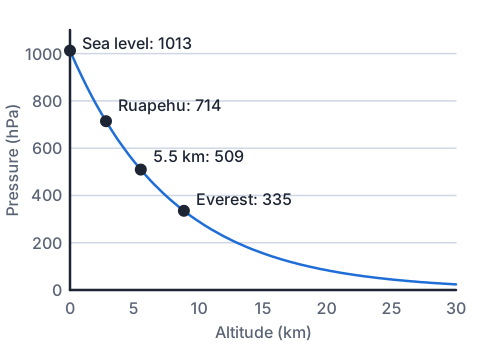
Example: the air at Ruapehu's summit
- Ruapehu's summit is 2797 m above sea level. On a day with 1013 hPa and 18 °C at sea level, estimate the pressure and temperature at the summit.
- Use H = 8.0 km and an average fall of 6.5 °C per kilometre in the troposphere.
- p = 1013 × e^(−2.797 ÷ 8.0) = 1013 × e^(−0.3496)
- p = 1013 × 0.705 = 714 hPa
- temperature fall = 6.5 × 2.797 = 18.2 °C
- T = 18 − 18.2 = −0.2 °C
- 714 ÷ 1013 = 0.70: about 30% less air in each breath
- about 714 hPa and −0.2 °C
The layers and their temperatures
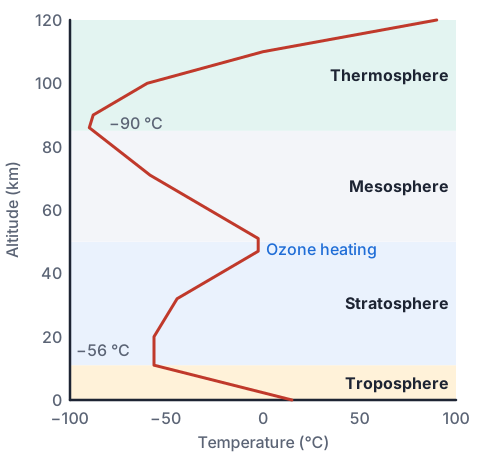
- Troposphere (ground to about 11 km over New Zealand, 16 to 18 km at the equator, 8 km at the poles): heated from below by the ground, so temperature falls with height, about 6.5 °C per kilometre on average. It holds about three quarters of the air and nearly all the water vapour and weather.
- Stratosphere (to about 50 km): ozone absorbs ultraviolet light and converts it to heat, so temperature rises with height; warm air on top of cold makes it very stable, so there is little vertical mixing.
- Mesosphere (50 to 85 km): very little ozone or other absorber, and heat comes only from below, so it cools with height to about −90 °C, the coldest place in the atmosphere.
- Thermosphere (above 85 km): the few gas particles absorb X-rays and extreme ultraviolet, reaching 500 to 2000 °C depending on solar activity, although the air is so thin it would not feel hot. Its ionised region, the ionosphere, reflects radio waves.
- The boundaries (tropopause, stratopause, mesopause) are where the temperature trend reverses; a warmer troposphere expands, so the tropopause is highest over the equator.
How the layers protect the surface
- Thermosphere: absorbs gamma rays, X-rays and extreme ultraviolet; charged particles from the solar wind, steered by Earth's magnetic field towards the poles, collide with gas particles here and make them glow as the aurora australis, often seen from Southland and Stewart Island.
- Mesosphere: thin, but dense enough that friction heats incoming meteoroids until most burn up as meteors (shooting stars) 75 to 100 km up.
- Stratosphere: ozone absorbs nearly all UV-C and most UV-B: O₂ + UV → 2O, then O + O₂ → O₃, and O₃ + UV → O₂ + O, which releases the absorbed energy as heat.
- Troposphere: clouds and aerosols reflect part of the incoming sunlight, and greenhouse gases absorb outgoing infrared, keeping the surface warm enough for liquid water.
Try it: the electromagnetic spectrum
Earth's energy balance
- Sunlight arrives at the top of the atmosphere at about 1361 W m⁻². Spread over the whole spinning sphere (four times the area of the disc that catches it), that averages about 340 W m⁻².
- About 30% is reflected straight back by clouds, aerosols, ice and bright surfaces: Earth's albedo is about 0.30. The rest, about 240 W m⁻², is absorbed, mostly by the surface.
- The warm surface radiates long-wave infrared. To stay at a steady temperature, Earth must send as much energy back to space as it absorbs.
- Heat also leaves the surface without radiation: conduction to the air touching the ground and convection (sensible heat), and evaporation, whose energy is released when vapour condenses into cloud (latent heat).
Example: Earth without a greenhouse effect
- A body radiates energy E = σT⁴ per square metre, with σ = 5.67 × 10⁻⁸ W m⁻² K⁻⁴.
- Find the temperature Earth would have if it radiated the absorbed 238 W m⁻² straight to space, and compare it with the real average surface temperature of 15 °C (288 K).
- absorbed = (1361 ÷ 4) × (1 − 0.30) = 340 × 0.70 = 238 W m⁻²
- σT⁴ = 238, so T⁴ = 238 ÷ 5.67 × 10⁻⁸ = 4.20 × 10⁹ K⁴
- T = (4.20 × 10⁹)^0.25 = 255 K = −18 °C
- 288 K − 255 K = 33 K
- without greenhouse gases about −18 °C, so they keep the surface 33 °C warmer
The greenhouse effect
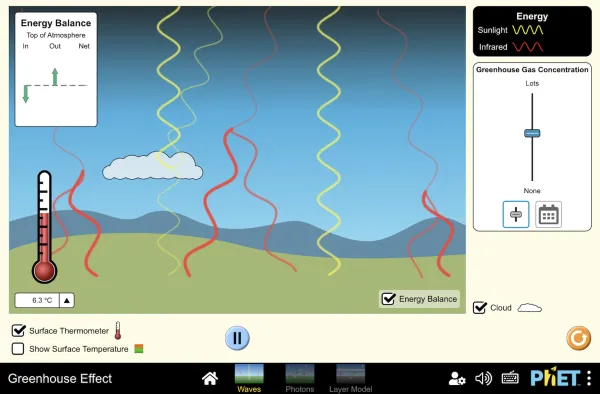
- The atmosphere lets most short-wave visible sunlight through but absorbs much of the long-wave infrared the surface emits.
- Molecules absorb infrared when their vibrations change the way charge is spread across them: water vapour, carbon dioxide, methane, nitrous oxide and ozone can; two-atom molecules of one element, N₂ and O₂, cannot.
- The absorbing gases re-emit infrared in all directions, some back down, so the surface receives energy from both the Sun and the atmosphere and is warmer than 255 K.
- Adding CO₂ and methane strengthens the effect (the enhanced greenhouse effect): the surface must warm until outgoing energy again balances incoming. Warmer air holds more water vapour, which absorbs more infrared: a positive feedback.
What Achieved, Merit and Excellence look like
- Merit links each temperature trend to its heat source; Excellence connects the layers' heating, structure and protection into one system.
| Grade | A model answer |
|---|---|
| Achieved | The stratosphere has ozone, which absorbs UV and heats it. The troposphere is heated from the ground, so it is colder higher up. |
| Merit | Ozone absorbs UV from the Sun and turns it into heat. Most UV is absorbed in the upper stratosphere, so the top is warmest. The troposphere is heated by infrared, conduction and convection from the Earth's surface, so the further from the ground, the colder it is. |
| Excellence | Each layer's trend follows where its energy is absorbed. UV is strongest at the top of the stratosphere and is used up as it passes down through the ozone, so heating is greatest high up and temperature rises with height; the warm air above cold air makes the stratosphere stable. The troposphere is transparent to most sunlight, so the ground absorbs it and heats the air from below; rising air also expands as pressure falls and cools, so temperature falls with height, and that instability drives convection and weather. |
Common mistakes
- The thermosphere is 1500 °C, so it would burn a spacecraft.Its particles are fast but so few that little heat is transferred; spacecraft orbit in it without burning.
- The greenhouse effect is caused by the ozone hole letting heat in.Greenhouse gases absorb outgoing infrared; the ozone hole lets more UV reach the ground, a separate problem.
- Nitrogen is the main greenhouse gas because there is most of it.N₂ and O₂ do not absorb infrared; water vapour and CO₂ do, despite their small amounts.
- Pressure falls by the same amount for every kilometre you climb.Pressure falls exponentially, halving about every 5.5 km, so the drop per kilometre gets smaller with height.
Let air pressure crush a bottle
You need: an empty 1.5 L plastic drink bottle with its cap, hot tap water, a bowl of cold water with ice cubes
- Fill the bottle a third full with hot tap water, put the cap on loosely and swirl it for 30 seconds to warm the air inside.
- Pour the water out, then screw the cap on tightly straight away.
- Stand the bottle in the bowl of ice water, or run cold water over it, and wait a minute.
- Notice the bottle dent and crumple as the air inside cools.
- Look for: cooling makes the trapped air's particles slow down, so the pressure inside falls, and the air pressure outside, about 10 tonnes on every square metre, pushes the bottle in.
Safety: Use hot water only from the tap, check it with your hand first, and hold the bottle by the cap end because the sides can get hot.
Your turn
Use p = 1013 e^(−h ÷ 8.0) to find the pressure at 5.5 km.
On a day when it is 15 °C at the ground, estimate the temperature 4.0 km up, using 6.5 °C per kilometre.
In which layer does temperature rise with height because ozone absorbs ultraviolet light?
Why is nitrogen not a greenhouse gas?
If Earth's albedo rose from 0.30 to 0.32, how much energy per square metre would be absorbed, taking 340 W m⁻² arriving?
Show answer
1. p = 1013 × e^(−0.6875) = 1013 × 0.503 = 509 hPa, about half. 2. 15 − 6.5 × 4.0 = 15 − 26 = −11 °C. 3. The stratosphere. 4. N₂ is two identical atoms; its vibration does not change how charge is spread across it, so it cannot absorb infrared. 5. 340 × (1 − 0.32) = 340 × 0.68 = 231 W m⁻², down from 238 W m⁻².
Exam-style question: summer UV in Aotearoa
- Measurements at Lauder in Central Otago show that summer UV levels in New Zealand are much higher than at similar latitudes in Europe and North America.
Describe how ozone forms in the stratosphere and how it absorbs ultraviolet light.
Explain why temperature increases with height in the stratosphere.
Explain why New Zealand's summer UV is higher than at the same latitude in the Northern Hemisphere.
Explain how clouds and aerosols change the amount of UV reaching the ground.
Show answer
1. Ultraviolet light splits O₂ into oxygen atoms, which join other O₂ molecules to make O₃. Ozone absorbs UV and splits into O₂ and O, which recombine, so the cycle repeats and the UV energy becomes heat (Achieved). 2. UV arrives from above and is absorbed as it passes down through the ozone, so most heating happens high in the stratosphere; with heat added at the top and none from below, temperature rises with height (Merit). 3. The Earth is closest to the Sun in early January, during the southern summer, so about 7% more sunlight arrives than in the northern summer; the air over New Zealand has fewer pollution aerosols to scatter and absorb UV; and southern summer ozone is slightly lower (Merit for two linked reasons). 4. Thick cloud reflects and absorbs much of the UV, cutting it sharply, while broken cloud can reflect extra UV onto the ground near cloud edges; aerosols such as smoke and sulfate scatter and absorb UV, so clean air lets more through. Combining Earth's orbit, clean air and the ozone layer explains New Zealand's high UV, and why the UV Index can be high even on a cool or partly cloudy day (Excellence).
Greenhouse Effect
Full screen · PhET Interactive Simulations, University of Colorado Boulder, CC BY 4.0
Recap
- Dry air is 78% N₂, 21% O₂ and 0.9% Ar; CO₂, CH₄, water vapour and ozone are small but control climate.
- Pressure and density fall exponentially with height, halving about every 5.5 km.
- Each layer's temperature trend follows its heat source: ground (troposphere), ozone (stratosphere), none (mesosphere), X-rays and extreme UV (thermosphere).
- Absorbed sunlight (about 240 W m⁻²) must equal outgoing infrared; greenhouse gases make the surface 33 °C warmer than it would otherwise be.
| Layer | Height | Temperature with height | Why |
|---|---|---|---|
| Troposphere | 0 to about 11 km | Falls | Heated from the ground |
| Stratosphere | to about 50 km | Rises | Ozone absorbs UV |
| Mesosphere | 50 to 85 km | Falls | Little absorption, heat from below |
| Thermosphere | above 85 km | Rises | Absorbs X-rays and extreme UV |
Report a mistake
How is NCEA Level 3 maths going?
See the NCEA Level 3 maths guide