Water, carbon, volcanoes and climate trends
What this lesson covers
- The water cycle in the atmosphere, latent heat transport and atmospheric rivers.
- The carbon cycle in the atmosphere: sources, sinks, the yearly wiggle and the rising trend.
- How volcanic gases and aerosols behave in the troposphere and the stratosphere, and their effect on climate.
- Global trends in temperature and rainfall, and why a warmer atmosphere holds more water.
- New Zealand's temperature and rainfall trends, and how to read and process real climate data.
Water in the atmosphere
- About 86% of the water that evaporates each year comes from the oceans. Plants add more by transpiration, and the vapour is carried by the winds, rises, cools, condenses into cloud and falls as precipitation.
- A water molecule stays in the atmosphere for only about 9 days on average, so the air holds little water at any moment but moves a huge amount through each year.
- Evaporating water absorbs latent heat, about 2.26 × 10⁶ J for every kilogram, without changing temperature; condensation releases it into the air, often thousands of kilometres away. This latent heat is one of the main ways heat moves from the surface and from the tropics into the atmosphere.
- Long, narrow bands of very moist air called atmospheric rivers carry tropical water vapour towards the mid-latitudes. When one reaches New Zealand and is lifted by the ranges, it can drop extreme rain, as in many West Coast floods and Auckland's January 2023 floods.
Try it: the water cycle
Example: the heat in a day's rain
- 10 mm of rain falls on 1.0 km² of land. The vapour that condensed to form it released latent heat of 2.26 × 10⁶ J kg⁻¹. Water has density 1000 kg m⁻³.
- How much energy was released into the atmosphere?
- volume = 0.010 m × 1.0 × 10⁶ m² = 1.0 × 10⁴ m³
- mass = 1.0 × 10⁴ × 1000 = 1.0 × 10⁷ kg
- Q = mL = 1.0 × 10⁷ × 2.26 × 10⁶ = 2.26 × 10¹³ J
- this energy warms the air in the cloud, helping it rise further
- 2.3 × 10¹³ J released
Carbon in the atmosphere
- Carbon moves into the air through respiration, decomposition, fires, volcanoes, release from warm ocean water, and burning fossil fuels; it leaves through photosynthesis and by dissolving in cold ocean water (the physical pump), with marine plankton then carrying some to the deep ocean (the biological pump).
- Without people these flows roughly balanced. Burning fossil fuels and clearing forest now add about 11 billion tonnes of carbon a year; roughly half stays in the air, about a quarter dissolves in the ocean and about a quarter is taken up by land plants.
- CO₂ is well mixed, so measurements at Mauna Loa in Hawaiʻi and Baring Head near Wellington show the same rising trend.
- Each year the record wiggles: CO₂ falls during the northern summer, when the large forests of the Northern Hemisphere photosynthesise, and rises in the northern winter. The wiggle is much smaller at Baring Head, far from those forests.
Try it: the CO₂ record
Example: reading the CO₂ record
- The table gives yearly average CO₂ measured at Mauna Loa.
- Find the average rate of rise from 1960 to 1980 and from 2000 to 2020, and describe the trend.
| Year | 1960 | 1970 | 1980 | 1990 | 2000 | 2010 | 2020 | 2024 |
|---|---|---|---|---|---|---|---|---|
| CO₂ (ppm) | 316.9 | 325.7 | 338.8 | 354.4 | 369.7 | 390.1 | 414.2 | 424.6 |
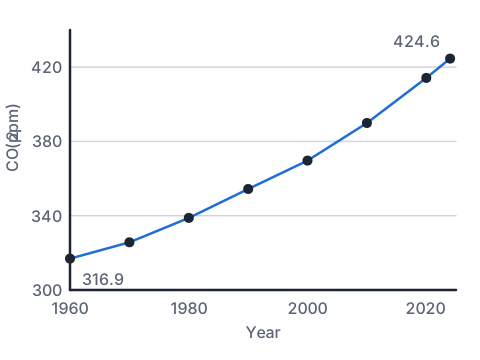
- 1960 to 1980: (338.8 − 316.9) ÷ 20 = 21.9 ÷ 20 = 1.1 ppm a year
- 2000 to 2020: (414.2 − 369.7) ÷ 20 = 44.5 ÷ 20 = 2.2 ppm a year
- 2.2 ÷ 1.1 = 2: the rate has doubled
- CO₂ is rising, and the rise is speeding up: about 1.1 ppm a year then, 2.2 ppm a year now
Volcanic gases and aerosols
- Eruptions release ash, water vapour, carbon dioxide and sulfur dioxide (SO₂). What happens next depends on how high the column reaches.
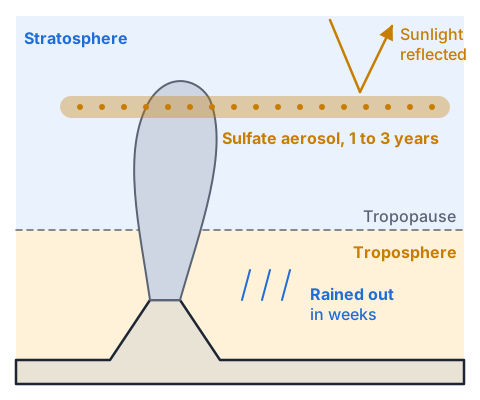
- In the troposphere, ash falls out within hours to days and SO₂ forms sulfate that rain washes out within about a week or two, so effects are local and short: haze, acid rain and cooler days under the plume.
- An explosive eruption can push SO₂ into the stratosphere, where there is no rain. Over weeks it reacts with water to form tiny sulfuric acid droplets, which stratospheric winds spread around the globe within months.
- This aerosol layer reflects sunlight back to space, cooling the surface for one to three years until the droplets slowly settle out; it also absorbs heat, warming the stratosphere. After Pinatubo (Philippines, 1991) global surface temperature fell by about 0.5 °C in 1992.
- Volcanic CO₂ is small compared with human emissions, and volcanic cooling is temporary, so eruptions cause dips in the warming trend rather than reversing it. The 2022 Hunga Tonga-Hunga Haʻapai eruption was unusual: it sent about 150 million tonnes of water vapour, a greenhouse gas, into the stratosphere along with relatively little SO₂.
Global trends
- Global surface temperature in 2011 to 2020 was about 1.1 °C above 1850 to 1900, and 2024 was the warmest year on record, about 1.55 °C above.
- Land warms faster than ocean, and the Arctic is warming fastest, because melting snow and ice expose darker surfaces that absorb more sunlight.
- Air holds about 7% more water vapour for every 1 °C of warming, so heavy rain events are becoming more intense, while subtropical regions tend to get drier: wet regions wetter, dry regions drier.
- Climate is the long-term average of weather, usually over 30 years, so trends are found by comparing averages or fitting a line, not from one hot day or one cold winter.
New Zealand's climate trends
- NIWA's seven-station series, from long-running sites around the country, shows New Zealand's average temperature rose by about 1.1 °C between 1909 and 2019.
- Since 2013 New Zealand has had a run of its warmest years on record, with 2022 the warmest, and there are fewer frosts and more hot days than in the mid-1900s.
- Rainfall trends differ by region: generally more rain in the south and west of the South Island and less in parts of the north and east, matching stronger westerlies and the drying of the subtropics.
- Southern Alps glaciers have lost a large share of their ice since the late 1970s, measured each year in NIWA's end-of-summer snowline survey.
| Year | Mean temperature | Above the 1981 to 2010 average |
|---|---|---|
| 2021 | 13.56 °C | 0.95 °C |
| 2022 | 13.76 °C | 1.15 °C |
Example: processing New Zealand's temperature data
- Use the table and the trend of about 1.1 °C from 1909 to 2019.
- Find the 1981 to 2010 average, the trend per decade, and whether 2022 was unusual against the trend.
- 1981 to 2010 average = 13.76 − 1.15 = 12.61 °C
- check with 2021: 13.56 − 0.95 = 12.61 °C
- trend = 1.1 °C ÷ 11 decades = 0.10 °C per decade
- from the middle of 1981 to 2010 (about 1995) to 2022 is about 2.7 decades, so the long-term trend adds about 0.27 °C
- 2022 was 1.15 °C above, far morewarming has sped up since the mid-1900s, and 2022 also had record marine heatwaves
- 12.61 °C; 0.10 °C per decade; 2022 was far warmer than the long-term trend alone predicts
What Achieved, Merit and Excellence look like
- Excellence answers connect processes across the system: where the gas goes, what it does to energy, and why the effect lasts as long as it does.
| Grade | A model answer |
|---|---|
| Achieved | The volcano puts sulfur dioxide into the atmosphere. This makes aerosols that reflect sunlight, so it gets cooler. |
| Merit | An explosive eruption sends SO₂ into the stratosphere, where it forms sulfuric acid droplets. These reflect incoming sunlight back to space, so less reaches the surface and global temperatures fall. |
| Excellence | Because the stratosphere is above the weather, there is no rain to remove the sulfate aerosol, and the stable layer has little vertical mixing, so the droplets stay up for one to three years. Stratospheric winds spread them around the world within months, so the cooling is global, not just near the volcano. In the troposphere the same SO₂ would be rained out within weeks, so only stratospheric injection gives lasting cooling, and once the aerosol settles out the warming trend from greenhouse gases resumes. |
Common mistakes
- Volcanic ash in the stratosphere is what cools the climate for years.Ash falls out within weeks; the long cooling comes from sulfate aerosol droplets made from SO₂.
- Last winter was cold, so the climate is not warming.Climate is a 30-year average; one season is weather, and trends need long records.
- Evaporation cools the air because the water takes heat from it.Evaporation cools the surface it leaves; the latent heat is released into the air when the vapour condenses.
- The yearly wiggle in CO₂ is caused by people burning more fuel in winter.It comes from Northern Hemisphere plants taking in CO₂ in their summer and releasing it in winter.
Make a water cycle in a bowl
You need: a large glass or plastic bowl, a small cup, cling film, ice cubes, hot tap water, a coin
- Stand the empty cup in the middle of the bowl and pour hot tap water around it, about 2 cm deep, without getting any in the cup.
- Cover the bowl tightly with cling film and put the coin in the centre so the film dips over the cup.
- Put a few ice cubes on the film around the coin and leave the bowl in a sunny spot for 30 minutes.
- Lift the film and look in the cup.
- Look for: water evaporates from the warm water, condenses on the cold film above, runs to the lowest point and drips into the cup as fresh water, the same steps as in the atmosphere.
Safety: Use hot water only from the tap, check it with your hand first, and do not drink the water in the cup.
Your turn
25 mm of rain falls on 1.0 km². How much latent heat was released when it condensed? Use L = 2.26 × 10⁶ J kg⁻¹.
Using the CO₂ table, find the average rate of rise from 2010 to 2020.
New Zealand's mean temperature in 2021 was 13.56 °C. How far above the 1981 to 2010 average of 12.61 °C was it?
Why does SO₂ that reaches the stratosphere affect climate for longer than SO₂ that stays in the troposphere?
Why does the CO₂ record rise and fall a little every year?
Show answer
1. Mass = 0.025 m × 1.0 × 10⁶ m² × 1000 kg m⁻³ = 2.5 × 10⁷ kg; Q = 2.5 × 10⁷ × 2.26 × 10⁶ = 5.7 × 10¹³ J. 2. (414.2 − 390.1) ÷ 10 = 24.1 ÷ 10 = 2.4 ppm a year. 3. 13.56 − 12.61 = 0.95 °C. 4. There is no rain in the stratosphere to wash the sulfate aerosol out, so it stays for one to three years and spreads worldwide; in the troposphere rain removes it within about a week or two. 5. Plants in the Northern Hemisphere, which has most of the land, take in CO₂ during the northern summer and release it as they decay in winter.
Exam-style question: the Pinatubo eruption
- In June 1991, Mt Pinatubo in the Philippines erupted, sending a column of ash and gas about 35 km high and putting around 15 million tonnes of SO₂ into the stratosphere. In 1992, average global surface temperature was about 0.5 °C lower than before the eruption.
Describe what happened in the troposphere close to the volcano.
Explain how the SO₂ in the stratosphere cooled the Earth's surface.
Explain why the cooling was felt around the world, including in New Zealand.
Explain why the cooling lasted only about two years.
Show answer
1. Ash and gas fell out of the troposphere near the volcano within days, darkening the sky and cooling it locally; SO₂ there formed sulfate that rain washed out as acid rain (Achieved). 2. In the stratosphere the SO₂ reacted with water vapour to form tiny sulfuric acid droplets. These reflect and scatter incoming short-wave sunlight back to space, so less reaches the surface and it cools; they also absorb some radiation, warming the stratosphere (Merit). 3. The stratosphere has no weather to remove the droplets, and stratospheric winds carried the aerosol around the globe within months and spread it into both hemispheres, so the reduction in sunlight was global, reaching New Zealand's skies with vivid sunsets (Merit). 4. The droplets slowly grow and settle out of the stratosphere over one to three years, so as the aerosol layer thinned, sunlight returned to normal; meanwhile the greenhouse gases that drive the long-term warming were unchanged, so warming resumed (Excellence links injection height, aerosol formation, global spread, residence time and the long-term trend).
Recap
- Water vapour carries latent heat from the surface and tropics; it is released when vapour condenses into cloud.
- CO₂ is rising at about 2.2 ppm a year, with a yearly wiggle from northern plants; about half of emissions stay in the air.
- Volcanic SO₂ cools the surface for one to three years only if it reaches the stratosphere.
- The world is about 1.1 °C warmer than 1850 to 1900, and New Zealand about 1.1 °C warmer than in 1909, with regional changes in rainfall.
| Formula or rule | Use it for |
|---|---|
| Q = mL, L = 2.26 × 10⁶ J kg⁻¹ | latent heat of condensation |
| rate = change ÷ time | trends in CO₂ or temperature |
| anomaly = value − average | comparing a year with normal |
| about 7% more vapour per 1 °C | heavier rain as it warms |
The maths behind it
Report a mistake
How is NCEA Level 3 maths going?
See the NCEA Level 3 maths guide