Investigating an aspect of astronomy with real data
What this lesson covers
- What AS 91415 assesses, and how explaining the science and its links lifts the grade.
- Choosing an aspect of astronomy: an event, a discovery, a principle or what a probe or telescope has revealed.
- Where to find reliable data: exoplanet archives, light curves, star catalogues and orbital data.
- Processing data: transit depth and planet size, Kepler's third law, and parallax distance.
- Evaluating sources and conclusions: reliability, uncertainty, assumptions and cross-checks.
What AS 91415 asks of you
- AS 91415 is a 4-credit internal. You research one aspect of astronomy, gather information and data from a wide range of reliable sources, process it, and report.
- Achieved: select and process good-quality information about the aspect and the science behind it, and explain the aspect.
- Merit: explain the key science in depth, such as the gravity, light or nuclear physics that makes the aspect work.
- Excellence: explain the key links between the aspect and that science, showing how each piece of science accounts for what is observed.
- The aspect can be an event (a supernova, an eclipse, a comet), a discovery (exoplanets, gravitational waves), a principle (Kepler's laws, stellar evolution) or knowledge gained from a space probe or telescope.
Choosing a question
- Pick an aspect narrow enough to explain fully and rich enough to have real data you can process yourself.
- Turn it into a question: not 'exoplanets', but 'How do astronomers find the size and orbit of a planet from a star's light curve?'
- A New Zealand link can make a strong report: the MOA project at Mt John Observatory near Tekapo has found planets by gravitational microlensing, and the stars of Matariki are a young cluster whose distance Gaia has measured.
| Question idea | Key science | Data you could process |
|---|---|---|
| Finding exoplanets by transits | Light, orbits, Kepler's third law | TESS or Kepler light curves |
| Why planets further out take longer | Gravity, Kepler's laws | Planetary orbit data |
| How far away is Matariki? | Parallax, star life cycle | Gaia star catalogue |
| Comets returning to the inner Solar System | Elliptical orbits, sublimation | JPL orbital elements |
Where to find real data
- Exoplanets: the NASA Exoplanet Archive lists every confirmed planet with its period, radius, mass and the star's properties, each with uncertainties and a reference to the paper.
- Light curves: the Kepler and TESS space telescopes measured the brightness of hundreds of thousands of stars; their data are public through NASA's MAST archive.
- Star catalogues: ESA's Gaia mission has measured positions, parallaxes, brightness and colours for well over a billion stars.
- Orbits: NASA's planetary fact sheets and JPL's Small-Body Database give orbital data for planets, moons, asteroids and comets.
- Primary data from space agencies and peer-reviewed papers are the most reliable; news stories and websites are useful for ideas but must be checked against them.
Reading a transit light curve
- A light curve is a graph of a star's brightness against time. If a planet's orbit is lined up with our view, the planet blocks a little of the star each time it passes in front: a transit.
- The fraction of light blocked equals the fraction of the star's disc covered: depth = (Rp ÷ Rs)², where Rp is the planet's radius and Rs the star's.
- The time between dips is the orbital period, and repeated dips of the same depth rule out a one-off event such as a starspot or an instrument glitch.
- From the period and the star's mass, Kepler's third law gives the orbit's size, so a light curve and a star catalogue together give a planet's size and orbit.
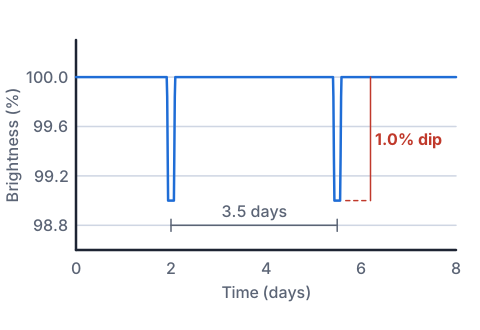
Example: sizing up a planet
- A Sun-like star (radius 6.96 × 10⁵ km, mass 1 solar mass) dims by 1.0% every 3.5 days.
- Find the planet's radius and the radius of its orbit in AU.
- depth = 0.010 = (Rp ÷ Rs)², so Rp ÷ Rs = √0.010 = 0.10
- Rp = 0.10 × 6.96 × 10⁵ = 7.0 × 10⁴ kmJupiter's radius is 7.0 × 10⁴ km
- T = 3.5 ÷ 365.25 = 0.00958 years
- a³ = T² = 9.18 × 10⁻⁵, so a = 0.045 AUKepler's third law in years and AU for a Sun-mass star
- Mercury orbits at 0.39 AU, so this giant is far closer than any planet of ours
- a Jupiter-sized planet (7.0 × 10⁴ km) orbiting at 0.045 AU: a hot Jupiter
Try it: find a planet by its transit
Orbital data and Kepler's third law
- Kepler's third law: the square of a planet's orbital period is proportional to the cube of its average distance from its star, T² ∝ a³. For anything orbiting the Sun, with T in years and a in astronomical units, T² = a³.
- It follows from gravity: Newton showed T² = 4π²a³ ÷ GM, so the constant depends only on the mass M of the central star, which is how astronomers weigh stars from their planets.
- Plotting log T against log a turns the curve into a straight line with gradient 1.5, a good way to test the law with real data.
| Planet | a (AU) | T (years) | a³ | T² |
|---|---|---|---|---|
| Mercury | 0.387 | 0.241 | 0.058 | 0.058 |
| Venus | 0.723 | 0.615 | 0.378 | 0.378 |
| Earth | 1.000 | 1.000 | 1.000 | 1.000 |
| Mars | 1.524 | 1.881 | 3.54 | 3.54 |
| Jupiter | 5.203 | 11.86 | 140.9 | 140.7 |
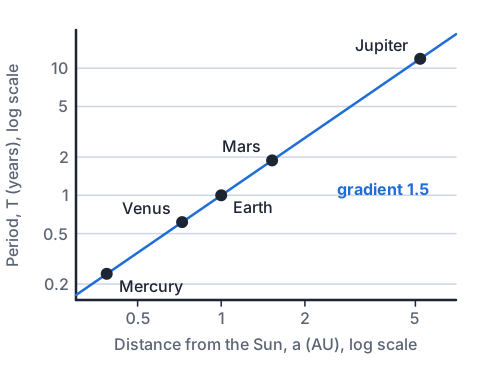
Example: predicting the period of Ceres
- The dwarf planet Ceres orbits the Sun at an average distance of 2.77 AU. Predict its orbital period.
- T² = a³ = 2.77³ = 21.25
- T = √21.25 = 4.61 years
- 2.77 lies between Mars (1.52) and Jupiter (5.20), and 4.61 years lies between their periods
- about 4.61 years; the measured period is 4.6 years
Star catalogues and parallax
- As Earth orbits the Sun, a nearby star seems to shift against distant ones. Half that shift, measured from opposite sides of the orbit, is the parallax angle p.
- Distance in parsecs is d = 1 ÷ p, with p in arcseconds; 1 parsec = 3.26 light years. The smaller the parallax, the further away the star.
- With distance and apparent brightness you can find a star's true luminosity; with its colour you know its surface temperature, and the two together place it on the Hertzsprung-Russell diagram, which shows its stage of life.
- Gaia's parallaxes are precise for stars out to thousands of light years, but every value comes with an uncertainty, and for distant stars that uncertainty can be large.
Try it: the HR diagram
Example: how far to the Pointers?
- Alpha Centauri, the brighter of the two Pointers beside the Southern Cross, has a parallax of 0.747 arcseconds.
- Find its distance in parsecs and light years.
- d = 1 ÷ p = 1 ÷ 0.747 = 1.34 pc
- 1.34 × 3.26 = 4.37 light years
- the nearest star system to the Sun; only its smaller companion, Proxima Centauri, has a larger parallax
- 1.34 pc, or 4.37 light years
Evaluating sources and conclusions
- For each source, record who produced it, whether it was peer reviewed, how recent it is, and whether it gives the uncertainty in its numbers; quote the uncertainty when you use a value.
- Check your processed results against the archive: if your planet radius from a light curve matches the catalogue value within its uncertainty, your method is supported.
- State the assumptions behind each calculation: a circular orbit, a star's radius that is itself measured with error, a transit that crosses the middle of the star.
- Separate what the data show from what is inferred: a transit shows a dark object of a certain size; that it is a gas giant is an inference from its size and, if known, its mass.
What Achieved, Merit and Excellence look like
- The same idea, written up at each grade for a report on the transit method.
| Grade | What the student wrote |
|---|---|
| Achieved | When a planet passes in front of its star, the star gets dimmer. TESS measures this dimming. A bigger planet blocks more light, so the dip is deeper. |
| Merit | The planet blocks a fraction of the star's disc equal to (Rp ÷ Rs)², so a 1.0% dip on a Sun-sized star means Rp is one tenth of the star's radius, about the size of Jupiter. The dips repeat every orbit, so the gap between them is the period. |
| Excellence | The depth gives the planet's size only because the star's radius is known from its temperature and luminosity in Gaia's catalogue, so errors in the star carry into the planet. The period, through Kepler's third law, which comes from gravity, gives an orbit of 0.045 AU, far closer than Mercury. Together these show a giant planet so close it must be very hot, which challenged the idea from our Solar System that giant planets only form far from their star. |
Common mistakes
- A 1% dip means the planet is 1% of the star's radius.The dip is the ratio of areas, so Rp ÷ Rs = √0.01 = 0.1, a tenth of the star's radius.
- Kepler's third law: T = a³.It is T² = a³ (in years and AU for the Sun), so T = a^1.5.
- A bigger parallax means a star is further away.d = 1 ÷ p, so a bigger parallax means a closer star.
- I used five websites, so my information is reliable.Reliability comes from the kind of source (primary data, peer review, uncertainties), not the number of websites.
Record a transit with your phone
You need: a torch that runs on AA or AAA batteries, a small ball and a larger ball, a piece of string, a phone with a free light meter app, tape
- In a dark room, tape the torch to a table so it shines sideways: this is the star.
- Lay the phone 1 m away facing the torch, with the light meter app recording.
- Hang the small ball from the string and swing it slowly across the beam halfway between torch and phone, so it passes in front of the torch.
- Repeat with the larger ball and compare the dips in the app's graph.
- Look for: a steady reading, a dip while the ball crosses, then recovery; the larger ball makes a deeper dip, about in proportion to its cross-sectional area.
Safety: Point the torch away from people's eyes, and keep the swinging ball away from faces.
Your turn
A star of radius 7.0 × 10⁵ km dims by 0.25% during a transit. Find the planet's radius.
A planet orbits a Sun-like star at 4.0 AU. What is its orbital period?
A star has a parallax of 0.10 arcseconds. How far away is it in parsecs and light years?
If a planet's radius were doubled, by what factor would its transit depth change?
For a report on an exoplanet's radius, which is more reliable: the NASA Exoplanet Archive or a news article, and why?
Show answer
1. Rp ÷ Rs = √0.0025 = 0.05, so Rp = 0.05 × 7.0 × 10⁵ = 3.5 × 10⁴ km. 2. T² = 4.0³ = 64, so T = 8.0 years. 3. d = 1 ÷ 0.10 = 10 pc = 10 × 3.26 = 32.6 light years. 4. Depth ∝ Rp², so 2² = 4 times deeper. 5. The archive: it gives the measured value with its uncertainty and the peer-reviewed paper it came from, while a news article may round, simplify or misreport it.
Kepler's Laws
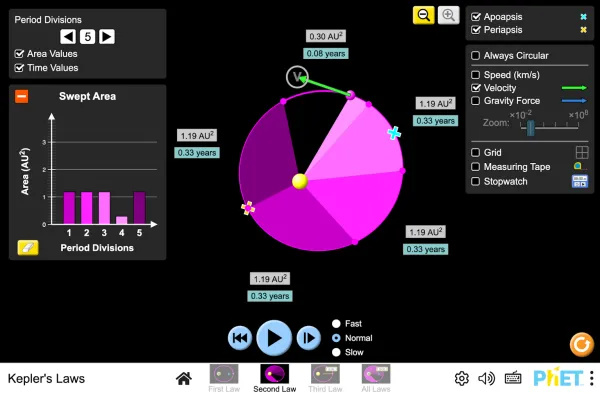
Full screen · PhET Interactive Simulations, University of Colorado Boulder, CC BY 4.0
Recap
- Choose one aspect and turn it into a question you can answer with real data.
- Use primary sources: NASA's Exoplanet Archive and fact sheets, MAST light curves, Gaia, JPL.
- Process the data yourself: transit depth, Kepler's third law, parallax.
- Merit explains the key science; Excellence links each piece of science to what is observed, and states assumptions and uncertainties.
| Formula | Use it for |
|---|---|
| depth = (Rp ÷ Rs)² | planet size from a transit |
| T² = a³ (years, AU, Sun-mass star) | orbit size or period |
| d = 1 ÷ p (parsecs, arcseconds) | distance from parallax |
| 1 pc = 3.26 light years | converting distances |
Report a mistake
How is NCEA Level 3 maths going?
See the NCEA Level 3 maths guide