Centre of mass and momentum in two dimensions
What this lesson covers
- The centre of mass of a system is the mass-weighted average position, worked out separately in x and in y.
- With no external force, the centre of mass of a system moves at constant velocity, whatever happens inside the system.
- Momentum p = mv is a vector, and the total momentum of an isolated system is the same before and after a collision or explosion, in each direction.
- Impulse FΔt equals the change in momentum, found by subtracting the initial momentum vector from the final one.
- A vector diagram (momenta drawn tip to tail) turns a 2D momentum problem into a triangle solved with Pythagoras, trigonometry or the cosine rule.
Centre of mass
- The centre of mass is the single point that moves as if all the system's mass were there and every external force acted on it.
- For masses along a line, x_cm = (m₁x₁ + m₂x₂ + ...) ÷ (m₁ + m₂ + ...): each position is weighted by its mass, so the centre of mass sits closer to the heavier object.
- In two dimensions, do the same calculation twice, once for the x coordinates and once for the y coordinates, using the same origin for every mass.
- Internal forces (in a collision, an explosion or a push between skaters) come in equal and opposite pairs, so they cannot change the motion of the centre of mass.
- So with no external force, the centre of mass keeps a constant velocity; under gravity alone, it follows the same parabola the whole object would have.
Example: where the Earth and Moon really orbit
- The Earth and Moon both orbit their shared centre of mass, called the barycentre. Use the NASA data below to find how far it is from the centre of the Earth, and whether it lies inside the Earth.
| Quantity | Value |
|---|---|
| Mass of the Earth | 5.972 × 10²⁴ kg |
| Mass of the Moon | 7.346 × 10²² kg |
| Semimajor axis of the Moon's orbit | 3.844 × 10⁸ m |
| Mean radius of the Earth | 6.371 × 10⁶ m |
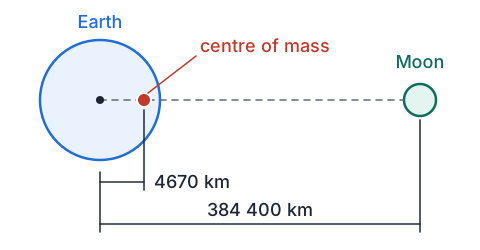
- origin at Earth's centre: x_E = 0, x_M = 3.844 × 10⁸ mputting the origin on one mass makes its term zero
- x_cm = (5.972 × 10²⁴ × 0 + 7.346 × 10²² × 3.844 × 10⁸) ÷ (5.972 × 10²⁴ + 7.346 × 10²²)
- x_cm = 2.824 × 10³¹ ÷ 6.045 × 10²⁴ = 4.671 × 10⁶ m
- 4.671 × 10⁶ m < 6.371 × 10⁶ mcompare with the Earth's radius
- 4.67 × 10⁶ m (4670 km) from Earth's centre, inside the Earth
Example: centre of mass in two dimensions
- A light frame holds three masses: 2.0 kg at (0, 0), 3.0 kg at (4.0 m, 0) and 1.0 kg at (0, 3.0 m).
- Find the coordinates of the centre of mass.
- total mass = 2.0 + 3.0 + 1.0 = 6.0 kg
- x_cm = (2.0 × 0 + 3.0 × 4.0 + 1.0 × 0) ÷ 6.0 = 12 ÷ 6.0 = 2.0 m
- y_cm = (2.0 × 0 + 3.0 × 0 + 1.0 × 3.0) ÷ 6.0 = 3.0 ÷ 6.0 = 0.50 m
- x_cm is nearer the 3.0 kg mass and y_cm is small, because only the lightest mass is off the x axis
- centre of mass at (2.0 m, 0.50 m)
Try it: move the centre of mass
Momentum is conserved as a vector
- Momentum p = mv (kg m s⁻¹) points the same way as the velocity, so two momenta at an angle add like forces or displacements, not like ordinary numbers.
- In an isolated system (no external net force), the total momentum vector after a collision or explosion equals the total before, so it is conserved in the x direction and in the y direction separately.
- To solve a 2D problem, either draw the momenta tip to tail to make a triangle, or resolve every momentum into x and y components and add each set.
- Kinetic energy is conserved only in an elastic collision; when objects stick together or deform, some kinetic energy becomes heat and sound, but momentum is still conserved.
Try it: collisions
Example: two cars collide at an intersection
- Car A (1200 kg) travels east at 15.0 m s⁻¹ and car B (1500 kg) travels north at 14.0 m s⁻¹. They collide and lock together.
- Find the velocity of the wreck just after the collision, and the kinetic energy lost.
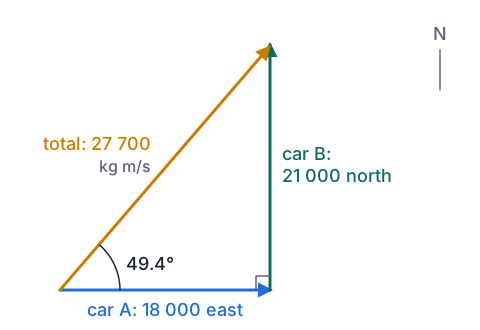
- p_A = 1200 × 15.0 = 18 000 kg m s⁻¹ east, p_B = 1500 × 14.0 = 21 000 kg m s⁻¹ north
- p = √(18 000² + 21 000²) = 27 659 kg m s⁻¹the two momenta are at right angles, so the vector triangle is right-angled
- tan θ = 21 000 ÷ 18 000, θ = 49.4° north of east
- v = p ÷ m = 27 659 ÷ 2700 = 10.24 m s⁻¹momentum after equals momentum before, with the combined mass
- Ek before = ½ × 1200 × 15.0² + ½ × 1500 × 14.0² = 282 000 J; Ek after = ½ × 2700 × 10.24² = 141 700 J
- Ek after is less than Ek before, as it must be when the cars stick
- 10.2 m s⁻¹ at 49.4° north of east; 1.40 × 10⁵ J of kinetic energy lost
Example: a glancing collision with components
- An ice hockey puck (0.170 kg) slides at 6.00 m s⁻¹ along the x axis and strikes an identical puck at rest. Afterwards the first puck moves at 3.00 m s⁻¹ at 60.0° to the left of its original line.
- Find the velocity of the second puck.
- before: p_x = 0.170 × 6.00 = 1.020 kg m s⁻¹, p_y = 0
- first puck after: p_x = 0.170 × 3.00 cos 60.0° = 0.255, p_y = 0.170 × 3.00 sin 60.0° = 0.4417 kg m s⁻¹
- second puck: p_x = 1.020 − 0.255 = 0.765, p_y = 0 − 0.4417 = −0.4417 kg m s⁻¹each component is conserved separately
- p = √(0.765² + 0.4417²) = 0.8834 kg m s⁻¹, v = 0.8834 ÷ 0.170 = 5.20 m s⁻¹
- tan θ = 0.4417 ÷ 0.765, θ = 30.0° to the right of the original line
- Ek before = ½ × 0.170 × 6.00² = 3.06 J; after = ½ × 0.170 × (3.00² + 5.20²) = 3.06 J, so this collision is elastic
- 5.20 m s⁻¹ at 30.0° to the right of the first puck's original direction
Impulse and change in momentum
- Impulse is the average force multiplied by the time it acts, FΔt (N s), and it equals the change in momentum Δp = p_final − p_initial.
- Both are vectors, so find Δp by adding the final momentum and the reverse of the initial momentum: draw p_final, then −p_initial from its tip.
- The force is in the direction of Δp, which is often not the direction the object was moving.
- For the same change in momentum, a longer contact time means a smaller force: crumple zones, airbags and bending your knees on landing all work this way.
Example: a football bouncing off a wall
- A 0.430 kg football hits a wall at 12.0 m s⁻¹, travelling at 40.0° to the wall, and rebounds at the same speed and angle. It is in contact for 0.0150 s.
- Find the change in momentum and the average force from the wall.
- parallel to the wall: 12.0 cos 40.0° before and after, so no changethe wall can only push at right angles to itself if there is no friction
- perpendicular: 12.0 sin 40.0° = 7.713 m s⁻¹ towards the wall, then 7.713 m s⁻¹ away
- Δp = 0.430 × (7.713 − (−7.713)) = 0.430 × 15.43 = 6.634 kg m s⁻¹ away from the wall
- F = Δp ÷ Δt = 6.634 ÷ 0.0150 = 442 N
- Δp = 6.63 kg m s⁻¹ and F = 442 N, both at right angles to the wall, outwards
What Achieved, Merit and Excellence look like
- Achieved states one correct idea or does a one-step calculation; Merit explains it or completes a two-step vector calculation; Excellence links every idea, from cause to effect, for this situation.
- In explanations name the system, say whether an external force acts, and finish by answering the question that was asked.
| Grade | A model answer |
|---|---|
| Achieved | Momentum is conserved in the explosion, so the pieces' momenta add up to the shell's momentum before. |
| Merit | The explosion forces are internal and act in equal and opposite pairs, so the total momentum vector just after equals the shell's momentum just before, even though the pieces fly apart. |
| Excellence | The explosion forces are internal pairs, so they change each piece's momentum but not the total, and so cannot change the centre of mass's velocity. The only external force is the weight of the pieces, the same total as before, so the centre of mass keeps following the shell's original parabola until a piece lands. |
Common mistakes
- Total momentum = 18 000 + 21 000 = 39 000 kg m s⁻¹ for the two cars.Momenta at right angles add as vectors: √(18 000² + 21 000²) = 27 700 kg m s⁻¹.
- The ball hits and leaves at 12.0 m s⁻¹, so its momentum did not change and there was no impulse.The speed is the same but the direction changed, so Δp = p_final − p_initial is not zero.
- Momentum is conserved, so kinetic energy must be conserved as well.Kinetic energy is conserved only in elastic collisions; momentum is conserved in every collision without an external force.
- The angle of 49.4° is just given as the answer, with no reference direction.Give a direction against something fixed, such as 49.4° north of east or measured from car A's original path.
Find the centre of mass of an L shape
You need: a cereal box, a ruler, a pencil, scissors, paper and a pen
- Cut an L shape from the cereal box made of two rectangles: one 20 cm × 5 cm, and one 5 cm × 10 cm joined at one end so the L is 20 cm across and 15 cm tall.
- Put the corner of the L at the origin and mark the centre of each rectangle: (10, 2.5) for the long one and (2.5, 10) for the short one, in cm.
- Card has the same mass per area everywhere, so weight each centre by area (100 cm² and 50 cm²): x_cm = (100 × 10 + 50 × 2.5) ÷ 150 = 7.5 cm, y_cm = (100 × 2.5 + 50 × 10) ÷ 150 = 5.0 cm.
- Mark (7.5, 5.0) on the card and try to balance the L, flat, on the blunt end of a pencil at that point.
- Look for: it balances at the calculated point, and that point is on the card but close to the inside corner; with some shapes the centre of mass lies outside the object altogether.
Safety: Cut away from your fingers with the scissors and keep the card flat on the table while cutting, because cereal box card can slip and the blades can slide off it.
Your turn
A 4.0 kg mass sits at x = 0 and a 1.0 kg mass at x = 2.5 m. Where is the centre of mass?
A 0.0580 kg tennis ball hits a racquet at 20.0 m s⁻¹ and returns straight back at 30.0 m s⁻¹. Contact lasts 4.00 ms. Find the average force on the ball.
A 0.400 kg ball moving east at 5.00 m s⁻¹ hits a 0.600 kg ball moving north at 2.50 m s⁻¹, and they stick together. Find their velocity.
A 3.00 kg object at rest explodes into three 1.00 kg pieces. One goes east at 6.00 m s⁻¹ and one north at 8.00 m s⁻¹. Find the velocity of the third piece.
Show answer
1. x_cm = (4.0 × 0 + 1.0 × 2.5) ÷ 5.0 = 0.50 m from the 4.0 kg mass. 2. Taking the return direction as positive, Δp = 0.0580 × (30.0 − (−20.0)) = 0.0580 × 50.0 = 2.90 kg m s⁻¹; F = 2.90 ÷ 0.00400 = 725 N, in the direction the ball returns. 3. p east = 0.400 × 5.00 = 2.00, p north = 0.600 × 2.50 = 1.50 kg m s⁻¹; p = √(2.00² + 1.50²) = 2.50 kg m s⁻¹; v = 2.50 ÷ 1.00 = 2.50 m s⁻¹; tan θ = 1.50 ÷ 2.00, θ = 36.9° north of east. 4. Total momentum stays zero, so the third piece has momentum equal and opposite to the sum of the other two: √(6.00² + 8.00²) = 10.0 kg m s⁻¹, so v = 10.0 m s⁻¹; the other two add to a direction 53.1° north of east (tan θ = 8.00 ÷ 6.00), so the third piece moves at 10.0 m s⁻¹ at 53.1° south of west.
Exam-style question: a tackle
- In a rugby match, Sione (95.0 kg) runs east at 6.00 m s⁻¹. Nikau (110 kg) runs at 5.00 m s⁻¹ in a direction 60.0° north of west. Nikau tackles Sione and they move off together. Ignore friction from the ground during the tackle.
Calculate the size of each player's momentum before the tackle.
Calculate the velocity of the two players just after the tackle. A vector diagram may help.
The tackle lasts 0.300 s. Calculate the size of the average force on Sione.
Explain why momentum is conserved in the tackle but kinetic energy is not.
Show answer
1. Sione: 95.0 × 6.00 = 570 kg m s⁻¹; Nikau: 110 × 5.00 = 550 kg m s⁻¹ (Achieved for both). 2. Components with east and north positive: Sione (570, 0); Nikau (−550 cos 60.0°, 550 sin 60.0°) = (−275, 476.3). Total (295, 476.3) kg m s⁻¹, size √(295² + 476.3²) = 560.3 kg m s⁻¹; v = 560.3 ÷ 205 = 2.73 m s⁻¹; tan θ = 476.3 ÷ 295, θ = 58.2° north of east (Merit for the method with one slip, Excellence for the size and direction). 3. Sione's velocity after is (1.439, 2.323) m s⁻¹, so Δv = (1.439 − 6.00, 2.323) = (−4.561, 2.323); Δp = 95.0 × √(4.561² + 2.323²) = 486.3 kg m s⁻¹; F = 486.3 ÷ 0.300 = 1620 N (Excellence; Nikau's change in momentum has the same size, the other way). 4. During the tackle the forces between the players are an internal action and reaction pair, equal in size, opposite in direction and acting for the same time, so the impulses cancel and the total momentum is unchanged. Kinetic energy falls from 3085 J to ½ × 205 × 2.73² = 766 J because the players deform and grip, so work is done converting kinetic energy into heat and sound; this is an inelastic collision (Excellence links the internal forces to momentum and the energy change to the inelastic collision).
Recap
- Centre of mass: a mass-weighted average, in x and in y separately.
- No external force means the centre of mass keeps a constant velocity.
- Momentum is a vector conserved in each direction; draw the momenta tip to tail or use components.
- Impulse FΔt = Δp, with Δp = p_final − p_initial found by vector subtraction.
- Momentum is always conserved in a collision; kinetic energy only when it is elastic.
| Formula | Use it for |
|---|---|
| x_cm = Σmx ÷ Σm | centre of mass (repeat for y) |
| p = mv | momentum, a vector |
| Σp before = Σp after | collisions and explosions |
| FΔt = Δp | impulse and average force |
| p = √(p_x² + p_y²), tan θ = p_y ÷ p_x | adding perpendicular momenta |
Report a mistake
How is NCEA Level 3 maths going?
See the NCEA Level 3 maths guide