Circular motion and gravity
What this lesson covers
- An object moving in a circle at constant speed accelerates towards the centre at v²/r, so the net force on it points to the centre and equals mv²/r.
- The centripetal force is the resultant of real forces (tension, weight, a normal reaction, friction or gravity), never an extra force.
- On a banked curve the horizontal part of the normal reaction can supply the centripetal force; in a vertical circle the tension or reaction changes round the loop.
- Newton's law of gravitation, F = GMm ÷ r², gives the attraction between two masses, with r measured between their centres.
- For a satellite, gravity is the centripetal force, so its speed and period depend only on the mass it orbits and the radius of the orbit.
Centripetal acceleration and force
- An object can move at a steady speed in a circle and still accelerate, because its velocity keeps changing direction.
- The acceleration points to the centre of the circle and has size a = v² ÷ r; with angular speed ω = 2π ÷ T, v = rω and a = rω².
- Newton's second law then needs a net force towards the centre, F = mv² ÷ r, called the centripetal force.
- It is not an extra force on the free-body diagram: it is the resultant of the real forces, so the question is always which forces supply it.
- If the net inward force suddenly stops, the object moves off along the tangent in a straight line; it is not flung outwards.
Try it: circular motion
Banked curves
- On a flat bend, friction between the tyres and the road supplies the centripetal force, so on ice the car slides straight on.
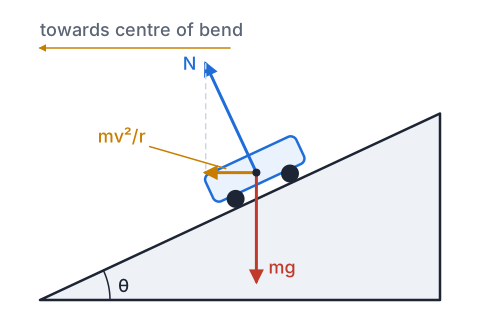
- On a road banked at angle θ, the normal reaction tilts towards the centre of the bend; its vertical component balances the weight and its horizontal component supplies the centripetal force.
- With no friction, N cos θ = mg and N sin θ = mv² ÷ r; dividing one by the other gives tan θ = v² ÷ (rg).
- At this design speed no friction is needed at all, and the angle does not depend on the car's mass. Faster than this, friction must act down the slope; slower, up the slope.
Example: designing a banked bend
- A curve on a motorway on-ramp has a radius of 85.0 m and is designed for 60.0 km h⁻¹.
- Find the angle of banking that needs no friction at that speed.
- v = 60.0 ÷ 3.6 = 16.67 m s⁻¹
- tan θ = v² ÷ (rg) = 16.67² ÷ (85.0 × 9.81) = 277.8 ÷ 833.9 = 0.3332
- θ = tan⁻¹ 0.3332 = 18.4°
- mass cancelled, so a truck and a car need the same angle
- θ = 18.4°
Vertical circles
- For a ball whirled on a string in a vertical circle, weight acts down everywhere but the tension always points to the centre, so the forces combine differently round the loop.
- At the top both point to the centre: T + mg = mv² ÷ r. At the bottom they are opposite: T − mg = mv² ÷ r, so the tension is greatest at the bottom.
- The slowest the ball can go at the top and still follow the circle is when T = 0 and weight alone supplies the centripetal force: v = √(gr).
- The speed is not constant: energy conservation links the speeds, ½mv_bottom² = ½mv_top² + mg(2r).
Example: a ball on a string in a vertical loop
- A 0.200 kg ball on a 0.800 m string moves in a vertical circle. At the bottom its speed is 7.00 m s⁻¹.
- Find its speed at the top and the tension at the top and at the bottom.
- v_top² = v_bottom² − 2g(2r) = 7.00² − 4 × 9.81 × 0.800 = 49.0 − 31.39 = 17.61 m² s⁻²energy conservation, the ball rises 2r
- v_top = 4.20 m s⁻¹
- top: T = mv² ÷ r − mg = 0.200 × 17.61 ÷ 0.800 − 0.200 × 9.81 = 4.403 − 1.962 = 2.44 N
- bottom: T = mv² ÷ r + mg = 0.200 × 49.0 ÷ 0.800 + 1.962 = 12.25 + 1.962 = 14.2 N
- minimum speed at the top is √(9.81 × 0.800) = 2.80 m s⁻¹, less than 4.20, so the string stays tight
- 4.20 m s⁻¹; 2.44 N at the top; 14.2 N at the bottom
Newton's law of gravitation
- Every two masses attract each other with a force F = GMm ÷ r², where G = 6.67 × 10⁻¹¹ N m² kg⁻² and r is the distance between their centres.
- It is an inverse square law: double the distance and the force falls to a quarter; triple it and the force is a ninth.
- The forces on the two masses are equal and opposite, even when one is a planet and the other a person.
- The gravitational field strength at distance r from a planet's centre is g = GM ÷ r², which is 9.81 N kg⁻¹ at the Earth's surface and less higher up.
Satellite motion
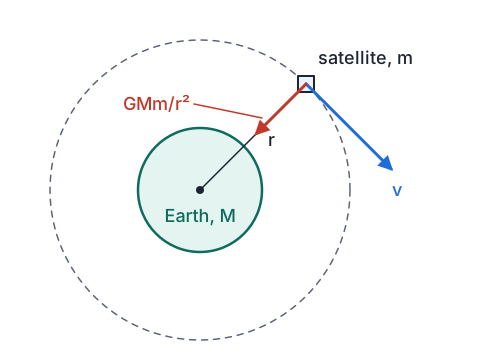
- For a satellite in a circular orbit, gravity is the only force and it supplies the centripetal force: GMm ÷ r² = mv² ÷ r.
- So v = √(GM ÷ r) and, using v = 2πr ÷ T, T² = 4π²r³ ÷ (GM): lower orbits are faster and have shorter periods, and the satellite's own mass cancels.
- The force is always at right angles to the velocity, so it does no work: it changes the direction of motion, not the speed, and no engine is needed to keep going.
- A geostationary satellite orbits above the equator once per sidereal day (86 164 s), so it stays over one spot above the equator; that is why satellite TV dishes in New Zealand all face roughly north and never move.
Try it: orbits and periods
Example: timing the Moon's orbit
- Use G = 6.67 × 10⁻¹¹ N m² kg⁻² and the NASA data below to calculate the Moon's orbital speed and period, and compare with the measured period.
| Quantity | Value |
|---|---|
| Mass of the Earth | 5.972 × 10²⁴ kg |
| Semimajor axis of the Moon's orbit | 3.844 × 10⁸ m |
| Sidereal orbital period of the Moon | 27.32 days |
- GMm ÷ r² = mv² ÷ r, so v = √(GM ÷ r)gravity supplies the centripetal force
- v = √(6.67 × 10⁻¹¹ × 5.972 × 10²⁴ ÷ 3.844 × 10⁸) = √(1.036 × 10⁶) = 1018 m s⁻¹
- T = 2πr ÷ v = 2π × 3.844 × 10⁸ ÷ 1018 = 2.373 × 10⁶ s
- 2.373 × 10⁶ ÷ 86 400 = 27.5 days, within 1% of the measured 27.32 daysthe small gap is because the Earth also moves round the barycentre
- v = 1.02 × 10³ m s⁻¹, T = 2.37 × 10⁶ s (27.5 days)
Example: the height of a geostationary orbit
- Find the orbital radius and the height above the surface of a geostationary satellite. Earth's mass is 5.97 × 10²⁴ kg and its radius 6.37 × 10⁶ m; the period is 86 164 s.
- r³ = GMT² ÷ (4π²)rearranged from T² = 4π²r³ ÷ (GM)
- r³ = 6.67 × 10⁻¹¹ × 5.97 × 10²⁴ × 86 164² ÷ (4π²) = 7.488 × 10²² m³
- r = ∛(7.488 × 10²²) = 4.215 × 10⁷ m
- height = 4.215 × 10⁷ − 6.37 × 10⁶ = 3.578 × 10⁷ m
- r = 4.22 × 10⁷ m, about 35 800 km above the equator
What Achieved, Merit and Excellence look like
- Achieved names a force or the direction of the acceleration; Merit links the forces to the centripetal force; Excellence connects the forces, the acceleration and what the person actually feels.
- Draw the free-body diagram first and say which force or resultant supplies mv² ÷ r.
| Grade | A model answer |
|---|---|
| Achieved | At the top the car is moving in a circle, so it accelerates downwards towards the centre of the hump. |
| Merit | The net force must point down to the centre, so the seat's upward reaction is less than the weight: mg − N = mv² ÷ r. The reaction is what the passengers feel as their weight, so they feel lighter. |
| Excellence | At the top the net force must be mv² ÷ r downwards, so N = mg − mv² ÷ r, which is smaller than mg. Passengers feel the seat's reaction, not gravity, so they feel lighter. As v rises N falls, and at v = √(gr) N is zero: weight alone supplies the centripetal force and they feel weightless. Any faster and gravity is too small to keep them on the circle, so the car leaves the road. |
Common mistakes
- The free-body diagram shows weight, tension and a centripetal force.Centripetal force is the resultant of the real forces, so draw only weight and tension; their sum points to the centre.
- For a satellite 700 km up, F = GMm ÷ (7.00 × 10⁵)².r is measured from Earth's centre: r = 6.37 × 10⁶ + 7.00 × 10⁵ = 7.07 × 10⁶ m.
- Astronauts in orbit are weightless because there is no gravity up there.Gravity is still about 90% of its surface value; they are in free fall with their craft, so nothing pushes on them.
- A heavier satellite must go faster to stay in the same orbit.The satellite's mass cancels in GMm ÷ r² = mv² ÷ r, so every satellite at radius r has the same speed.
Measure the centripetal force with a whirling eraser
You need: an empty ballpoint pen tube, 1.5 m of string, a rubber eraser, a bunch of keys, kitchen scales, a phone stopwatch, a tape measure
- Thread the string through the pen tube, tie the eraser to the top end and the keys to the bottom end; weigh the eraser and the keys on a kitchen scale.
- Mark the string 0.50 m above the tube with a knot or tape, then hold the tube and whirl the eraser in a horizontal circle above your head, adjusting the speed until the mark stays just at the top of the tube.
- Have a helper time 20 revolutions, then find T, v = 2πr ÷ T and the centripetal force m_eraser × v² ÷ r.
- Compare it with the weight of the keys, m_keys × 9.81, which is what pulls the string inwards.
- Look for: the two forces agree roughly, and with heavier keys you have to whirl faster to keep the radius the same.
Safety: Do this outside, well away from people and windows, and keep the circle above head height, because the eraser can fly off if the knot slips.
Your turn
A 0.050 kg ball on a string moves in a horizontal circle of radius 0.40 m, taking 0.50 s per revolution. Find the tension, ignoring gravity.
A bend of radius 120 m is banked at 12.0°. At what speed is no friction needed?
A roller coaster loop has radius 12.0 m at the top. What is the slowest the car can go at the top and still follow the track?
An 80.0 kg astronaut weighs 785 N on the Earth's surface. What is the gravitational force on her one Earth radius above the surface?
Show answer
1. v = 2πr ÷ T = 2π × 0.40 ÷ 0.50 = 5.03 m s⁻¹; T = mv² ÷ r = 0.050 × 5.03² ÷ 0.40 = 3.16 N. 2. tan θ = v² ÷ (rg), so v = √(rg tan θ) = √(120 × 9.81 × tan 12.0°) = √250.2 = 15.8 m s⁻¹. 3. At the slowest speed the track pushes with zero force and weight alone supplies the centripetal force: v = √(gr) = √(9.81 × 12.0) = 10.8 m s⁻¹. 4. One Earth radius above the surface she is twice as far from the centre, so the force is a quarter: 785 ÷ 4 = 196 N.
Exam-style question: an Earth observation satellite
- A satellite that images New Zealand's forests orbits 700 km above the Earth's surface in a circular orbit. Earth's mass is 5.97 × 10²⁴ kg, its radius 6.37 × 10⁶ m, and G = 6.67 × 10⁻¹¹ N m² kg⁻².
Show that the gravitational field strength at the satellite's height is 7.97 N kg⁻¹.
Calculate the satellite's orbital speed.
Calculate its orbital period in minutes.
Explain why the satellite keeps a constant speed without using its engines, even though a force acts on it the whole time.
Show answer
1. r = 6.37 × 10⁶ + 7.00 × 10⁵ = 7.07 × 10⁶ m; g = GM ÷ r² = 6.67 × 10⁻¹¹ × 5.97 × 10²⁴ ÷ (7.07 × 10⁶)² = 7.97 N kg⁻¹ (Achieved). 2. Gravity supplies the centripetal force, so v² = GM ÷ r, or v = √(gr) = √(7.966 × 7.07 × 10⁶) = 7.50 × 10³ m s⁻¹ (Merit). 3. T = 2πr ÷ v = 2π × 7.07 × 10⁶ ÷ 7505 = 5919 s, which is 98.7 minutes (Excellence for the full chain with the radius from Earth's centre). 4. The only force is gravity, pointing to the Earth's centre, which is at right angles to the velocity at every point of a circular orbit. A force at right angles to the motion does no work, so the kinetic energy and speed do not change; the force only changes the direction, which gives the centripetal acceleration that keeps the satellite on the circle. With no air resistance at this height, nothing removes energy, so no engine is needed (Excellence links the force direction, work and the circular path).
Gravity and Orbits
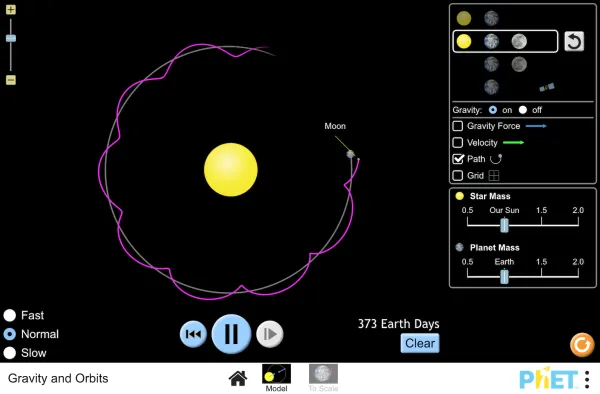
Full screen · PhET Interactive Simulations, University of Colorado Boulder, CC BY 4.0
Recap
- Circular motion needs a net force mv² ÷ r towards the centre, supplied by real forces.
- Banked curve with no friction: tan θ = v² ÷ (rg).
- Vertical circle: T + mg = mv² ÷ r at the top, T − mg = mv² ÷ r at the bottom; minimum speed at the top is √(gr).
- Gravity: F = GMm ÷ r², with r from centre to centre.
- Orbits: GMm ÷ r² = mv² ÷ r gives v = √(GM ÷ r) and T² = 4π²r³ ÷ (GM).
| Formula | Use it for |
|---|---|
| v = 2πr ÷ T = rω | speed in a circle |
| a = v² ÷ r, F = mv² ÷ r | centripetal acceleration and force |
| tan θ = v² ÷ (rg) | banked curves without friction |
| F = GMm ÷ r² | gravitational force |
| v = √(GM ÷ r) | orbital speed |
Report a mistake
How is NCEA Level 3 maths going?
See the NCEA Level 3 maths guide