Rotational motion
What this lesson covers
- Angular displacement θ (rad), angular velocity ω (rad s⁻¹) and angular acceleration α (rad s⁻²) are linked to motion at the rim by d = rθ, v = rω and a = rα.
- With constant angular acceleration, four equations link θ, ωi, ωf, α and t, exactly like the linear ones.
- A net torque τ = Fr causes angular acceleration, τ = Iα, where the rotational inertia I depends on how far the mass sits from the axis.
- Angular momentum L = Iω is conserved when no external torque acts, so making I smaller makes ω larger.
- A rotating object has rotational kinetic energy ½Iω², and a rolling object shares its energy between moving along and spinning.
Angles, angular velocity and angular acceleration
- Measure angles in radians: one revolution is 2π rad, so θ = (number of turns) × 2π.
- Angular velocity ω is the rate of change of angle (rad s⁻¹), and angular acceleration α is the rate of change of ω (rad s⁻²).
- Every point on a rigid object has the same θ, ω and α, but points further out move further and faster: d = rθ, v = rω, a = rα.
- To change revolutions per minute into rad s⁻¹, multiply by 2π and divide by 60.
| Straight line | Rotation | Link |
|---|---|---|
| d (m) | θ (rad) | d = rθ |
| v (m s⁻¹) | ω (rad s⁻¹) | v = rω |
| a (m s⁻²) | α (rad s⁻²) | a = rα |
| F = ma | τ = Iα | τ = Fr |
| p = mv | L = Iω | L = mvr for a point mass |
| Ek = ½mv² | Ek(rot) = ½Iω² |
Constant angular acceleration
- When α is constant, the four equations of motion carry straight over with θ, ωi, ωf, α and t.
- As before, list the three quantities you know and the one you want, then use the equation without the fifth.
- Choose one direction of turning as positive; a wheel slowing down has a negative α.
| Equation | Leaves out |
|---|---|
| ωf = ωi + αt | θ |
| θ = ωi t + ½αt² | ωf |
| θ = ½(ωi + ωf)t | α |
| ωf² = ωi² + 2αθ | t |
Example: a washing machine spin cycle
- A washing machine drum of radius 0.250 m speeds up uniformly from rest to 1200 revolutions per minute in 15.0 s.
- Find its final angular velocity, its angular acceleration, how many turns it makes, and the speed of the drum wall at full speed.
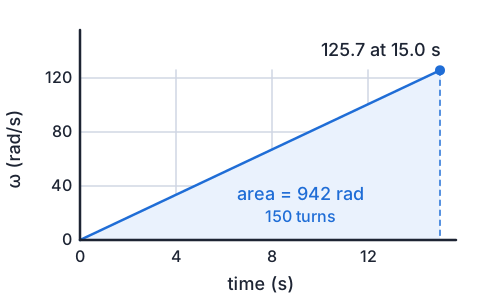
- ωf = 1200 × 2π ÷ 60 = 125.7 rad s⁻¹
- α = (ωf − ωi) ÷ t = 125.7 ÷ 15.0 = 8.38 rad s⁻²
- θ = ½(ωi + ωf)t = ½ × (0 + 125.7) × 15.0 = 942.5 radthe area under the ω against t graph
- turns = 942.5 ÷ 2π = 150
- v = rω = 0.250 × 125.7 = 31.4 m s⁻¹
- average speed is 600 rpm, which is 10 turns per second for 15.0 s, so 150 turns
- 125.7 rad s⁻¹, 8.38 rad s⁻², 150 turns, 31.4 m s⁻¹
Try it: angle as the area under ω
Torque and rotational inertia
- A torque is the turning effect of a force: τ = Fr, where r is the perpendicular distance from the axis to the line of the force (N m).
- A net torque gives an angular acceleration, τ = Iα, just as a net force gives F = ma.
- The rotational inertia I (kg m²) is the resistance to changes in spin. For a point mass I = mr², and for an object it is the sum of mr² over every part, so mass far from the axis counts much more.
- That is why a hoop is harder to spin up than a solid disc of the same mass and radius: all of the hoop's mass is at the rim. The exam gives you I or tells you how to work it out.
Try it: torques and balance
Example: spinning up a bicycle wheel
- A mechanic pushes along the tyre of a bicycle wheel with a steady 12.0 N force, tangent to the rim at 0.330 m from the axle. The wheel's rotational inertia is 0.110 kg m² and friction is negligible.
- Find the torque, the angular acceleration and the angular velocity after 0.500 s from rest.
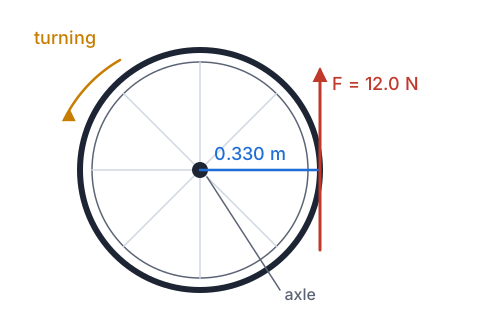
- τ = Fr = 12.0 × 0.330 = 3.96 N mthe force is tangential, so r is the perpendicular distance
- α = τ ÷ I = 3.96 ÷ 0.110 = 36.0 rad s⁻²
- ωf = ωi + αt = 0 + 36.0 × 0.500 = 18.0 rad s⁻¹
- rim speed = rω = 0.330 × 18.0 = 5.94 m s⁻¹, a sensible hand speed
- τ = 3.96 N m, α = 36.0 rad s⁻², ω = 18.0 rad s⁻¹
Angular momentum and its conservation
- Angular momentum is L = Iω for a spinning object, and L = mvr for a point mass moving at speed v at a perpendicular distance r from the axis (kg m² s⁻¹).
- Torque changes angular momentum: τ = ΔL ÷ Δt. With no external torque, the total angular momentum of a system stays constant.
- So if a spinning system pulls mass inwards, I falls and ω rises in proportion: Iiωi = Ifωf.
- When something lands on or grips a turntable, use the same law with the new object's L before (often mvr) and the combined I after.
Example: a skater pulls in her arms
- A figure skater spins at 6.00 rad s⁻¹ with her arms out, rotational inertia 3.60 kg m². She pulls her arms in, reducing her rotational inertia to 1.20 kg m².
- Find her new angular velocity and the change in her rotational kinetic energy.
- Iiωi = Ifωf, so 3.60 × 6.00 = 1.20 × ωfthe ice exerts almost no torque about her vertical axis
- ωf = 21.6 ÷ 1.20 = 18.0 rad s⁻¹
- Ek before = ½ × 3.60 × 6.00² = 64.8 J; Ek after = ½ × 1.20 × 18.0² = 194.4 J
- I fell by a factor of 3, ω rose by 3, so Ek = ½Iω² rose by 3
- 18.0 rad s⁻¹; Ek rises by 129.6 J, about 130 J, supplied by the work her muscles do pulling her arms in
Rotational kinetic energy and rolling
- A spinning object stores rotational kinetic energy Ek(rot) = ½Iω², with ω in rad s⁻¹.
- An object rolling without slipping both moves along and spins, with v = rω, so its energy is ½mv² + ½Iω².
- Rolling down a slope, mgh is shared between the two, so an object with a bigger share in spinning (a larger I for its mass and radius) gains less speed and arrives later.
- Energy is conserved in every rotating system unless friction does work, so use it whenever heights, speeds and spins are linked.
Example: a cylinder rolls down a ramp
- A solid cylinder (I = ½mr²) rolls without slipping from rest down a ramp of vertical height 1.20 m.
- Find its speed at the bottom, and compare it with an object that slides down without friction.
- mgh = ½mv² + ½Iω² = ½mv² + ½ × ½mr² × (v ÷ r)²rolling without slipping means ω = v ÷ r
- mgh = ½mv² + ¼mv² = ¾mv², so v = √(4gh ÷ 3)m and r both cancel
- v = √(4 × 9.81 × 1.20 ÷ 3) = √15.70 = 3.96 m s⁻¹
- sliding: v = √(2gh) = √(2 × 9.81 × 1.20) = 4.85 m s⁻¹
- a third of the cylinder's energy is spin, so it is slower
- 3.96 m s⁻¹ rolling, against 4.85 m s⁻¹ sliding
What Achieved, Merit and Excellence look like
- Achieved states one correct idea; Merit gives the reason; Excellence links the torque, the rotational inertia, angular momentum and energy in this situation.
- Always say why angular momentum is conserved (no external torque), not just that it is.
| Grade | A model answer |
|---|---|
| Achieved | Tucking makes her spin faster because her mass is closer to the axis. |
| Merit | In the air no external torque acts about her centre of mass, so her angular momentum Iω stays constant. Tucking brings mass closer to the axis, so I decreases and ω must increase. |
| Excellence | With no external torque about her centre of mass, L = Iω is conserved. Tucking moves mass closer to the axis, so I falls and ω rises by the same factor. Ek(rot) = ½Iω² = ½Lω, and since L is constant while ω rises, her rotational kinetic energy increases; the extra energy comes from the work her muscles do pulling her limbs inwards, since they must supply the centripetal force on her arms and legs as they move in. |
Common mistakes
- 1200 rpm is put straight into ωf = ωi + αt as ω = 1200.Convert to rad s⁻¹ first: 1200 × 2π ÷ 60 = 125.7 rad s⁻¹.
- Angular momentum is conserved, so rotational kinetic energy is conserved too.L is conserved with no external torque, but Ek(rot) changes when I changes; pulling in raises it, a lump landing on a turntable lowers it.
- The torque is F × r, using the distance to where the force acts, even when the force is at an angle.Use the perpendicular distance from the axis to the line of the force, or the force component at right angles to r.
- The calculator is in degree mode for the trig in a rotation problem.Angular quantities are in radians, so set the calculator to radians for sin ωt and similar.
Race full and empty tins down a ramp
You need: a long tray or chopping board, a pile of books, an unopened can of soup, an empty can with both ends removed, a roll of sticky tape, a ruler, a phone stopwatch
- Prop one end of the board on books to make a gentle ramp on the floor, about 10 cm high at the top.
- Hold two objects at the top with a ruler across them, then lift the ruler so they start together.
- Race the full can against the empty open-ended can, then the tape roll against each, three times each, and note the order they arrive.
- Predict the order first: the empty can and the tape roll have their mass near the rim, so a larger share of their energy goes into spinning.
- Look for: the full can wins, the tape roll comes next and the empty can comes last, because the further out the mass sits, the bigger the share of energy that goes into spinning; the objects' masses do not decide the order.
Safety: Use a can with its ends removed by a safe-edge opener or have an adult check it, because a freshly cut can rim is sharp enough to cut fingers.
Your turn
A wind turbine turns at 15.0 revolutions per minute. Find its angular velocity and the speed of a blade tip 40.0 m from the hub.
A fan spinning at 25.0 rad s⁻¹ slows uniformly to rest in 10.0 s. Find its angular acceleration and how many turns it makes.
A net torque of 0.900 N m acts on a wheel with rotational inertia 0.0450 kg m². Find its angular acceleration.
A skater spinning at 3.00 rad s⁻¹ changes her rotational inertia from 4.00 kg m² to 1.60 kg m². Find her new angular velocity and her rotational kinetic energy before and after.
Show answer
1. ω = 15.0 × 2π ÷ 60 = 1.571 rad s⁻¹, about 1.57 rad s⁻¹; v = rω = 40.0 × 1.571 = 62.8 m s⁻¹. 2. α = (0 − 25.0) ÷ 10.0 = −2.50 rad s⁻²; θ = ½(25.0 + 0) × 10.0 = 125 rad, and 125 ÷ 2π = 19.9 turns. 3. α = τ ÷ I = 0.900 ÷ 0.0450 = 20.0 rad s⁻². 4. ωf = 4.00 × 3.00 ÷ 1.60 = 7.50 rad s⁻¹; Ek before = ½ × 4.00 × 3.00² = 18.0 J, after = ½ × 1.60 × 7.50² = 45.0 J.
Exam-style question: the potter's wheel
- A potter's wheel has a rotational inertia of 0.850 kg m². The motor brings it from rest to 12.0 rad s⁻¹ in 3.00 s with constant angular acceleration.
Calculate the net torque on the wheel while it speeds up.
Calculate how many turns the wheel makes in those 3.00 s.
With the motor off and the wheel spinning freely at 12.0 rad s⁻¹, the potter drops a 4.00 kg disc of clay, radius 0.120 m, centrally onto it. The clay's rotational inertia is ½mr². Calculate the new angular velocity.
Explain why the rotational kinetic energy of the system decreases when the clay lands, even though angular momentum is conserved.
Show answer
1. α = 12.0 ÷ 3.00 = 4.00 rad s⁻²; τ = Iα = 0.850 × 4.00 = 3.40 N m (Achieved). 2. θ = ½(0 + 12.0) × 3.00 = 18.0 rad, and 18.0 ÷ 2π = 2.86 turns (Achieved). 3. I_clay = ½ × 4.00 × 0.120² = 0.0288 kg m²; with no external torque, 0.850 × 12.0 = (0.850 + 0.0288) × ωf, so ωf = 10.2 ÷ 0.8788 = 11.6 rad s⁻¹ (Merit for the method, Excellence with the clay's I included). 4. Ek(rot) before = ½ × 0.850 × 12.0² = 61.2 J; after = ½ × 0.8788 × 11.6² = 59.2 J. When the clay lands it is not spinning, so the wheel's surface slides under it at first; friction between them gives the clay a torque that speeds it up and an equal and opposite torque that slows the wheel. These internal torques cancel, so angular momentum is conserved, but the sliding friction turns about 2.0 J of kinetic energy into heat, like an inelastic collision (Excellence links the internal torques to conservation of L and the friction to the energy loss).
Recap
- Work in radians; d = rθ, v = rω, a = rα link the rim to the rotation.
- The rotational equations of motion are the linear ones with θ, ω and α.
- τ = Fr and τ = Iα; mass far from the axis makes I large.
- With no external torque, L = Iω is conserved: smaller I, faster spin.
- Ek(rot) = ½Iω²; rolling objects share their energy between moving and spinning.
| Formula | Use it for |
|---|---|
| ω = 2πf, v = rω | spin rate and rim speed |
| ωf = ωi + αt, θ = ½(ωi + ωf)t | constant angular acceleration |
| τ = Fr = Iα | torque and angular acceleration |
| L = Iω, Iiωi = Ifωf | angular momentum |
| Ek(rot) = ½Iω² | rotational kinetic energy |
The maths behind it
Report a mistake
How is NCEA Level 3 maths going?
See the NCEA Level 3 maths guide