Modern physics: photons, energy levels and the nucleus
What this lesson covers
- How this internal is assessed, and what lifts an answer from Achieved to Excellence.
- Photons: E = hf = hc/λ, and energies in joules and electronvolts.
- The photoelectric effect, the work function and threshold frequency, and why it shows light behaves as particles.
- The Bohr model of hydrogen, energy levels, ionisation, and emission and absorption line spectra.
- The strong interaction, mass defect and binding energy, and why both fission and fusion release energy.
- Wave-particle duality for light and for electrons, with the de Broglie wavelength λ = h/p.
How this internal works
- Your school assesses this standard, usually with a written test or task in class on situations you have not met before, using the formulas and constants it gives you.
- Achieved shows awareness of a simple facet: a correct calculation or a correct statement about what happens.
- Merit explains: it says why, using the model (photons, energy levels, binding energy) in a full chain of reasoning.
- Excellence connects ideas: for example linking photon energy, the work function and energy conservation to explain exactly what an experiment shows and what it rules out.
Photons and the electronvolt
- Light is emitted and absorbed in packets called photons; each carries energy E = hf = hc/λ, where h = 6.63 × 10⁻³⁴ J s is Planck's constant.
- Higher frequency (shorter wavelength) means more energy per photon: a 300 nm ultraviolet photon has more than twice the energy of a 650 nm red one.
- Atomic energies are tiny in joules, so we also use the electronvolt: 1 eV = 1.60 × 10⁻¹⁹ J, the energy an electron gains across 1 V.
- Brighter light of the same colour means more photons per second, not more energetic photons.
Try it: photon energy across the spectrum
The photoelectric effect
- Light on a clean metal surface can eject electrons, but only if its frequency is above a threshold f₀ for that metal; below f₀ nothing comes off, however bright the light.
- Above f₀ electrons come off at once, even in very dim light, and their maximum kinetic energy rises with frequency but not with brightness.
- A wave model predicts the opposite (bright light of any colour should work, given time), so these results show light arrives as photons.
- Each electron absorbs one photon: Ek(max) = hf − φ, where the work function φ is the least energy needed to free an electron from the surface, and φ = hf₀.
- Brighter light gives more photons, so more electrons per second and a bigger current, but the same maximum energy for each.
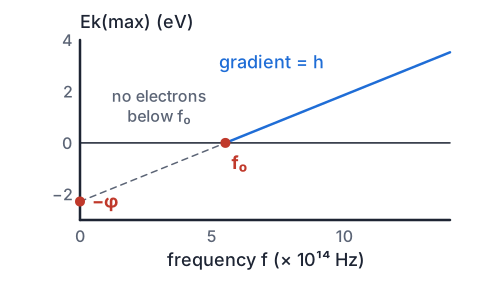
Try it: change the work function
Example: ultraviolet on sodium
- Light of wavelength 300 nm falls on sodium, which has a work function of 2.28 eV.
- Find the photon energy, the maximum kinetic energy of the electrons and the threshold wavelength.
- E = hc ÷ λ = (6.63 × 10⁻³⁴ × 3.00 × 10⁸) ÷ (300 × 10⁻⁹) = 6.63 × 10⁻¹⁹ J
- φ = 2.28 × 1.60 × 10⁻¹⁹ = 3.648 × 10⁻¹⁹ Jconvert eV to J before subtracting
- Ek(max) = 6.63 × 10⁻¹⁹ − 3.648 × 10⁻¹⁹ = 2.98 × 10⁻¹⁹ J = 1.86 eV
- f₀ = φ ÷ h = 3.648 × 10⁻¹⁹ ÷ 6.63 × 10⁻³⁴ = 5.50 × 10¹⁴ Hz
- λ₀ = c ÷ f₀ = 3.00 × 10⁸ ÷ 5.50 × 10¹⁴ = 5.45 × 10⁻⁷ m = 545 nmgreen light or anything bluer will work
Energy levels and line spectra
- In the Bohr model the electron in a hydrogen atom can only have certain energies, En = −13.6/n² eV, with n = 1 the ground state.
- The energies are negative because the electron is bound: 0 eV means just free, so 13.6 eV is the ionisation energy of hydrogen from the ground state.
- An electron dropping from a higher level to a lower one emits a single photon with exactly the energy difference: hf = E_upper − E_lower.
- Because only certain differences exist, a hot gas emits only certain wavelengths: a line spectrum, a fingerprint of the element.
- Shine white light through a cool gas and it absorbs the same wavelengths, lifting electrons up: dark lines in a continuous spectrum, which is how we know what the Sun is made of.
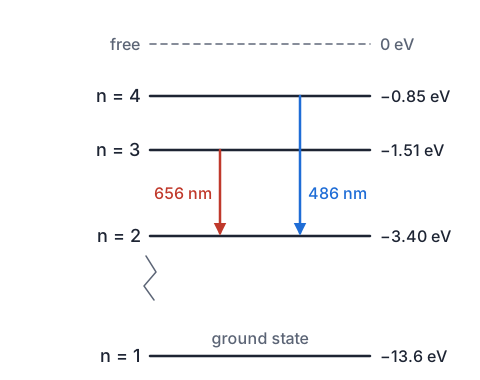
Example: hydrogen's red line
- An electron in hydrogen falls from n = 3 to n = 2.
- Find the energy of the photon in eV and in J, and its wavelength.
- E₃ = −13.6 ÷ 9 = −1.51 eV, E₂ = −13.6 ÷ 4 = −3.40 eV
- ΔE = −1.51 − (−3.40) = 1.89 eV
- ΔE = 1.89 × 1.60 × 10⁻¹⁹ = 3.02 × 10⁻¹⁹ J
- λ = hc ÷ ΔE = 1.989 × 10⁻²⁵ ÷ 3.02 × 10⁻¹⁹ = 6.58 × 10⁻⁷ m
- λ = 658 nm, red
- the measured line is 656 nm; the small gap comes from rounding h, c and the energies
Binding energy and mass defect
- Protons in a nucleus repel each other electrically (Coulomb repulsion), but the strong interaction, a very short-range attraction between all nucleons, holds the nucleus together.
- A nucleus has less mass than its separate protons and neutrons; this mass defect Δm is the binding energy, by E = Δmc², the energy needed to pull it apart.
- Binding energy per nucleon shows how tightly each nucleon is held; it peaks near iron-56 at about 8.8 MeV.
- Any reaction that moves nuclei towards the peak releases energy: splitting a heavy nucleus (fission) or joining light ones (fusion).
- Mass-energy is conserved: the products have less mass than the reactants, and the missing mass appears as kinetic energy of the products and as gamma rays.
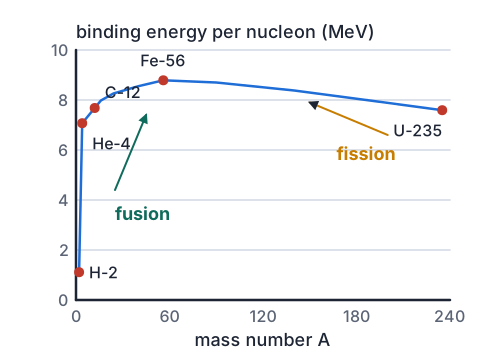
Example: binding energy of helium-4
- A helium-4 nucleus has a mass of 4.00151 u. A proton has a mass of 1.00728 u and a neutron 1.00866 u, with 1 u = 1.661 × 10⁻²⁷ kg.
- Find the mass defect, the binding energy and the binding energy per nucleon.
- separate nucleons: 2 × 1.00728 + 2 × 1.00866 = 4.03188 u
- Δm = 4.03188 − 4.00151 = 0.03037 u = 0.03037 × 1.661 × 10⁻²⁷ = 5.044 × 10⁻²⁹ kg
- E = Δmc² = 5.044 × 10⁻²⁹ × (3.00 × 10⁸)² = 4.54 × 10⁻¹² J
- in MeV: 4.54 × 10⁻¹² ÷ 1.60 × 10⁻¹³ = 28.4 MeV1 MeV = 1.60 × 10⁻¹³ J
- per nucleon: 28.4 ÷ 4 = 7.1 MeV
Fission and fusion
- Fission: a slow neutron is absorbed by uranium-235, which splits into two medium nuclei and two or three neutrons, releasing about 200 MeV; the neutrons can trigger further splits in a chain reaction.
- Fusion: very light nuclei such as deuterium and tritium join to make helium-4 and a neutron, releasing 17.6 MeV; it needs temperatures of tens of millions of degrees or more so the nuclei move fast enough to get close despite their repulsion.
- Per kilogram of fuel, fusion releases several times more energy than fission, because the binding energy curve rises so steeply at the light end.
- The Sun runs on fusion; nuclear power stations run on fission, though Aotearoa New Zealand has never built one.
| Fission | Fusion | |
|---|---|---|
| Nuclei | one heavy splits | two light join |
| Example | U-235 + n → Ba-141 + Kr-92 + 3n | H-2 + H-3 → He-4 + n |
| Energy per reaction | about 200 MeV | 17.6 MeV |
| Why energy is released | products nearer the iron peak | product far higher on the curve |
Try it: fission or fusion?
Wave-particle duality
- Light interferes and diffracts like a wave (the double slit), but is emitted and absorbed in photons like particles (the photoelectric effect); it needs both models.
- De Broglie proposed that matter behaves the same way, with wavelength λ = h/p = h/(mv); electrons fired at a crystal diffract into rings, confirming it.
- An electron at 2.00 × 10⁶ m s⁻¹ has λ = 6.63 × 10⁻³⁴ ÷ (9.11 × 10⁻³¹ × 2.00 × 10⁶) = 3.64 × 10⁻¹⁰ m, about the spacing of atoms, which is why crystals diffract electrons.
- Electron microscopes use this: electron wavelengths are many thousands of times shorter than visible light, so they resolve far finer detail.
- Which behaviour you see depends on the experiment: travelling and interfering, the wave model; arriving and transferring energy, the particle model.
Example: one question at three grades
- Question: red light, however bright, ejects no electrons from zinc, but dim ultraviolet does. Explain why.
- Notice how Excellence ties together photon energy, the one-photon-one-electron rule and the work function, and says why brightness cannot help.
| Grade | A model answer |
|---|---|
| Achieved | Red light's frequency is below zinc's threshold frequency, so no electrons are emitted. |
| Merit | Light comes as photons with E = hf. A red photon has less energy than zinc's work function, so it cannot free an electron; an ultraviolet photon has more, so it can. |
| Excellence | Each electron absorbs a single photon, of energy hf. A red photon's energy is less than zinc's work function, so no electron gets enough to escape. Brighter red light only means more photons, each still too weak, and an electron cannot add the energy of two. Ultraviolet photons each carry more than the work function, so even dim UV ejects electrons at once, with Ek = hf − φ. |
Common mistakes
- Brighter light gives the photoelectrons more kinetic energy.Brightness changes the number of photons; each electron's maximum energy depends only on frequency, Ek = hf − φ.
- Ek = 6.63 × 10⁻¹⁹ − 2.28 = 6.63 × 10⁻¹⁹ J.Put both in the same unit first: 2.28 eV = 3.65 × 10⁻¹⁹ J, then subtract.
- The electron drops from n = 3 to n = 2, so the photon has 13.6 ÷ 3 − 13.6 ÷ 2 eV.Levels go as 1/n²: E₃ − E₂ = −13.6/9 − (−13.6/4) = 1.89 eV.
- Fission releases energy because the nucleus has extra energy stored in it.The products have greater binding energy per nucleon, so less total mass; the missing mass becomes energy.
See line spectra with a CD
You need: an old CD or DVD, a fluorescent or compact fluorescent lamp if you have one, an ordinary LED torch or bulb, a darkened room
- Stand about 2 m from a fluorescent lamp in a darkened room and hold the CD close to your eye, tilted so you see the lamp's light reflected off the shiny side.
- Tilt it until the colours spread out beside the reflection, then look closely for bright separate lines in green, orange and violet.
- Do the same with a white LED torch shone at a wall, looking at the patch of light on the wall rather than the torch.
- Compare the two spectra and sketch where the bright lines are.
- Look for: the fluorescent lamp shows sharp bright lines (from atoms in the lamp, mainly mercury, dropping between energy levels) on top of its glow, while the LED gives a smooth band of colour.
Safety: Never look at the Sun or straight into an LED torch through the disc, because focused bright light can damage your eyes.
Your turn
Find the energy in joules of a 450 nm photon. Use h = 6.63 × 10⁻³⁴ J s and c = 3.00 × 10⁸ m s⁻¹.
Give that energy in electronvolts.
Those photons fall on a metal with a work function of 2.10 eV. Find the electrons' maximum kinetic energy in eV.
An electron in hydrogen falls from n = 4 to n = 2. Find the photon energy in eV.
The deuterium nucleus has a mass defect of 0.002388 u. Find its binding energy in MeV, using 1 u = 931.5 MeV.
Show answer
1. E = hc ÷ λ = 1.989 × 10⁻²⁵ ÷ 450 × 10⁻⁹ = 4.42 × 10⁻¹⁹ J. 2. 4.42 × 10⁻¹⁹ ÷ 1.60 × 10⁻¹⁹ = 2.76 eV. 3. Ek(max) = 2.76 − 2.10 = 0.66 eV. 4. E₄ = −13.6 ÷ 16 = −0.85 eV, E₂ = −3.40 eV, so ΔE = −0.85 − (−3.40) = 2.55 eV (a blue-green line at 486 nm). 5. E = 0.002388 × 931.5 = 2.22 MeV.
Rutherford Scattering
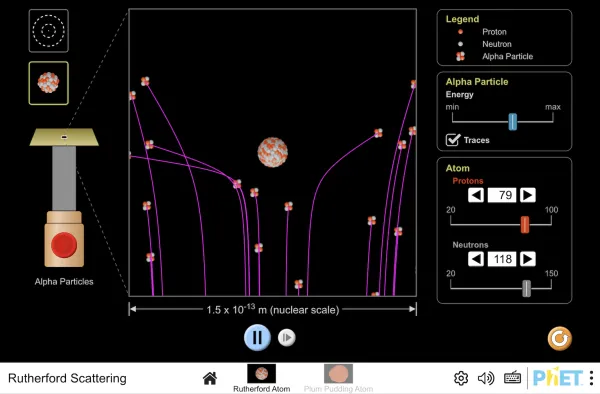
Full screen · PhET Interactive Simulations, University of Colorado Boulder, CC BY 4.0
Recap
- Photons: E = hf = hc/λ; brightness is the number of photons, frequency is the energy of each.
- Photoelectric effect: one photon per electron, Ek(max) = hf − φ, nothing below f₀ however bright.
- Hydrogen: En = −13.6/n² eV; each drop between levels emits one photon of the energy difference, giving line spectra.
- Binding energy = Δmc²; fission and fusion both move nuclei towards the iron peak and release energy.
- Light and electrons are both waves and particles: λ = h/p.
| Formula | Use it for |
|---|---|
| E = hf = hc/λ | photon energy |
| Ek(max) = hf − φ | photoelectric effect |
| En = −13.6/n² eV | hydrogen energy levels |
| E = Δmc² | binding energy, energy released |
| λ = h/p | de Broglie wavelength |
Report a mistake
How is NCEA Level 3 maths going?
See the NCEA Level 3 maths guide