Simple harmonic motion
What this lesson covers
- Motion is simple harmonic when the acceleration is proportional to the displacement from equilibrium and always directed back towards it: a = −ω²y.
- The period of a mass on a spring is 2π√(m ÷ k) and of a simple pendulum 2π√(l ÷ g); neither depends on the amplitude.
- Displacement, velocity and acceleration are sine or cosine functions of time, a quarter cycle out of step with each other.
- A reference circle turns SHM into a phasor of length A rotating at ω, which gives the time between any two positions.
- Damping removes energy and shrinks the amplitude; a driving force at the natural frequency causes resonance.
The condition for SHM
- An object oscillates about an equilibrium position, where the net force on it is zero; its displacement y is measured from there.
- The motion is simple harmonic when the net (restoring) force, and so the acceleration, is proportional to the displacement and always points back towards equilibrium: a = −ω²y.
- The minus sign says the acceleration is opposite to the displacement; ω is the angular frequency, ω = 2πf = 2π ÷ T, in rad s⁻¹.
- A mass on a spring obeys this exactly because the spring force is −ky (Hooke's law); a pendulum obeys it closely only for small angles, below about 10°.
Periods of springs and pendulums
- For a mass m on a spring of stiffness k: T = 2π√(m ÷ k). A heavier mass or a softer spring gives a longer period.
- For a simple pendulum of length l (to the centre of the bob): T = 2π√(l ÷ g). The mass of the bob does not matter.
- In SHM the period does not depend on the amplitude: a bigger swing has further to go but a bigger restoring force, so it moves faster and takes the same time.
Try it: time a pendulum
Example: a car bouncing on its suspension
- One corner of a car carries 350 kg on a suspension spring of stiffness 2.50 × 10⁴ N m⁻¹. Model it as a mass on a spring with no damping.
- Find the period, the frequency and the angular frequency of the bounce.
- T = 2π√(m ÷ k) = 2π√(350 ÷ 2.50 × 10⁴) = 2π × 0.1183 = 0.743 s
- f = 1 ÷ T = 1 ÷ 0.7434 = 1.35 Hz
- ω = 2πf = 2π × 1.345 = 8.45 rad s⁻¹
- ω = √(k ÷ m) = √(71.43) = 8.45 rad s⁻¹ agrees
- T = 0.743 s, f = 1.35 Hz, ω = 8.45 rad s⁻¹
Displacement, velocity and acceleration over time
- Starting at equilibrium and moving positive: y = A sin ωt, v = Aω cos ωt and a = −Aω² sin ωt.
- Starting from rest at the positive extreme: y = A cos ωt, v = −Aω sin ωt and a = −Aω² cos ωt.
- Velocity is a quarter cycle ahead of displacement: it is greatest (Aω) as the object passes equilibrium and zero at the extremes.
- Acceleration is always opposite to displacement: zero at equilibrium and greatest (Aω²) at the extremes, where the restoring force is biggest.
- Use radian mode on your calculator for every sin ωt and cos ωt.
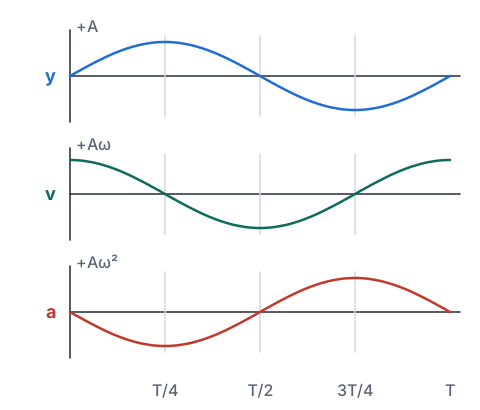
Try it: y, v and a over time
Reference circles and phasors
- Picture a phasor, an arrow of length A, rotating anticlockwise at angular velocity ω. Its projection on the vertical axis moves up and down in exactly the SHM of the object.
- The angle it has turned through is ωt, so a time between two positions is (angle swept in radians) ÷ ω, or that fraction of 2π times the period.
- Mark the start and end projections, draw the phasor at each, find the angle between them with trigonometry, then divide by ω.
- The phasor's tip moves at speed Aω, and its vertical component is the object's velocity, so the speed at displacement y is ω√(A² − y²).
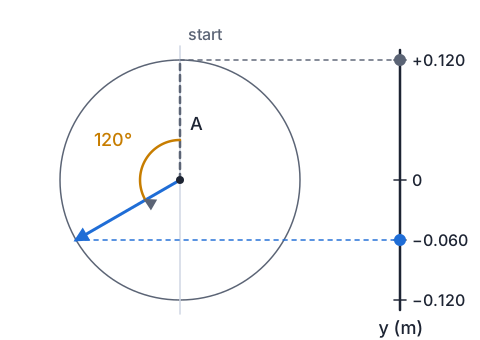
Example: timing with a reference circle
- A mass on a spring oscillates with amplitude 0.120 m and period 1.60 s. It is released from rest at y = +0.120 m.
- Find how long it takes to first reach y = −0.060 m, and its speed there.
- ω = 2π ÷ T = 2π ÷ 1.60 = 3.927 rad s⁻¹
- y = A cos ωt, so −0.060 = 0.120 cos ωt and cos ωt = −0.500released from rest at the top, so use cos
- ωt = cos⁻¹(−0.500) = 2.094 rad (120°)
- t = 2.094 ÷ 3.927 = 0.533 s
- 120° is a third of a circle, and 1.60 ÷ 3 = 0.533 s
- v = ω√(A² − y²) = 3.927 × √(0.120² − 0.060²) = 3.927 × 0.1039 = 0.408 m s⁻¹
- 0.533 s; 0.408 m s⁻¹ (moving downwards)
Energy in SHM
- Without damping the total energy stays constant and swaps between kinetic and potential energy every quarter cycle.
- For a spring, the total energy is ½kA²: all elastic potential energy at the extremes, and all kinetic energy, ½mv_max², at equilibrium.
- Since ½mv_max² = ½kA² and ω² = k ÷ m, this gives v_max = Aω again, the same result as from the velocity equation.
- For a pendulum, the energy swaps between gravitational potential energy at the ends of the swing and kinetic energy at the bottom.
Damping, driven oscillations and resonance
- Real oscillators lose energy to friction and air resistance, so the amplitude shrinks over time while the period stays almost the same. This is damping.
- Light damping lets it oscillate many times; critical damping returns it to equilibrium as fast as possible with no overshoot (car shock absorbers aim for this); heavy damping returns it slowly.
- A driven oscillator is pushed by a repeating force. When the driving frequency equals the natural frequency, each push is in step with the motion, so energy goes in every cycle and the amplitude grows: this is resonance.
- The amplitude stops growing when the energy lost to damping each cycle equals the energy put in, so heavier damping gives a smaller, broader resonance peak.
- Te Papa and Parliament Buildings in Wellington sit on base isolators, rubber and lead bearings that make the building's natural period much longer than the period of typical earthquake shaking, so resonance is avoided, and the lead absorbs energy as damping.
What Achieved, Merit and Excellence look like
- Achieved states one correct idea; Merit explains it with a force or an energy argument; Excellence links both forces and energy to what is seen.
- For damping and resonance questions, always say where the energy goes or comes from.
| Grade | A model answer |
|---|---|
| Achieved | Shock absorbers take energy out of the bouncing, so the car stops bouncing quickly. |
| Merit | The shock absorber exerts a force opposing the motion of the car body, so it does negative work and turns the kinetic energy of the bounce into heat in its oil. With worn ones, little energy is removed each cycle, so the bounce dies away slowly. |
| Excellence | After a bump the spring supplies a restoring force, so the body oscillates in SHM at its natural frequency. The shock absorber exerts a force opposite to the velocity, doing negative work every cycle, so the energy of oscillation is converted to heat and the amplitude falls; good ones are close to critical damping, so the body settles with little or no overshoot. Worn ones exert less force, so less energy is removed each cycle, the damping is light and the car keeps bouncing several times. |
Common mistakes
- cos⁻¹(−0.500) in degree mode gives 120, so t = 120 ÷ 3.927 = 30.6 s.ωt is in radians, so set the calculator to radians before any sin ωt or cos ωt.
- The acceleration is zero at the extremes because the object stops there.The velocity is zero at the extremes, but the restoring force and acceleration are greatest there, Aω².
- Using y = A sin ωt for a mass released from rest at the top.Choose the function from the start: from rest at +A use y = A cos ωt, from equilibrium use y = A sin ωt.
- A pendulum with a heavier bob or a bigger swing has a longer period.T = 2π√(l ÷ g) depends only on length and g, for small swings; mass and amplitude cancel.
Measure g with a pendulum
You need: 1.2 m of string, a bunch of keys, a tape measure, a doorframe or table edge, sticky tape, a phone stopwatch
- Tape the string to the top of a doorframe so it hangs freely, tie the keys to the end and measure the length from the top to the middle of the keys.
- Pull the keys aside by about a tenth of the string length (a small angle) and release; time 20 complete swings and divide by 20 to get T.
- Repeat for four different lengths, from about 0.30 m to 1.0 m.
- For each length work out g = 4π²l ÷ T²; then repeat the 1.0 m length with a 30 cm pull-aside and compare the period.
- Look for: g comes out close to 9.8 m s⁻², and the period hardly changes with the size of the swing while it stays small.
Safety: Keep the swinging keys away from faces and screens and stand to the side of the swing, because a heavy bunch of keys moving fast can hurt an eye or crack a screen.
Your turn
Find the period of a simple pendulum 0.800 m long.
A 0.500 kg mass hangs on a spring of stiffness 20.0 N m⁻¹. Find the period.
An object oscillates in SHM with amplitude 5.00 cm and period 0.400 s. Find its maximum speed and maximum acceleration.
A 0.300 kg mass on a spring of stiffness 120 N m⁻¹ oscillates with amplitude 0.0500 m. Find the total energy and the speed when y = 0.0300 m.
Show answer
1. T = 2π√(0.800 ÷ 9.81) = 1.79 s. 2. T = 2π√(0.500 ÷ 20.0) = 0.993 s. 3. ω = 2π ÷ 0.400 = 15.71 rad s⁻¹; v_max = Aω = 0.0500 × 15.71 = 0.785 m s⁻¹; a_max = Aω² = 0.0500 × 15.71² = 12.3 m s⁻². 4. E = ½kA² = ½ × 120 × 0.0500² = 0.150 J; ω = √(120 ÷ 0.300) = 20.0 rad s⁻¹, so v = ω√(A² − y²) = 20.0 × √(0.0500² − 0.0300²) = 20.0 × 0.0400 = 0.800 m s⁻¹.
Exam-style question: a mass on a spring
- A 0.250 kg mass hangs at rest on a spring of stiffness 40.0 N m⁻¹. It is pulled 6.00 cm below its equilibrium position and released.
Show that the angular frequency of the motion is 12.6 rad s⁻¹.
Calculate the maximum speed and the maximum acceleration of the mass.
Calculate the time after release when the mass first reaches 2.00 cm above equilibrium. A reference circle may help.
The top of the spring is then moved up and down by a hand at a frequency of 2.0 Hz. Explain, using forces and energy, why the mass oscillates with a very large amplitude.
Show answer
1. ω = √(k ÷ m) = √(40.0 ÷ 0.250) = √160 = 12.65 rad s⁻¹, which is 12.6 rad s⁻¹ (Achieved). 2. v_max = Aω = 0.0600 × 12.65 = 0.759 m s⁻¹; a_max = Aω² = 0.0600 × 160 = 9.60 m s⁻² (Achieved for one, Merit for both). 3. Taking up as positive, y = −0.0600 cos ωt; at y = +0.0200, cos ωt = −0.333, so ωt = 1.911 rad and t = 1.911 ÷ 12.65 = 0.151 s. On the reference circle the phasor turns 90° to equilibrium and then a further sin⁻¹(0.0200 ÷ 0.0600) = 19.5°, 109.5° in all (Merit for the method with one error, Excellence for 0.151 s). 4. The natural frequency is f = 12.65 ÷ 2π = 2.01 Hz, so the hand drives the system at its natural frequency. Each push from the hand is then in step with the motion, in the same direction as the velocity, so the driving force does positive work on every cycle. Energy is added faster than damping removes it, so the energy stored, ½kA², builds up cycle after cycle and the amplitude grows very large until the energy lost per cycle equals the energy supplied: this is resonance (Excellence links the matched frequency, the in-step force and the energy balance).
Masses and Springs
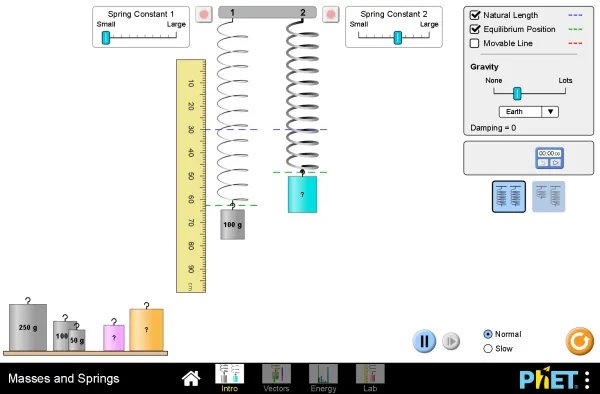
Full screen · PhET Interactive Simulations, University of Colorado Boulder, CC BY 4.0
Recap
- SHM: a = −ω²y, with the restoring force proportional to displacement and towards equilibrium.
- T = 2π√(m ÷ k) for a spring and 2π√(l ÷ g) for a pendulum; amplitude does not change T.
- Pick sin or cos from the starting position; v_max = Aω at equilibrium, a_max = Aω² at the extremes.
- A reference circle turns positions into phasor angles: t = angle ÷ ω, in radians.
- Damping removes energy; driving at the natural frequency gives resonance.
| Formula | Use it for |
|---|---|
| ω = 2πf = 2π ÷ T | angular frequency |
| T = 2π√(m ÷ k), T = 2π√(l ÷ g) | periods |
| y = A sin ωt, v = Aω cos ωt | starting from equilibrium |
| y = A cos ωt, v = −Aω sin ωt | starting from an extreme |
| a = −ω²y | acceleration at any displacement |
The maths behind it
Report a mistake
How is NCEA Level 3 maths going?
See the NCEA Level 3 maths guide