DC circuits, internal resistance and Kirchhoff's laws
What this lesson covers
- The EMF of a source is the energy it gives each coulomb of charge; some of that is used up inside the source by its internal resistance.
- Terminal voltage V = ε − Ir falls as the current rises, and a V against I graph has intercept ε and gradient −r.
- Kirchhoff's current law: the total current into a junction equals the total current out, because charge is conserved.
- Kirchhoff's voltage law: round any closed loop the EMFs add up to the sum of the IR drops, because energy is conserved.
- Circuits with several sources are solved by labelling currents, writing junction and loop equations and solving them simultaneously.
EMF and internal resistance
- The EMF ε of a battery is the energy it transfers to each coulomb of charge passing through it, in J C⁻¹ or volts.
- Every real source has internal resistance r, so some of that energy is turned into heat inside the source; these are the 'lost volts', Ir.
- The voltage at the terminals, available to the external circuit, is V = ε − Ir, and the current is I = ε ÷ (R + r).
- With no current flowing (an open circuit), there are no lost volts and the terminal voltage equals the EMF; the bigger the current, the lower the terminal voltage.
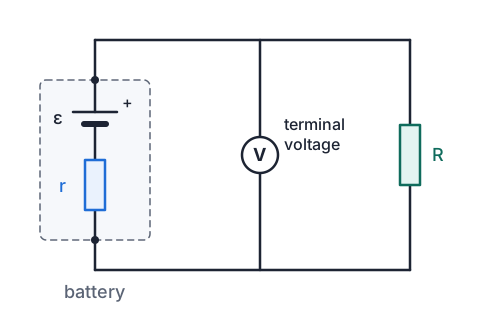
Example: starting a car
- A car battery with an EMF of 12.6 V has an internal resistance of 0.0200 Ω. The starter motor draws 150 A.
- Find the terminal voltage while the engine is cranking and the power wasted inside the battery.
- lost volts = Ir = 150 × 0.0200 = 3.00 V
- V = ε − Ir = 12.6 − 3.00 = 9.60 V
- power in r = I²r = 150² × 0.0200 = 450 Wthis heats the battery
- ε × I = 1890 W supplied; V × I = 1440 W delivered; 1890 − 1440 = 450 W
- terminal voltage 9.60 V; 450 W wasted in the battery
Example: finding ε and r from a graph
- A class connected an AA cell to a variable resistor and measured the terminal voltage at five currents.
- Use a V against I graph to find the cell's EMF and internal resistance.
| Current I (A) | Terminal voltage V (V) |
|---|---|
| 0.10 | 1.48 |
| 0.20 | 1.42 |
| 0.30 | 1.35 |
| 0.40 | 1.29 |
| 0.50 | 1.23 |
- V = ε − Ir has the form y = c + mx, so the gradient is −r and the intercept is ε
- gradient = (1.23 − 1.48) ÷ (0.50 − 0.10) = −0.25 ÷ 0.40 = −0.63 V A⁻¹use the line of best fit; here the end points lie on it
- r = 0.63 Ω
- intercept: ε = V + Ir = 1.48 + 0.10 × 0.63 = 1.54 Vextend the line back to I = 0
- a new AA cell is labelled 1.5 V, so 1.54 V is sensible
- ε = 1.54 V, r = 0.63 Ω
Try it: fit V = ε − Ir
Kirchhoff's current and voltage laws
- Current law: at any junction, the total current flowing in equals the total current flowing out. Charge is conserved, so it cannot pile up at a point.
- Voltage law: around any closed loop, the sum of the EMFs equals the sum of the potential drops IR. Energy given to each coulomb is all used before it gets back.
- Signs in a loop: go round in one chosen direction. An EMF counts as positive if you pass through it from − to +; an IR term counts as positive if you travel the same way as the assumed current.
- The series and parallel rules you already know are both special cases of these two laws.
Try it: currents at a junction
Example: two batteries and three resistors
- A 12.0 V battery in series with a 4.0 Ω resistor and a 6.0 V battery in series with a 2.0 Ω resistor are connected in parallel with a 6.0 Ω resistor, as in the diagram. Both batteries have negligible internal resistance and their positive terminals point up.
- Find the current in each branch.
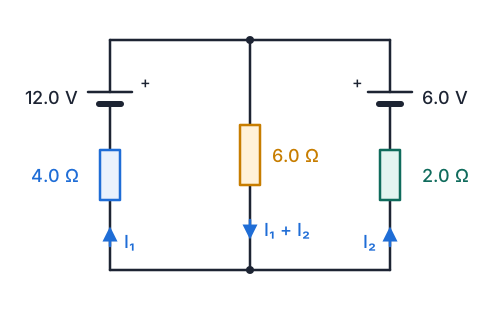
- guess I₁ up through the 12.0 V battery and I₂ up through the 6.0 V battery, so I₁ + I₂ flows down through the 6.0 Ωthe current law at the top junction
- left loop: 12.0 = 4.0I₁ + 6.0(I₁ + I₂), so 12.0 = 10I₁ + 6.0I₂
- right loop: 6.0 = 2.0I₂ + 6.0(I₁ + I₂), so 6.0 = 6.0I₁ + 8.0I₂
- solving: I₁ = 1.36 A, I₂ = −0.273 Asimultaneous equations, as in the maths of three unknowns
- I₂ is negative, so the current really flows down through the 6.0 V battery: it is being charged
- middle: I₁ + I₂ = 1.36 − 0.273 = 1.09 A down
- outer loop: 12.0 − 6.0 = 4.0 × 1.364 − 2.0 × (−0.273) = 5.45 + 0.55 = 6.0 V
- 1.36 A in the 4.0 Ω, 0.273 A down through the 6.0 V battery, 1.09 A in the 6.0 Ω
A method for any circuit
- Label a current in every branch with an arrow; any direction will do, since a wrong guess just gives a negative answer.
- Write the current law at enough junctions to link the branch currents, so you have fewer unknowns.
- Write the voltage law for enough independent loops to have as many equations as unknowns, including internal resistances as resistors in the loop.
- Solve the equations simultaneously, then check with a loop you did not use.
Example: a battery with internal resistance and a network
- A battery of EMF 9.00 V and internal resistance 0.500 Ω drives a 1.50 Ω resistor in series with a parallel pair, 6.00 Ω and 3.00 Ω.
- Find the current from the battery, the terminal voltage and the current in the 6.00 Ω resistor.
- parallel pair: 1 ÷ (1/6.00 + 1/3.00) = 2.00 Ω
- total resistance = 0.500 + 1.50 + 2.00 = 4.00 Ωthe internal resistance is in series with everything
- I = ε ÷ (R + r) = 9.00 ÷ 4.00 = 2.25 A
- V = ε − Ir = 9.00 − 2.25 × 0.500 = 7.88 V
- voltage across the pair = 2.25 × 2.00 = 4.50 V, so I₆ = 4.50 ÷ 6.00 = 0.750 A
- I₃ = 4.50 ÷ 3.00 = 1.50 A, and 0.750 + 1.50 = 2.25 A
- 2.25 A, 7.88 V, 0.750 A
What Achieved, Merit and Excellence look like
- Achieved states one correct idea; Merit gives the reason with the right quantity; Excellence links the current, the internal resistance and the energy to what is seen.
- Use V = ε − Ir in words as well as symbols, and say what stays the same as well as what changes.
| Grade | A model answer |
|---|---|
| Achieved | The starter motor takes a large current, so the voltage across the headlights drops. |
| Merit | The starter draws a very large current from the battery. The lost volts Ir across the internal resistance become large, so the terminal voltage ε − Ir falls, and the headlights, which are in parallel with the starter, get less voltage. |
| Excellence | The battery's EMF stays the same, but the starter motor has a very low resistance, so the total current from the battery becomes very large. More energy per coulomb is turned into heat inside the battery (the lost volts Ir), so less is left at the terminals: V = ε − Ir falls. The headlights are in parallel across those terminals, so their voltage drops, their current and power P = V² ÷ R fall, and they dim until the starter stops. |
Common mistakes
- I = ε ÷ R = 9.00 ÷ 3.50 = 2.57 A, leaving out the battery.The internal resistance is in series with the circuit: I = ε ÷ (R + r) = 9.00 ÷ 4.00 = 2.25 A.
- The EMF of the battery drops when a bigger current is drawn.The EMF stays the same; the terminal voltage ε − Ir drops because the lost volts grow.
- The answer for I₂ came out negative, so I must have made a mistake.A negative current means the real current flows opposite to the arrow you drew; keep the sign in the other equations.
- In the loop equation every EMF and every IR term is added as positive.Go round in one direction: an EMF is negative if you cross it from + to −, and an IR term is negative if you go against the current.
See the headlights dim
You need: a car with headlights, an adult driver, a garage door or fence, a phone to film
- At dusk, with the car parked outside, have the adult sit in the driver's seat and switch on the headlights with the engine off, pointing at a garage door or fence a few metres away (an older car with ordinary bulbs shows it best, because many newer cars switch their lights off or hold them steady while starting).
- Stand to one side of the car, never in front of or behind it, and start filming the patch of light on the door.
- Ask the adult to start the engine from the driver's seat while you keep filming, then switch the engine off again.
- Play the clip back slowly and note when the patch dims and when it recovers.
- Look for: the light dims sharply only while the starter turns, then brightens again once the engine runs, because the huge starter current makes the lost volts Ir large.
Safety: Only the adult operates the car, outdoors with the handbrake on and the car in Park or neutral, never in a closed garage where exhaust fumes build up; you never touch the battery, bonnet or engine, and you stay to one side of the car in case it moves when started.
Your turn
An AA cell of EMF 1.50 V and internal resistance 0.400 Ω is connected to a 2.60 Ω resistor. Find the current and the terminal voltage.
A battery reads 9.00 V on open circuit and 8.40 V when it supplies 0.300 A. Find its internal resistance.
Currents of 2.0 A and 0.5 A flow into a junction and 1.2 A flows out along one wire. What current flows in the only other wire, and which way?
An e-bike battery has an EMF of 36.0 V and internal resistance 0.150 Ω. Climbing a hill, the motor draws 12.0 A. Find the terminal voltage and the power wasted in the battery.
Show answer
1. I = ε ÷ (R + r) = 1.50 ÷ 3.00 = 0.500 A; V = IR = 0.500 × 2.60 = 1.30 V (or 1.50 − 0.500 × 0.400 = 1.30 V). 2. Lost volts = 9.00 − 8.40 = 0.60 V, so r = 0.60 ÷ 0.300 = 2.00 Ω (2.0 Ω). 3. In = 2.5 A, so out = 2.5 A: the other wire carries 2.5 − 1.2 = 1.3 A out of the junction. 4. V = 36.0 − 12.0 × 0.150 = 34.2 V; P = I²r = 12.0² × 0.150 = 21.6 W.
Exam-style question: two boat batteries
- On a fishing boat in the Hauraki Gulf, battery A (EMF 12.0 V, internal resistance 0.200 Ω) runs a bilge pump modelled as a 4.00 Ω resistor.
Calculate the current in the pump and the terminal voltage of battery A.
Explain why the terminal voltage is less than the EMF.
An older battery B (EMF 11.4 V, internal resistance 0.300 Ω) is connected in parallel with A, positive to positive. Use Kirchhoff's laws to calculate the current through each battery.
Explain what the sign of battery B's current tells you, and why connecting it this way wastes energy.
Show answer
1. I = 12.0 ÷ (4.00 + 0.200) = 2.857 A, about 2.86 A; V = 12.0 − 2.857 × 0.200 = 11.4 V (Achieved). 2. Some of the energy each coulomb gains in the battery is turned into heat as it passes through the internal resistance; these lost volts, Ir = 0.571 V, are not available at the terminals, so V = ε − Ir is less than ε (Merit). 3. Let the terminal voltage be V and the currents out of the positive terminals be I_A and I_B. Loop through A: 12.0 − 0.200I_A = V. Loop through B: 11.4 − 0.300I_B = V. Junction: I_A + I_B = V ÷ 4.00. Substituting: (12.0 − V) ÷ 0.200 + (11.4 − V) ÷ 0.300 = V ÷ 4.00, so 98.0 = 8.583V and V = 11.42 V. Then I_A = (12.0 − 11.42) ÷ 0.200 = 2.91 A and I_B = (11.4 − 11.42) ÷ 0.300 = −0.0583 A, with 2.85 A in the pump (Excellence for all three). 4. I_B is negative, so the current flows into battery B's positive terminal: battery A is charging battery B as well as running the pump. Because B's EMF is lower than the terminal voltage, A pushes current backwards through it, and both internal resistances turn that extra current into heat, so A's energy is wasted rather than all reaching the pump (Excellence links the sign, the EMFs and the energy).
Circuit Construction Kit: DC
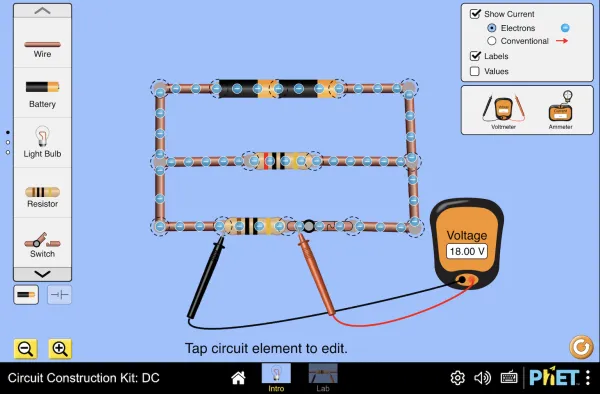
Full screen · PhET Interactive Simulations, University of Colorado Boulder, CC BY 4.0
Recap
- EMF is energy per coulomb from the source; internal resistance turns some of it into heat.
- V = ε − Ir: terminal voltage falls as the current rises.
- On a V against I graph, the intercept is ε and the gradient is −r.
- Current law: in equals out at every junction; voltage law: EMFs equal IR drops round every loop.
- Label, write equations, solve, then check with another loop; a negative current is just a reversed arrow.
| Formula | Use it for |
|---|---|
| V = ε − Ir | terminal voltage |
| I = ε ÷ (R + r) | current from a source with internal resistance |
| ΣI in = ΣI out | any junction |
| Σε = ΣIR | any closed loop |
| P = I²r | power wasted inside the source |
The maths behind it
Report a mistake
How is NCEA Level 3 maths going?
See the NCEA Level 3 maths guide