Capacitors
What this lesson covers
- Capacitance C = Q ÷ V is the charge stored per volt; for parallel plates C = ε₀εᵣA ÷ d, and a dielectric increases it.
- Capacitors in parallel add (C_T = C₁ + C₂); in series their reciprocals add (1 ÷ C_T = 1 ÷ C₁ + 1 ÷ C₂).
- Charging and discharging through a resistor follow exponential curves with time constant τ = RC.
- After one time constant, a charging capacitor reaches 63% of its final charge, and a discharging one falls to 37%.
- The energy stored is E = ½QV = ½CV², the area under the charge against voltage graph.
Parallel plate capacitors and dielectrics
- A capacitor is two conductors separated by an insulator. Connected to a battery, electrons are pushed onto one plate and pulled off the other, so the plates carry equal and opposite charges +Q and −Q.
- Capacitance C = Q ÷ V is the charge stored per volt across it, measured in farads (F); practical values are in μF, nF and pF.
- For parallel plates, C = ε₀εᵣA ÷ d: bigger plates and a smaller gap give more capacitance. ε₀ = 8.85 × 10⁻¹² F m⁻¹, and εᵣ is the dielectric constant of the material between the plates (1.00 for air).
- A dielectric's molecules become polarised in the field, lining up so that their own field partly cancels the plates' field. For the same charge the voltage is lower, so C = Q ÷ V is larger.
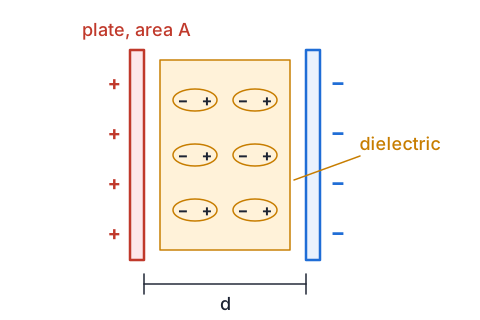
Try it: the field between the plates
Example: a home-made capacitor
- Two square plates 0.200 m by 0.200 m are held 1.00 mm apart in air and connected to a 12.0 V supply.
- Find the capacitance and the charge on each plate, then the capacitance if paper (εᵣ = 3.7) fills the gap.
- A = 0.200 × 0.200 = 0.0400 m², d = 1.00 × 10⁻³ m
- C = ε₀A ÷ d = 8.85 × 10⁻¹² × 0.0400 ÷ 1.00 × 10⁻³ = 3.54 × 10⁻¹⁰ F (354 pF)
- Q = CV = 3.54 × 10⁻¹⁰ × 12.0 = 4.25 × 10⁻⁹ C
- with paper: C = 3.7 × 3.54 × 10⁻¹⁰ = 1.3 × 10⁻⁹ FC is proportional to εᵣ
- 354 pF is tiny, which is why real capacitors roll long, thin plates very close together
- 354 pF; 4.25 × 10⁻⁹ C; 1.3 nF with paper
Capacitors in series and parallel
- In parallel, every capacitor has the same voltage and the charges add, so C_T = C₁ + C₂: like making the plates bigger.
- In series, every capacitor carries the same charge and the voltages add, so 1 ÷ C_T = 1 ÷ C₁ + 1 ÷ C₂: like making the gap wider, so the total is less than the smallest.
- These are the opposite way round to the rules for resistors, so check which one you are using.
- In a series chain, the smallest capacitor takes the largest share of the voltage, because V = Q ÷ C with the same Q.
Example: a series and parallel network
- A 4.0 μF and a 12 μF capacitor are in series, and that pair is in parallel with a 2.0 μF capacitor, all connected to 10.0 V.
- Find the total capacitance, the total charge, and the voltage across the 4.0 μF capacitor.
- series pair: 1 ÷ C = 1 ÷ 4.0 + 1 ÷ 12 = 4 ÷ 12, so C = 3.0 μF
- C_T = 3.0 + 2.0 = 5.0 μF
- Q_T = C_T V = 5.0 × 10⁻⁶ × 10.0 = 5.0 × 10⁻⁵ C (50 μC)
- series branch: Q = 3.0 μF × 10.0 V = 30 μC on each of the 4.0 μF and 12 μFboth in series carry the same charge
- V₄ = 30 μC ÷ 4.0 μF = 7.5 V, V₁₂ = 30 ÷ 12 = 2.5 V
- 7.5 + 2.5 = 10.0 V across the branch
- 5.0 μF, 50 μC, 7.5 V
Charging and discharging, and the time constant
- When charging through a resistor R from a supply ε, the current starts at ε ÷ R because the empty capacitor has no voltage across it.
- As charge builds up, the capacitor's voltage rises and opposes the supply, so the resistor's voltage and the current fall, and the charging slows down: the curves are exponential.
- The time constant τ = RC (seconds when R is in ohms and C in farads) sets the pace: after one τ the charge and voltage reach 63% of their final values and the current has fallen to 37%.
- On discharge the charge, the voltage and the current all fall to 37% in each time constant (V = V₀e^(−t ÷ RC)); after about 5τ the process is effectively complete.
- The current reverses direction between charging and discharging, so a discharge current graph is drawn below the time axis if charging is positive.
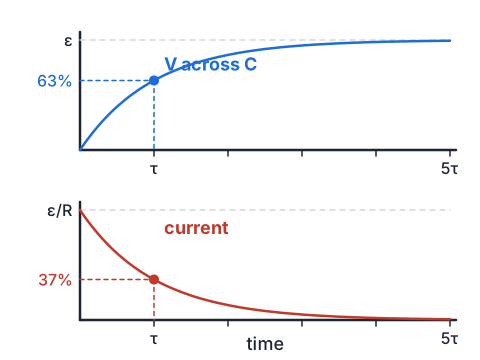
Try it: change R and C
Example: discharging through a resistor
- A 470 μF capacitor charged to 9.00 V is discharged through a 2.20 kΩ resistor.
- Find the time constant, the starting current, the current after one time constant, and the voltage after 2.00 s.
- τ = RC = 2200 × 470 × 10⁻⁶ = 1.034 s
- I₀ = V₀ ÷ R = 9.00 ÷ 2200 = 4.09 × 10⁻³ A
- after one τ: I = 0.368 × 4.091 × 10⁻³ = 1.50 × 10⁻³ Ae⁻¹ = 0.368, the 37% rule
- V = V₀e^(−t ÷ RC) = 9.00 × e^(−2.00 ÷ 1.034) = 9.00 × 0.1445 = 1.30 V
- 2.00 s is about 2τ, and 9.00 × 0.37² = 1.2 V, close
- τ = 1.03 s, 4.09 mA, 1.50 mA, 1.30 V
Energy stored in a capacitor
- Moving each extra bit of charge onto the plates takes more work, because the voltage already there pushes back; the voltage grows in proportion to the charge.
- The energy stored is the area under the graph of V against Q, a triangle: E = ½QV = ½CV² = Q² ÷ (2C).
- When a battery charges a capacitor through a resistor, the battery supplies QV but only ½QV is stored; the other half is turned into heat in the resistance, whatever its value.
Example: a defibrillator
- A defibrillator charges a 200 μF capacitor to 1.40 kV.
- Find the charge stored and the energy available for the shock.
- Q = CV = 200 × 10⁻⁶ × 1400 = 0.280 C
- E = ½CV² = ½ × 200 × 10⁻⁶ × 1400² = 196 J
- E = ½QV = ½ × 0.280 × 1400 = 196 J
- 0.280 C and 196 J
What Achieved, Merit and Excellence look like
- Achieved states one change correctly; Merit gives the reason using a formula; Excellence links what stays constant to what changes and accounts for the energy.
- First decide what is fixed: a capacitor left connected to a battery keeps its voltage, and an isolated one keeps its charge.
| Grade | A model answer |
|---|---|
| Achieved | The capacitance halves because C = ε₀A ÷ d and d has doubled. |
| Merit | The capacitance halves. The capacitor is isolated, so the charge cannot change, and V = Q ÷ C doubles. |
| Excellence | C = ε₀A ÷ d, so doubling d halves C. Disconnected, the charge Q has nowhere to go, so it stays the same and V = Q ÷ C doubles. The energy E = Q² ÷ (2C) therefore doubles. The extra energy comes from the work done pulling the plates apart, because the oppositely charged plates attract each other. |
Common mistakes
- 6.0 μF and 3.0 μF in series make 9.0 μF.In series the reciprocals add: 1 ÷ C = 1 ÷ 6.0 + 1 ÷ 3.0, so C = 2.0 μF; 9.0 μF is the parallel total.
- τ = RC = 2.20 × 470 = 1034 s, with kΩ and μF left as they are.Use ohms and farads: τ = 2200 Ω × 470 × 10⁻⁶ F = 1.03 s.
- After one time constant the capacitor is half charged.After one τ it reaches 63% of full charge; it is half charged at about 0.69τ.
- When the capacitor is fully charged the current is at its maximum because the most charge is stored.Fully charged, the capacitor's voltage equals the supply's, the resistor has no voltage and the current is zero.
Model a discharge with coins
You need: 50 coins, a cup, paper and a pen
- Treat each coin as a unit of charge left on a capacitor. Put all 50 coins in the cup and shake them out onto the table.
- Remove every coin showing heads, as the charge that flows away in that time step, and count the coins left.
- Put the remaining coins back in the cup and repeat until none are left, recording the number after each round.
- Plot coins left against round number, and find on your curve when about 37% (18 or 19 coins) remain.
- Look for: a curve that falls steeply at first and then levels off, with the number removed each round proportional to the number left, just like a discharging capacitor whose current depends on the charge remaining.
Safety: Keep the coins away from toddlers and pets, because a small coin is easy to swallow and can choke a young child.
Your turn
Two parallel plates, each of area 0.0100 m², are 0.200 mm apart in air. Find the capacitance.
Find the total capacitance of 6.0 μF and 3.0 μF in series, and in parallel.
How much energy does a 10 μF capacitor store at 12 V?
A 4.7 mF capacitor discharges through a 1.0 kΩ resistor. Find the time constant and roughly how long it takes to discharge fully.
Show answer
1. C = ε₀A ÷ d = 8.85 × 10⁻¹² × 0.0100 ÷ 2.00 × 10⁻⁴ = 4.43 × 10⁻¹⁰ F (443 pF). 2. Series: 1 ÷ C = 1 ÷ 6.0 + 1 ÷ 3.0 = 0.50, so C = 2.0 μF; parallel: 6.0 + 3.0 = 9.0 μF. 3. E = ½CV² = ½ × 10 × 10⁻⁶ × 12² = 7.2 × 10⁻⁴ J (0.72 mJ). 4. τ = RC = 1000 × 4.7 × 10⁻³ = 4.7 s; it is effectively discharged after about 5τ = 24 s.
Exam-style question: a camera flash
- A camera flash stores energy in a 220 μF capacitor charged to 330 V. After each flash, it is recharged from a 330 V supply through a 1.50 kΩ resistor.
Calculate the charge and energy stored when the capacitor is full.
Calculate the time constant, the starting recharge current, and the current after one time constant.
Explain why the recharge current is largest at the start and falls to zero.
A designer suggests two 220 μF capacitors charged from the same 330 V supply. Explain, with calculations, how much energy they store connected in parallel compared with in series across 330 V.
Show answer
1. Q = CV = 220 × 10⁻⁶ × 330 = 0.0726 C; E = ½CV² = ½ × 220 × 10⁻⁶ × 330² = 12.0 J (Achieved). 2. τ = RC = 1500 × 220 × 10⁻⁶ = 0.330 s; I₀ = 330 ÷ 1500 = 0.220 A; after one τ, I = 0.368 × 0.220 = 0.0809 A (Merit for all three). 3. At the start the capacitor is empty, so it has no voltage across it and the full 330 V is across the resistor, giving the biggest current. As charge builds up, the capacitor's voltage V = Q ÷ C rises and opposes the supply, so the voltage across the resistor, ε − V_C, falls, and so does the current. When V_C reaches 330 V the resistor has no voltage and the current is zero (Excellence links the charge, the capacitor voltage and the resistor current). 4. In parallel the total is 440 μF at 330 V: E = ½ × 440 × 10⁻⁶ × 330² = 24.0 J, double one capacitor. In series the total is 110 μF across 330 V, so each has only 165 V: E = ½ × 110 × 10⁻⁶ × 330² = 5.99 J, half of one capacitor. Parallel stores four times as much as series because the voltage on each capacitor is not shared and E depends on V² (Excellence for the comparison with reasons).
Recap
- C = Q ÷ V, and for parallel plates C = ε₀εᵣA ÷ d; a dielectric raises C.
- Parallel capacitors add; in series the reciprocals add, the reverse of resistors.
- τ = RC: 63% charged, or 37% left, after one time constant; done after about 5τ.
- Charging current starts at ε ÷ R and decays to zero as the capacitor's voltage rises.
- E = ½QV = ½CV²: half the battery's energy is stored, half heats the resistor.
| Formula | Use it for |
|---|---|
| Q = CV | charge stored |
| C = ε₀εᵣA ÷ d | parallel plates |
| C_T = C₁ + C₂; 1 ÷ C_T = 1 ÷ C₁ + 1 ÷ C₂ | parallel; series |
| τ = RC | time constant |
| E = ½QV = ½CV² | energy stored |
The maths behind it
Report a mistake
How is NCEA Level 3 maths going?
See the NCEA Level 3 maths guide