A socio-scientific issue: aerial 1080 in Aotearoa
What this lesson covers
- What makes an issue socio-scientific, with New Zealand examples such as 1080, gene editing and kauri dieback.
- The biology of 1080: how fluoroacetate blocks respiration, why it targets mammals and how it breaks down.
- The perspectives of conservation, farming, hunting, iwi and hapū, and animal welfare groups, and the evidence each relies on.
- Judging sources for validity (currency, peer review, scientific acceptance) and bias (attitudes, values, beliefs).
- Building a personal position with personal and societal actions, and justifying them for Merit and Excellence.
What a socio-scientific issue is
- A socio-scientific issue is a question where biology matters but science alone cannot settle the answer, because people weigh the costs and benefits differently.
- The social side can be economic (jobs, export income), ethical (animal suffering), cultural (tikanga, mahinga kai) or environmental (water, native species).
- New Zealand examples: aerial 1080 to protect native birds, gene editing of crops or pests, and kauri dieback, where rāhui and track closures limit people's access to protect the trees.
- This internal standard asks you to research one issue, explain the biology, compare viewpoints, then present and justify your own position and actions.
Try it: science or values?
What each grade needs
- Every grade needs a personal position and at least one proposed action, both built on biology; the grades differ in how far you explain and justify them.
| Grade | What the report does |
|---|---|
| Achieved | States a personal position using relevant biology, and proposes an action at a personal or societal level. |
| Merit | Explains why that position and those actions were chosen, using the biology and the implications. |
| Excellence | Justifies the position and actions by analysing and evaluating the biology: which implications matter most, how well the actions would work, and how valid and biased the sources are. |
How 1080 kills
- 1080 is sodium fluoroacetate, a compound also made naturally by some Australian plants as a defence against browsing mammals.
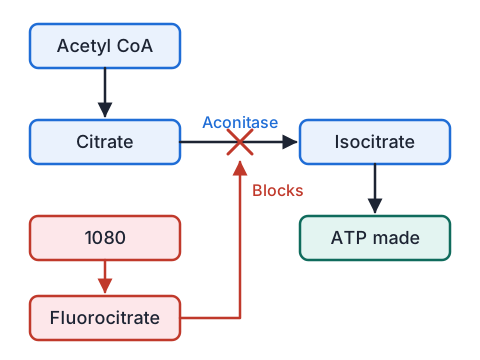
- Once eaten, the cell treats fluoroacetate like acetate and builds it into fluorocitrate, which blocks aconitase, an enzyme of the Krebs cycle in the mitochondria.
- With the cycle stopped, aerobic respiration makes very little ATP, so organs with a high energy demand, the heart and brain, fail first.
- Mammals such as possums, rats and dogs are very sensitive; many birds and reptiles need a much larger dose per kilogram, which is one reason it is used here, where most native land animals are birds, reptiles and insects.
Why New Zealand uses it
- Native birds evolved without land mammals, so many nest in holes or on the ground and have no defence against possums, ship rats and stoats.
- In a mast year, when beech or rimu seed heavily, rat and mouse numbers boom, stoat numbers follow, and when the seed runs out the predators turn on birds, eggs and chicks.
- Trapping works well in reachable areas, but much conservation land is rugged and roadless, so cereal baits sown from helicopters are often the only way to reach a whole catchment.
- Possums also carry bovine tuberculosis, so OSPRI uses 1080 to protect cattle and deer herds, giving the issue an economic side for farmers.
- Predator Free 2050, the national goal of removing possums, rats and stoats, relies on 1080 until other tools, such as self-resetting traps or gene technology, can work at scale.
What happens to 1080 afterwards
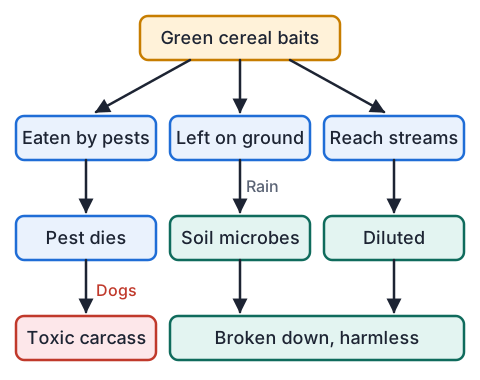
- 1080 dissolves in water, so rain leaches it out of uneaten baits, and soil bacteria and fungi break it down into harmless products; it is not stored in fat, so it does not build up along food chains.
- Traces that reach streams are diluted and broken down by aquatic microbes; regular water testing after drops has rarely found it, and only at very low levels.
- Possum and deer carcasses can stay toxic for weeks to months, which is why dogs are at real risk of secondary poisoning and areas carry warning signs.
- Baits are dyed green and flavoured with cinnamon to make them less attractive to birds, and deer repellent can be added; operators lay non-toxic prefeed first so possums eat a full dose.
Perspectives and the evidence behind them
- Each group uses evidence that fits its values, so name the value as well as the evidence when you describe a viewpoint.
- Viewpoints within a group differ: some hapū work with the Department of Conservation on drops in their rohe while others oppose them, and hunters are not all against it.
| Group | Usual position | Evidence they rely on | Underlying value |
|---|---|---|---|
| Conservation scientists | Support, with care | Nesting success and bird counts before and after drops | Protecting native species |
| Farmers | Support | Fewer TB-infected herds where possums are controlled | Economic security |
| Some hunters | Oppose | Deer killed by baits; risk to hunting dogs | Recreation and food gathering |
| Some iwi and hapū | Mixed | Concern about wai and mahinga kai; others value the return of birds | Kaitiakitanga and mana over land |
| Animal welfare groups | Oppose or want alternatives | Slow death, often hours after eating | Reducing animal suffering |
Try it: which kind of implication?
Judging sources: validity and bias
- Validity: is the source current, has it been peer reviewed, and does it agree with what most scientists accept? A 2011 report by the Parliamentary Commissioner for the Environment reviewed the research and recommended that 1080 use continue.
- Bias: who wrote it and what do they gain or value? A pest control company, a hunting club and a campaign group each have reasons to stress some facts and leave out others.
- Bias does not make a source wrong, and a peer-reviewed paper is not automatically right; say what the bias could change and check the claim against an independent source.
- Anecdotes (one dead dog, one silent valley) are real events but not evidence of how often something happens; look for the monitoring data.
Example: from position to actions
- Position: I support aerial 1080 in large, rugged forests where trapping cannot reach, as long as monitoring and consultation continue.
- Personal action: volunteer with a local trapping group, and keep my dog muzzled and on a lead near drop areas.
- Societal action: fund research into species-specific toxins and gene technologies, and require operators to agree drop plans with mana whenua for each area.
- Each action answers an implication: trapping cuts the need for poison near towns, the muzzle removes the secondary poisoning risk, and research targets the long-term welfare and cultural concerns.
Example: one justification at three grades
- Each paragraph backs up the same position; notice what is added at each step.
| Grade | What the student wrote |
|---|---|
| Achieved | I support 1080 because it kills possums, rats and stoats, which eat native birds and their eggs. I will join a trapping group. |
| Merit | I support 1080 because native birds evolved without mammal predators and cannot defend their nests, and 1080 reaches rugged land that traps cannot. It breaks down in soil and water, so it does not build up in food chains. Joining a trapping group reduces the need for poison close to towns. |
| Excellence | The biggest implication is extinction, which cannot be reversed, so it outweighs the deer and animals killed in each drop, which can recover. 1080 breaks down and does not accumulate, and peer-reviewed monitoring shows nesting success rises after drops; the hunters' and campaign groups' evidence is mostly anecdotal and comes from groups that lose from drops. My action is not perfect: trapping alone cannot cover remote catchments, so research into species-specific toxins is the action most likely to answer the welfare concern in the long run. |
Two other issues you could choose
- Kauri dieback is caused by Phytophthora agathidicida, a soil-borne water mould that infects kauri roots and damages the tissue carrying water and sugars; there is no cure, and it spreads in soil on boots, pigs and machinery.
- Its social side includes the rāhui Te Kawerau ā Maki placed on the Waitākere Ranges in 2017, track closures, and the cost of boot-cleaning stations and track upgrades.
- Gene editing tools such as CRISPR-Cas9 can change a single gene precisely, opening ideas from disease-resistant crops to gene drives that could make pest populations die out.
- Its social side includes how New Zealand regulates gene technology (a Gene Technology Bill, introduced in December 2024, had still not been passed by late 2026), export markets that value being GM-free, and Māori views on whakapapa and altering living things.
Common mistakes
- My position is that 1080 is good, because DOC says it works.A position needs your own reasoning from the biology; quoting one organisation is not a justification.
- Hunters only oppose 1080 because they are biased.Name their value and their evidence, then evaluate it; bias explains which facts they stress, not whether those facts are true.
- 1080 poisons the food chain because it builds up in animals that eat others.1080 is water soluble and broken down by microbes; it does not bioaccumulate, although carcasses can poison dogs that eat them.
- My action is that the government should fix it.An action is specific and linked to an implication, such as funding research into species-specific toxins to answer welfare concerns.
Find out which pests visit your section
You need: a piece of corrugated cardboard about 10 cm square, a teaspoon of peanut butter, a stick or a nail and a hammer, or a heavy stone, a phone camera
- Smear a thin layer of peanut butter into the grooves of the cardboard: this is a chew card, the same tool pest control groups use.
- In the late afternoon, fix it to a tree trunk or fence post about 30 cm off the ground, or weigh it down under a stone at the edge of a garden bed.
- Collect it the next morning and photograph both sides.
- Compare the bite marks with a chew card guide online: possums leave wide paired tooth marks, rats leave narrow grooves in pairs, mice tiny nibbles.
- Look for: whether your section has the same mammal pests that 1080 and trapping target in the bush.
Safety: Wear gloves or wash your hands after handling the card, as rats carry disease, and set it where dogs and anyone with a peanut allergy cannot reach it.
Your turn
Why is the use of aerial 1080 a socio-scientific issue rather than a purely scientific question?
Explain how 1080 kills a possum.
Why does 1080 not build up along food chains?
A campaign website says a stream was poisoned after a drop but gives no test results. What two checks would you make before using the claim?
Give one personal action and one societal action that respond to the risk to dogs.
Show answer
1. Biology can describe what 1080 does, but whether to use it depends on how people weigh benefits to native birds against costs such as animal suffering, risks to dogs and cultural concerns, so people hold different views. 2. It is converted into fluorocitrate, which blocks the Krebs cycle enzyme aconitase, so aerobic respiration makes little ATP and the heart and brain fail. 3. It is water soluble and broken down by soil and water microbes, and it is not stored in fat, so it does not accumulate in predators. 4. Validity: is there test data, is it current and peer reviewed, and does independent water monitoring agree? Bias: who runs the site and what values or interests shape what it reports? 5. Personal: keep dogs muzzled and on a lead in drop areas until signs are removed. Societal: require warning signs and carcass monitoring until baits and carcasses have broken down.
Recap
- A socio-scientific issue has biological and social implications, and people disagree about it.
- 1080 blocks the Krebs cycle, hits mammals hardest, and breaks down without building up in food chains, though carcasses can poison dogs.
- Each perspective rests on evidence and a value; judge sources for validity and bias rather than dismissing them.
- Excellence ranks the implications, weighs how well each action would work, and evaluates the sources behind the position.
| Part of the report | What to include |
|---|---|
| Biology | How 1080 works, why it is used, what happens to it |
| Perspectives | Each group's position, evidence and value |
| Position | Your view, built on the biology |
| Actions | Personal and societal, each linked to an implication |
| Justification | Weigh implications, effectiveness, validity and bias |
The maths behind it
Report a mistake
How is NCEA Level 3 maths going?
See the NCEA Level 3 maths guide