Orientation in space: tropisms, taxes, kineses and migration
What this lesson covers
- Tropisms (growth towards or away from a directional stimulus) and nastic responses (non-directional movements) in plants.
- How auxin causes phototropism in shoots and gravitropism in roots, including the acid growth of cell walls.
- Taxes (directed movement) and kineses (changes in speed or turning) in animals, with measured examples.
- Homing and migration, and the cues animals navigate by: sun, stars, the magnetic field, landmarks and smell.
- Linking a response's process to the selective advantage it gives the organism in its ecological niche.
Four kinds of orientation in space
- Plants cannot move from place to place, so they orient by growing in a direction (tropisms) or by moving parts reversibly (nastic responses).
- Animals move the whole body: a taxis is movement steered by the direction of the stimulus, while a kinesis is a change in speed or turning rate set by how strong the stimulus is, not where it comes from.
- Name each response by its stimulus and direction: positive phototropism is growth towards light; negative phototaxis is moving away from light.
| Response | Organism | Directional? | Example |
|---|---|---|---|
| Tropism | Plant | Yes: growth towards or away | Shoot bending to a window |
| Nastic response | Plant | No | Mimosa leaflets folding when touched |
| Taxis | Animal or single cell | Yes: moves towards or away | Euglena swimming towards light |
| Kinesis | Animal | No: speed or turning changes | Woodlice slowing down in damp air |
Tropisms
- A tropism is a growth response, so it is slow (hours to days) and permanent: the stem stays bent.
- Phototropism is a response to light, gravitropism (geotropism) to gravity, thigmotropism to touch, hydrotropism to water and chemotropism to chemicals.
- Shoots are positively phototropic and negatively gravitropic; roots are positively gravitropic, and pollen tubes grow chemotropically down the style to the ovule.
- Climbers such as native clematis (puawānanga) wrap their leaf stalks around a support: cells on the side away from the touch grow faster, a thigmotropism.
How auxin bends a shoot
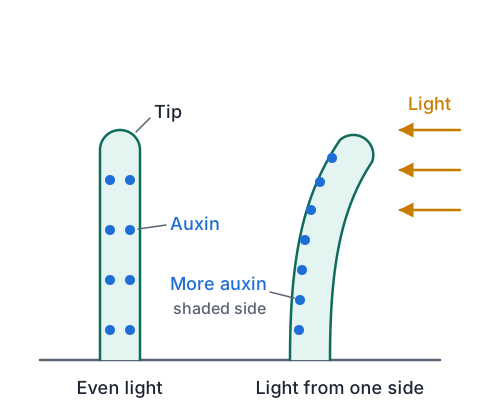
- Auxin (IAA) is made in the shoot tip and moves down the shoot, cell to cell, through carrier proteins.
- Light from one side is detected by phototropin, a blue-light receptor in the tip, which redirects auxin carriers so auxin moves sideways to the shaded side.
- Auxin causes cells to pump hydrogen ions into their walls; the acid activates expansin proteins that loosen the links between cellulose fibres, and turgor pressure stretches the softened cells (acid growth).
- Cells on the shaded side elongate more than those on the lit side, so the shoot curves towards the light.
Roots and gravity
- Cells in the root cap contain statoliths, starch-filled amyloplasts that sink to the lower side of the cell when a root is turned on its side.
- Their position redirects auxin carriers so auxin collects on the lower side of the root.
- Root cells are far more sensitive to auxin than shoot cells: the high concentration on the lower side slows their elongation, the upper side grows faster, and the root curves down.
- So the same hormone causes opposite bending in shoots and roots because of the different concentrations each tissue responds to best.
Nastic responses
- A nastic response is a movement whose direction is fixed by the plant's structure, not by where the stimulus comes from, and it is usually quick and reversible.
- Touch Mimosa pudica and an electrical signal reaches the pulvinus at the base of each leaflet; potassium ions leave its motor cells, water follows by osmosis, the cells lose turgor and the leaflets fold within seconds.
- The Venus flytrap closes when two trigger hairs are touched within about 20 seconds, so a raindrop does not waste its energy; many daisies and oxalis close their flowers or leaves at night (nyctinasty).
- The advantage is linked to the niche: folding may startle or dislodge grazing insects and shows less leaf, and closed flowers keep pollen dry overnight.
Taxes and kineses
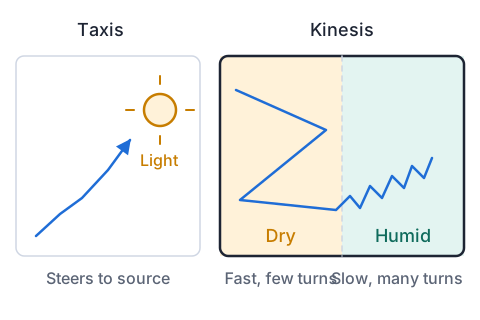
- In a taxis the animal compares the stimulus on its two sides, with paired receptors or by swinging its head, and steers towards (positive) or away from (negative) the source.
- Euglena swims towards light (positive phototaxis) to photosynthesise; mosquitoes follow rising carbon dioxide to a host (chemotaxis); fly larvae crawl away from light.
- In a kinesis the animal does not steer: in orthokinesis its speed depends on the stimulus intensity, and in klinokinesis its rate of turning does.
- Woodlice move fast and turn little in dry air, carrying them out of it, and slow down and turn more in damp air, so they end up gathered where it is damp.
Try it: name the response
Example: measuring a kinesis
- A Year 13 class tracked six woodlice for 60 s each over dry paper towel and six over damp paper towel, in a dark box so light could not act as a second stimulus.
- Calculate the mean speed in each condition and say which kind of kinesis the data show.
| Condition | Distance in 60 s (cm) | Turns in 60 s |
|---|---|---|
| Dry paper | 54 | 3 |
| Damp paper | 18 | 11 |
- speed = distance ÷ time
- dry: 54 cm ÷ 60 s = 0.90 cm s⁻¹
- damp: 18 cm ÷ 60 s = 0.30 cm s⁻¹
- speed in dry air is 3 times that in damp air: orthokinesisspeed depends on humidity
- turning rises from 3 to 11 per minute in damp air: klinokinesisturning rate depends on humidity
- the dark box rules out light, so humidity alone caused the change
Homing and migration
- Homing is returning to a home site, such as a nest, hive or breeding colony, after travelling away from it; migration is a regular, usually seasonal, journey between two areas.
- Kuaka (bar-tailed godwits) breed in Alaska and spend the southern summer on New Zealand estuaries; in 2007 a tagged female flew about 11,700 km from Alaska to the Firth of Thames in roughly eight days without landing.
- Tītī (sooty shearwaters) breed on islands around Stewart Island and loop around the whole Pacific in a figure of eight each southern winter.
- Longfin tuna (eels) live for decades in New Zealand rivers, then migrate thousands of kilometres to spawn once in the deep tropical Pacific and die.
The cues animals navigate by
- A sun compass gives direction from the Sun's position, but the Sun moves about 15° an hour, so the animal must use its internal clock to correct for the time of day (time compensation).
- Polarised light patterns in the sky still show the Sun's position through cloud; night migrants use the star pattern around the celestial pole.
- Magnetic receptors let birds, turtles and salmon read the direction and the angle of the Earth's field, giving a compass and a rough sense of latitude.
- Close to home, landmarks and smell take over: chinook salmon in Canterbury rivers return to the stream they hatched in by the smell of its water.
Try it: which cue?
Selective advantage in the niche
- A response is an advantage when individuals that have it survive and reproduce more than those without it, so the alleles behind it become more common.
- Link it to the niche: a shoot bending to light in a crowded forest floor captures more light for photosynthesis, makes more glucose, and grows taller and sets more seed than its shaded neighbours.
- Woodlice lose water easily through their thin cuticle, so a kinesis that keeps them in damp, dark places cuts deaths from drying out and from daytime predators such as birds.
- Kuaka gain from two summers a year: long Arctic days with an insect boom for raising chicks, and food-rich New Zealand mudflats while Alaska freezes; the cost is a non-stop flight that uses up most of the fat they store before leaving.
What Achieved, Merit and Excellence look like
- Achieved describes the response or its advantage; Merit explains how it happens and why it helps; Excellence links the mechanism to the advantage in this organism's niche, with comparisons or justification.
| Grade | A model answer |
|---|---|
| Achieved | The shoot grows towards the light so it can photosynthesise more. |
| Merit | Auxin moves to the shaded side of the shoot and makes those cells elongate more, so the shoot bends towards the gaps in the canopy. More light means more photosynthesis and more glucose for growth. |
| Excellence | On a shaded forest floor light comes mainly through gaps, so the seedling's tip detects it and auxin moves to the shaded side, where acid growth lengthens cells and bends the shoot into the gap. Capturing that light raises photosynthesis above respiration, so the seedling can grow before its neighbours shade it out. Seedlings that bend reach maturity and set seed more often than those that do not, so the response is selected for in this low-light niche. |
Common mistakes
- Light destroys auxin on the lit side, so the shaded side grows more.Auxin is moved sideways to the shaded side by carrier proteins; it is redistributed, not mostly destroyed.
- Woodlice move towards the damp, so it is a taxis.Woodlice do not steer towards damp air; they slow down and turn more in it, which is a kinesis.
- Mimosa folding its leaves is a tropism because it responds to touch.It is a nastic response: fast, reversible, caused by turgor change, and its direction does not depend on where it was touched.
- Godwits migrate so they can survive, which helps the species.Selection acts on individuals: birds that migrate leave more surviving offspring, so the migratory behaviour spreads.
See woodlice choose damp or dry
You need: a shallow plastic container with a lid, 2 paper towels, a cup of water, a cardboard box or tea towel to make it dark, 6 to 10 woodlice from under a log or pot, a phone timer
- Cut a paper towel in half; wet one half and squeeze it out, leave the other dry, and lay them side by side in the container.
- Gently tip the woodlice onto the line between the two halves and put the lid on.
- Cover the container so it is dark, then count how many are on each side every 2 minutes for 10 minutes.
- For one woodlouse, observe it for 30 seconds on each side and count its turns.
- Look for: more woodlice on the damp side over time, and individuals moving fast and straight on the dry side but slowly with many turns on the damp side.
Safety: Handle woodlice gently with a spoon or paper, wash your hands afterwards, and return them to where you found them within half an hour.
Your turn
A flatworm moves away from a bright light by steering its head from side to side. Name the response.
A woodlouse covers 42 cm in 60 s on dry paper. What is its speed in cm s⁻¹?
Why does a root bend down while a shoot bends up, if both have more auxin on the lower side?
Clover leaflets fold at night and open in the morning, whichever side the light comes from. Name the response.
What does a bird need, as well as seeing the Sun, to use a sun compass?
Show answer
1. Negative phototaxis, because it steers in relation to the direction of the light. 2. 42 ÷ 60 = 0.70 cm s⁻¹. 3. Root cells are much more sensitive to auxin, so the high concentration on the lower side inhibits their elongation; in shoots the same concentration speeds elongation, so the lower side grows more and the shoot bends up. 4. A nastic response (nyctinasty), because the direction of movement does not depend on the direction of the stimulus. 5. An internal clock, so it can correct for the Sun moving across the sky through the day.
Exam-style question: kuaka migration
- Kuaka (bar-tailed godwits) feed on worms and shellfish on New Zealand mudflats from September to March, then fly north to breed in Alaska, where the short summer brings a huge burst of insects. Young birds make their first southward flight without adults.
Describe the difference between migration and homing, using kuaka as an example.
Explain two cues kuaka could use to navigate across open ocean.
Discuss why migration gives kuaka a selective advantage, despite the cost of the journey.
Show answer
1. Migration is a regular seasonal journey between two areas, here between Alaska and New Zealand each year; homing is returning to a particular site, such as the same estuary or breeding ground (Achieved). 2. A time-compensated sun compass, using the internal clock to allow for the Sun's movement, and a magnetic compass reading the direction and angle of the Earth's field; the magnetic sense works under cloud, and young birds flying alone show the route depends on these inherited cues, not on following adults (Merit). 3. In Alaska long days and an insect boom give enough protein to raise chicks quickly; leaving before winter avoids freezing mudflats with no food, while New Zealand estuaries offer plentiful food in the southern summer. The journey costs a lot of fat and some birds die, but birds that migrate raise more surviving young than any that stayed in either place, so the behaviour and its inherited cues are selected for (Excellence links the cues, the timing and the food supply to breeding success).
Recap
- Tropisms are directional growth; nastic responses are non-directional, reversible movements, often by turgor change.
- Auxin moves to the shaded or lower side: it speeds elongation in shoots and slows it in roots.
- Taxes steer towards or away from a stimulus; kineses change speed or turning without steering.
- Navigators use the Sun with an internal clock, polarised light, stars, the magnetic field, landmarks and smell; Excellence links the process to survival and reproduction in the niche.
| Response | Process | Advantage |
|---|---|---|
| Positive phototropism | Auxin to shaded side, acid growth | More light for photosynthesis |
| Root gravitropism | Statoliths, auxin inhibits lower side | Anchorage, water and minerals |
| Woodlice kinesis | Slower, more turning in damp air | Less water loss, fewer predators |
| Kuaka migration | Sun and magnetic compasses | Two food-rich summers a year |
Report a mistake
How is NCEA Level 3 maths going?
See the NCEA Level 3 maths guide