Relationships between species: competition, mutualism, exploitation
What this lesson covers
- The kinds of relationship between species, shown by their effect on each partner (+, − or 0).
- Interspecific competition, competitive exclusion and the difference between fundamental and realised niches.
- Mutualism, with New Zealand examples such as the short-tailed bat and Dactylanthus.
- Exploitation: herbivory, predation and parasitism, including brood parasitism by cuckoos.
- Explaining the selective advantage, and the cost, for both species in a relationship.
Relationships by their effect on each species
- Interspecific relationships are between individuals of different species; each partner either gains (+), loses (−) or is unaffected (0).
- Exploitation covers every + / − relationship where one species feeds on another: herbivory, predation and parasitism.
- Commensalism (+ / 0), such as epiphytes perching on a rātā for light, is real but rarely examined, because a true zero effect is hard to show.
| Relationship | Species A | Species B | New Zealand example |
|---|---|---|---|
| Competition | − | − | Wasps and tūī both feeding on beech honeydew |
| Mutualism | + | + | Short-tailed bat and Dactylanthus |
| Herbivory | + | − | Possums browsing rātā leaves |
| Predation | + | − | Stoats killing kiwi chicks |
| Parasitism | + | − | Shining cuckoo in grey warbler nests |
Try it: name the relationship
Competition and competitive exclusion
- Interspecific competition happens when two species use the same limited resource, such as food, nest holes, light or space, so each lowers the other's survival or reproduction.
- Exploitation competition is using the resource up first; interference competition is blocking the other from it, such as a larger barnacle undercutting and crushing a smaller one.
- The competitive exclusion principle says two species with identical niches cannot coexist for long: Gause grew two Paramecium species together and one always died out.
- Species that do coexist usually partition the resource, feeding at different heights, times or on different sizes of prey, so their niches overlap only partly.
Fundamental and realised niches
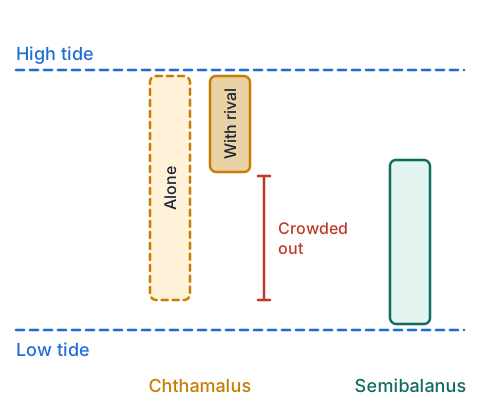
- The fundamental niche is every condition and resource a species could use with no competitors; the realised niche is the part it actually occupies when competitors are present.
- On a Scottish shore Connell found the small barnacle Chthamalus only on the upper shore; when he scraped off the larger Semibalanus below, Chthamalus settled and survived much lower down.
- So competition set Chthamalus's lower limit, while drying out set the upper limit of Semibalanus, which cannot survive long in air.
- The species that is the better competitor holds the richer zone; the weaker survives where its tolerance is higher than its rival's.
Example: wasps and birds compete for honeydew
- In South Island beech forests, scale insects living in the bark give off droplets of sugary honeydew, an important energy source for kākā, tūī and korimako (bellbirds).
- Introduced common and German wasps reach some of the highest densities in the world there and take most of the honeydew in late summer and autumn.
- Birds then spend longer foraging for less energy, and kākā breeding is limited by the food available; the wasps also kill native insects that birds eat.
- This is exploitation competition: the wasps do not attack the birds, they use the shared resource up first, and the cost falls hardest on the native species.
Mutualism
- In mutualism both species gain; some pairs cannot live apart (obligate), others benefit but can survive alone (facultative).
- Rhizobia, nitrogen-fixing bacteria in the root nodules of kōwhai, fix nitrogen gas into ammonia for the tree and receive sugars and a low-oxygen home in return.
- Lichens are a fungus and an alga or cyanobacterium together: the alga photosynthesises, the fungus holds water and minerals, and together they colonise bare rock.
- Kererū are now the only native birds big enough to swallow the large fruit of taraire, tawa and miro; they gain food and the trees gain seed carried away from the parent tree.
Example: the bat and the wood rose
- Dactylanthus (pua o te reinga) is a flowering plant with no leaves that lives underground, attached to the roots of host trees; its flowers push up through the leaf litter and give off a strong scent and lots of dilute nectar.
- The short-tailed bat (pekapeka-tou-poto) is unusual in feeding on the ground, folding its wings and scrambling through litter; it follows the scent, drinks the nectar and carries pollen to the next plant.
- Bat gains: a rich energy source in late summer and autumn, when insects are fewer. Plant gains: pollen moved between plants spread far apart, which wind and most birds cannot do at ground level.
- Both have lost from introduced mammals: possums and rats eat the flowers, so DOC protects many plants with mesh cages that let bats in but keep possums out.
Herbivory and plant defences
- Herbivores eat plants, usually without killing them, so the plant pays a cost in lost leaves, flowers or seeds.
- Possums browse the young leaves of rātā and kāmahi night after night, and heavy browsing kills whole canopies.
- Plants defend themselves with structures and chemicals: juvenile lancewood (horoeka) has long, stiff, toothed leaves pointing down, then changes leaf shape once it grows above about 3 m, the height a moa could reach.
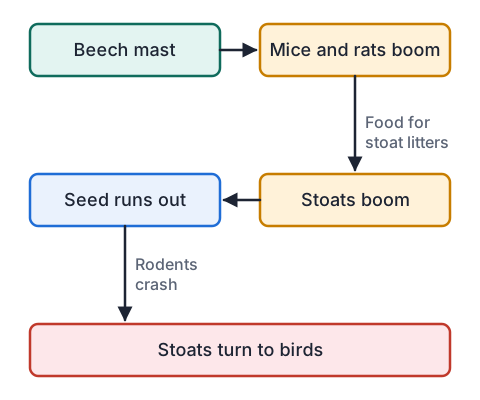
- Beech and rimu seed heavily only every few years (masting), so in most years seed-eaters stay few, and in a mast year there is far more seed than they can eat.
Predation after a mast year
- A predator kills and eats its prey, so the predator gains energy and the prey loses its life and all future reproduction.
- A beech mast feeds a boom in mice and rats, and stoats, which breed once a year, raise large litters on that plentiful food.
- When the seed runs out the rodents crash, and a large stoat population switches to birds such as mohua, kākā and kiwi chicks, which nest in holes or on the ground.
- Native birds evolved with avian predators that hunt by sight, so behaviours like freezing work against falcons but fail against mammals that hunt by smell.
Food web
Parasitism
- A parasite lives on or in a host and feeds from it over a long time, usually without killing it quickly: ectoparasites such as ticks and lice live outside, endoparasites such as tapeworms and avian malaria live inside.
- Mistletoes, such as the red mistletoe Peraxilla, are hemiparasites: they photosynthesise but tap the host's xylem for water and minerals; Dactylanthus is a full root parasite with no chlorophyll.
- Brood parasites trick another species into raising their young: the shining cuckoo (pīpīwharauroa) lays in grey warbler (riroriro) nests, and its chick pushes out the warbler's eggs.
- A parasite that killed its host quickly would lose its food and home, so selection tends to favour parasites that keep the host alive long enough to reproduce.
What Achieved, Merit and Excellence look like
- Achieved names the relationship and describes it; Merit explains how it works and what each species gains or loses; Excellence links the benefit and cost for both species to their niches and to survival and reproduction.
| Grade | A model answer |
|---|---|
| Achieved | It is mutualism: the bat gets nectar and the plant gets pollinated. |
| Merit | The bat follows the flower's scent along the forest floor and drinks its nectar, getting energy. Pollen sticks to its fur and is carried to the next plant, so Dactylanthus is cross-pollinated and can make seed. |
| Excellence | The bat forages on the ground, an unusual niche, so it can reach flowers in the leaf litter that wind and most birds never visit; the nectar gives energy in autumn, when insect prey is scarce, so bats survive to breed. Dactylanthus plants are far apart, so a mobile pollinator that seeks them by scent is the only reliable way to cross-pollinate, giving genetic variation in its seed. Each species' traits, the scent and nectar, the ground foraging, have been selected because they raise the other's visits. |
Common mistakes
- The bat pollinates the flower to help it.The bat is feeding for its own benefit; pollination is a side effect that selection has favoured in the plant.
- Wasps and birds are in a predator–prey relationship over honeydew.They compete: both use the same limited honeydew, and each lowers the amount left for the other.
- The realised niche is bigger than the fundamental niche.The realised niche is the part of the fundamental niche a species keeps once competitors and predators are present, so it is never larger.
- Mistletoe is not a parasite because it photosynthesises.It is a hemiparasite: it makes its own sugars but takes water and minerals from the host's xylem.
Measure herbivory on two plants
You need: two different garden plants or hedges, paper and a pen, a phone camera
- Choose two plants growing near each other, such as a native shrub and an exotic one, or the same plant in sun and shade.
- On each plant, take 20 leaves at random by closing your eyes and touching the plant, then opening them and checking the nearest leaf.
- For each leaf, record whether it has holes, chewed edges, mines (wiggly pale tracks) or galls, and estimate how much of the leaf is missing.
- Photograph one example of each kind of damage and, if you can find the herbivore (a caterpillar, a slug, a beetle), note it.
- Look for: a difference in the percentage of damaged leaves between the plants, and think about which defences, such as tough, hairy or bitter leaves, might explain it.
Safety: Do not handle plants with milky sap or stinging hairs, such as euphorbias and ongaonga (tree nettle), and wash your hands afterwards.
Your turn
A tūī drinks flax nectar and carries pollen on its forehead to the next flower. Name the relationship.
Possums eat the leaves of kāmahi trees. Name the relationship and the effect on each species.
Two species of Paramecium with the same diet are grown together and one dies out. Name the principle.
What is the difference between a fundamental and a realised niche?
Why is the long-tailed cuckoo's relationship with whiteheads called brood parasitism?
Show answer
1. Mutualism: the tūī gains nectar, the flax is pollinated. 2. Herbivory, a form of exploitation: the possum gains food (+), the kāmahi loses leaves and photosynthetic area (−). 3. The competitive exclusion principle: two species with identical niches cannot coexist. 4. The fundamental niche is the full range a species could occupy with no competitors; the realised niche is the smaller part it occupies when competitors are present. 5. The cuckoo lays its egg in the whitehead's nest and the whiteheads raise the cuckoo chick, losing their own brood: the cuckoo exploits their parental care.
Exam-style question: cuckoo and warbler
- The shining cuckoo spends winter in the Solomon Islands and arrives in New Zealand in September or October. The female lays one egg in each grey warbler nest she finds, and the newly hatched cuckoo chick pushes the warbler's eggs out. Grey warblers usually start their first brood in August and a second in late October.
Describe the relationship between the shining cuckoo and the grey warbler.
Explain the selective advantage of brood parasitism to the cuckoo.
Discuss how the timing of the warbler's breeding reduces the cost of the relationship to the warbler.
Show answer
1. Brood parasitism, a form of exploitation: the cuckoo gains (+) because the warbler raises its chick, and the warbler loses (−) its own eggs and the energy spent feeding the cuckoo (Achieved). 2. The cuckoo spends no energy building nests, incubating or feeding chicks, so a female can lay many eggs, one per nest, spreading the risk across many hosts; more of her energy goes into eggs, so she leaves more offspring than a bird raising one brood itself. Ejecting the warbler eggs means the chick gets all the food (Merit). 3. The warbler's first brood begins in August, before cuckoos arrive, so it is raised unparasitised and the pair still produces young that season; only the second brood is at risk. Warblers that breed early leave more surviving offspring than late breeders, so early breeding is selected for, which limits the cuckoo's impact and lets both species persist; the cuckoo in turn depends on the warbler's second brood being timed with its own arrival (Excellence links both species' timing to reproductive success).
Recap
- Competition is − / −; species with identical niches cannot coexist, so they partition resources or one is excluded.
- The realised niche is the part of the fundamental niche left once competitors are present.
- Mutualism is + / +; herbivory, predation and parasitism are + / − exploitation.
- Excellence answers explain the gain and the cost for both species, linked to each one's niche, survival and reproduction.
| Relationship | Effect | Example |
|---|---|---|
| Competition | − / − | Wasps and kākā for honeydew |
| Mutualism | + / + | Kererū and taraire |
| Herbivory | + / − | Possums and rātā |
| Predation | + / − | Stoats and mohua |
| Parasitism | + / − | Shining cuckoo and grey warbler |
Report a mistake
How is NCEA Level 3 maths going?
See the NCEA Level 3 maths guide