Biological rhythms: clocks, zeitgebers and photoperiodism
What this lesson covers
- Daily (circadian), tidal (circatidal), lunar (circalunar) and annual (circannual) rhythms, with New Zealand examples.
- Endogenous clocks, free-running periods in constant conditions, and entrainment by zeitgebers such as light.
- Reading an actogram to find activity onset, phase shifts and the free-running period.
- Photoperiodism: short-day, long-day and day-neutral plants and the critical night length.
- How the phytochrome system measures night length, and the effect of a night break.
- Explaining why anticipating a regular change gives a selective advantage.
Four environmental cycles, four rhythms
- A biological rhythm is a behaviour or process that repeats at regular intervals, matched to a regular change in the environment.
- The prefix circa- means about: in constant conditions these rhythms keep running with a period close to, but not exactly, the environmental one.
- Many organisms show more than one: a shore crab can be active when the tide is in (tidal) and mostly at night (daily).
| Rhythm | Period | Environmental cycle | Example |
|---|---|---|---|
| Circadian (daily) | About 24 h | Earth turning | Kiwi foraging after dusk |
| Circatidal | About 12.4 h | Two high tides a lunar day | Estuary crabs feeding while the mud is exposed |
| Circalunar and semilunar | About 29.5 or 14.8 days | Moon phases and spring tides | Īnanga spawning on spring tides |
| Circannual | About 365 days | Earth's orbit, seasons | Kuaka leaving New Zealand each March |
Try it: which rhythm?
Endogenous clocks and free-running periods
- An endogenous rhythm is generated inside the organism by a biological clock, while an exogenous rhythm is a direct response to an environmental change and stops when the change stops.
- The test is to keep the organism in constant conditions, such as constant darkness and temperature: if the rhythm continues, it is endogenous.
- In constant conditions the rhythm free-runs with its own period, written τ (tau); people isolated from daylight free-run at a little over 24 h, about 24.2 h.
- In mammals the master clock is the suprachiasmatic nucleus (SCN) in the hypothalamus; in every cell, clock genes switch their own transcription off through the proteins they code for, a feedback loop that takes about 24 h.
Entrainment and zeitgebers
- Because τ is not exactly 24 h, the clock must be reset every day to stay in step with the real day; this resetting is entrainment.
- A zeitgeber (time giver) is an environmental cue that resets the clock: light is the strongest for most organisms, with temperature, food and social contact as others.
- In mammals, light-sensitive ganglion cells in the retina signal the SCN, which shifts the clock and controls melatonin release from the pineal gland at night.
- Jet lag is a mismatch between the clock and local time; flying from Auckland to London needs about a day per hour of shift before the zeitgebers fully re-entrain it.
Reading an actogram
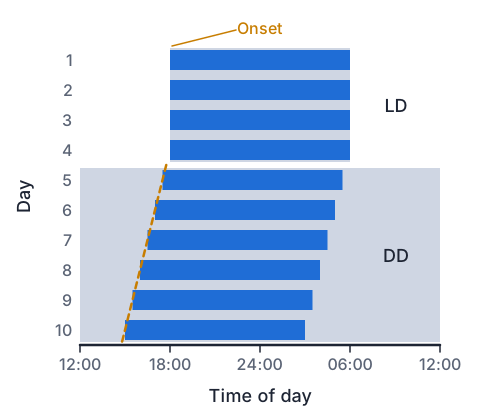
- An actogram stacks one row per day, with activity drawn as bars along a time axis, so a regular rhythm forms a vertical column.
- Grey shows darkness: on days 1 to 4 the mouse has 12 h light and 12 h dark (LD), and from day 5 it is in constant darkness (DD).
- In LD the activity starts at lights-off every day, because light entrains the clock; in DD the start of activity (onset) drifts, showing the free-running period.
- Onset moving earlier each day means τ is shorter than 24 h; onset moving later means τ is longer.
Example: finding the free-running period
- From the actogram, activity onset is 17:30 on day 5 and 15:00 on day 10.
- Calculate the free-running period of the mouse.
- shift = 17:30 − 15:00 = 2.5 h earlieronset on day 5 minus onset on day 10
- days between = 10 − 5 = 5count intervals, not rows
- daily shift = 2.5 h ÷ 5 = 0.5 h earlier per day
- τ = 24 h − 0.5 h = 23.5 h
- onset moves earlier, so τ is under 24 h
Tidal and lunar rhythms
- High tide comes about 50 minutes later each day, so tidal animals need a clock running at about 12.4 h, not 12 h; shore crabs taken into a tank away from tides keep their tidal activity for several days.
- Spring tides, the highest and lowest, come every 14.8 days, around new and full moon, when the Sun and Moon pull in line.
- Īnanga, the main whitebait species, swim up to the top of the estuary on autumn spring tides and lay eggs among grasses at the highest wet line.
- The eggs develop in damp air, safe from aquatic predators, and hatch about two weeks later when the next spring tide covers them and carries the larvae out to sea.
Try it: spring and neap tides
Photoperiodism in plants
- Photoperiodism is a response to the relative lengths of day and night, which tell a plant the season far more reliably than temperature does.
- What plants actually measure is the length of uninterrupted darkness: the critical night length is the threshold that switches flowering on or off.
- Short-day plants (really long-night plants), such as chrysanthemums and poinsettias, need nights that exceed the critical length, so they bloom in autumn.
- Long-day plants (short-night plants), such as spinach and wheat, bloom only once nights fall below the critical length, in late spring and summer; day-neutral plants such as tomatoes flower whatever the night length.
Try it: day length through the year
Phytochrome, the night timer
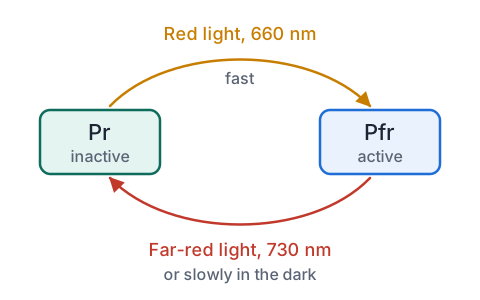
- Phytochrome is a light-absorbing protein in leaves with two forms: Pr absorbs red light (660 nm) and Pfr absorbs far-red light (730 nm).
- Daylight holds more red than far-red, so during the day Pr is quickly converted to Pfr, the active form.
- In the dark Pfr slowly reverts to Pr, so the amount of Pfr left at dawn measures how long the night was.
- A long night leaves little Pfr, which lets short-day plants flower; a short night leaves plenty of Pfr, which lets long-day plants flower. The leaves then send a flowering signal (the FT protein, florigen) through the phloem to the shoot tips.
Example: predicting a night break
- A short-day and a long-day plant both have a critical night length of 10 h. Predict whether each flowers under four treatments.
- A flash of red light in the middle of a long night turns Pr back into Pfr, so the plant reads two short nights; far-red straight after the red flash undoes it.
| Treatment | What the plant measures | Short-day plant | Long-day plant |
|---|---|---|---|
| 16 h light, 8 h dark | Short night, high Pfr at dawn | No flowers | Flowers |
| 8 h light, 16 h dark | Long night, low Pfr at dawn | Flowers | No flowers |
| 8 h light, 16 h dark with a red flash at 8 h | Two 8 h nights, high Pfr | No flowers | Flowers |
| As above, red then far-red flash | Far-red cancels red: one long night | Flowers | No flowers |
Why an internal clock is an advantage
- A clock lets an organism prepare before a change arrives instead of reacting after it: a kiwi's metabolism and senses are ready for foraging at dusk, when its earthworm prey come to the surface.
- Photoperiodism makes all the plants of a species flower in the same weeks, so cross-pollination is possible, and seed sets before winter.
- Tidal and lunar clocks time feeding and breeding to the narrow window when the shore or estuary is right, such as īnanga eggs being placed where only spring tides reach.
- Entrainment matters as much as the clock: it keeps the internal rhythm matched to the local season and day length as the year changes.
What Achieved, Merit and Excellence look like
- Achieved describes the rhythm or the advantage; Merit explains how the rhythm is timed and why it helps; Excellence links the clock, the zeitgeber and the niche to survival and reproduction.
| Grade | A model answer |
|---|---|
| Achieved | Īnanga lay their eggs at the top of the spring tide so the eggs are out of the water. |
| Merit | Spring tides happen every 14.8 days, so eggs laid at the top of one spring tide stay in damp air, away from fish that would eat them, until the next spring tide covers them and they hatch. |
| Excellence | A semilunar rhythm, entrained by the Moon's phase or the tides, brings adults to the top of the estuary on the highest tide. Eggs there sit out of the water for two weeks, safe from aquatic predators yet kept damp by grass, and the next spring tide, timed by the same cycle, is the first water to reach them, so larvae hatch exactly when they can be carried to sea. Fish that spawn at this time leave more surviving larvae than any that spawn on lower tides, where eggs would be eaten or dry out. |
Common mistakes
- Short-day plants flower when the days are short.They respond to an uninterrupted night longer than the critical length; a short flash of light at night stops them flowering even in short days.
- The rhythm stopped drifting when the lights came back, so it is exogenous.Drift in constant conditions shows it is endogenous; the lights coming back simply entrain it again.
- Onset moved 2.5 h over days 5 to 10, so τ = 24 − 2.5 ÷ 6.Days 5 to 10 is 5 intervals, not 6 rows, so the shift is 0.5 h per day and τ = 23.5 h.
- Pfr builds up in the dark.Pfr is made in red light; in the dark it slowly reverts to Pr, which is how the plant measures the night.
Does your reaction time follow a daily rhythm?
You need: a 30 cm ruler, a helper, a phone clock, paper and a pen
- Sit with your forearm on a table and your hand over the edge, finger and thumb open about 2 cm apart.
- Your helper holds the ruler with 0 cm level with your fingers and drops it without warning; catch it and read the centimetre mark at your thumb.
- Do five catches straight after waking, five in mid-afternoon and five late in the evening, and work out each mean.
- Repeat on a second day to see whether the pattern holds.
- Look for: shorter catch distances (faster reactions) in the afternoon, when body temperature and alertness peak, and longer ones soon after waking.
Safety: Keep the ruler low and drop it straight down so it cannot hit anyone's face.
Your turn
In constant darkness a hamster's activity onset moves 3 h later over 6 days. Calculate its free-running period.
A mouse has τ = 23.8 h. In constant darkness, how much earlier will its onset be after 10 days?
Name the most common zeitgeber.
A short-day plant gets 14 h of darkness, interrupted in the middle by a red flash. Will it flower?
Why do tidal animals need a clock period of about 12.4 h rather than 12 h?
Show answer
1. 3 h ÷ 6 = 0.5 h later per day, so τ = 24 + 0.5 = 24.5 h. 2. 24 − 23.8 = 0.2 h per day; 0.2 × 10 = 2 h earlier. 3. Light. 4. No: the red flash converts Pr back to Pfr, so the plant reads two short nights of 7 h and Pfr stays high. 5. High tide comes about 50 minutes later each day, because tides follow the Moon, so the cycle is about 12 h 25 min.
Exam-style question: a shore crab in a tank
- Shore crabs were collected from a beach and kept in a laboratory tank with no tides, in constant dim light and temperature. For the first four days they were most active at the times high tide occurred on their home beach; after that their peaks became later each day and less sharp.
Describe a circatidal rhythm and state what evidence shows the crabs' rhythm is endogenous.
Explain why the peaks drifted and became less sharp, and what would bring them back in time.
Discuss the selective advantage of an endogenous tidal rhythm for a crab on the shore.
Show answer
1. A circatidal rhythm repeats about every 12.4 h, matching the tides. The rhythm continued in a tank with no tides, so it is generated by an internal clock, not by the water itself (Achieved). 2. Without tides as a zeitgeber the clock free-runs with its own period, slightly different from the real tidal cycle, so each peak falls a little later; different crabs drift at different rates, so the group's peaks spread out. Returning them to the shore, where wave action and immersion reset the clock, would entrain them again (Merit). 3. The clock lets a crab become active and leave shelter just before the tide covers it, when it can feed and is hidden from shorebirds, and retreat before the tide leaves, when it would dry out and be exposed to birds and gulls. Crabs that anticipate the tide feed longer and are eaten less than ones that only react to it, so they survive and breed more, and entrainment keeps that timing right as the tide shifts each day (Excellence links clock, zeitgeber and niche).
Recap
- Circadian, circatidal, circalunar and circannual rhythms match the day, the tide, the Moon and the year.
- Endogenous rhythms continue in constant conditions with a free-running period τ, and zeitgebers such as light entrain them.
- On an actogram, onset drifting earlier means τ under 24 h; divide the total shift by the number of days between rows.
- Phytochrome measures night length: Pr to Pfr in red light, Pfr back to Pr in far-red or slowly in the dark.
| Term | Meaning |
|---|---|
| Free-running period (τ) | The clock's own period in constant conditions |
| Zeitgeber | A cue that resets the clock, mainly light |
| Critical night length | The darkness that switches flowering on or off |
| Night break | A red flash that splits one long night into two short ones |
The maths behind it
Report a mistake
How is NCEA Level 3 maths going?
See the NCEA Level 3 maths guide