Relationships within a species: territories, hierarchies, mating
What this lesson covers
- Intraspecific competition for resources: scramble and contest competition.
- Territoriality, its costs and benefits, and when defending a territory pays.
- Dominance hierarchies and ritualised agonistic behaviour.
- Cooperative behaviour, altruism and kin selection, including Hamilton's rule.
- Courtship and mating systems: monogamy, polygyny, polyandry and promiscuity, including leks.
- Writing an Excellence answer that links the process, the response and the selective advantage.
Why members of one species interact
- Members of the same species need exactly the same resources, so intraspecific competition is usually more intense than competition between species.
- They also share genes and need each other to breed, so the same population shows competition, cooperation and courtship side by side.
- For every behaviour, ask what it costs the individual in energy, time and risk, and what it gains in survival and offspring.
| Behaviour | What happens | New Zealand example |
|---|---|---|
| Territoriality | An area is defended against others of the species | Toutouwai (robin) pairs hold patches of bush all year |
| Hierarchy | Rank decides access to food and mates | Red deer stags during the autumn roar |
| Cooperation | Individuals help others raise young or find food | Pūkeko groups sharing one nest |
| Courtship | Displays before mating | Kākāpō males booming from bowls |
Try it: which behaviour?
Scramble and contest competition
- In scramble competition everyone takes what they can and the resource is shared out unevenly by luck and speed, so when it runs short, many individuals get too little and all may suffer.
- In contest competition individuals fight or display for the resource, so winners get enough and losers get little or nothing; territories and hierarchies are forms of contest.
- Both are density-dependent: the more individuals there are, the less each gets, which slows population growth as numbers rise.
- Contest is often an advantage to the population's survival in hard times, because at least some individuals get enough to breed.
Territories: when defence pays
- A territory is an area an individual, pair or group defends against others of its species, using songs, displays, scent marks and, when those fail, chases.
- Benefits include a reliable food supply, a safe nest site and mates attracted to a good territory; costs are the energy and time spent defending and the risk of injury.
- A larger territory holds more food, but the benefit levels off while defence costs keep climbing as the border gets longer and intruders more frequent.
- Territories are only worth defending when the resource is valuable and predictable enough; tūī defend a single flowering kōwhai, but leave it once the flowers are gone.
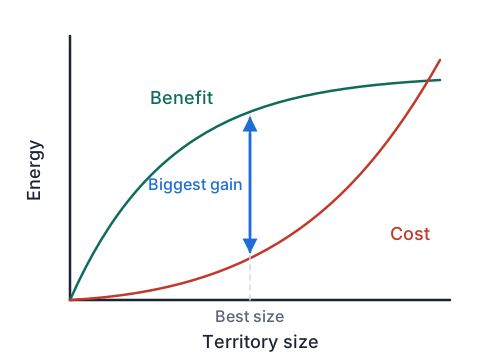
Example: why a robin defends its patch
- Toutouwai (North Island and South Island robins) live in pairs that defend the same territory of about one to a few hectares of forest all year round.
- Males sing long bouts from perches at the edges, especially in spring, and chase intruders; neighbours that know each other's boundaries rarely fight.
- Process: song and display signal ownership. Response: intruders turn back, so the owners keep a known patch with insects in the leaf litter. Advantage: the pair can feed chicks quickly in the breeding season and survive winter on a food supply they know well.
- The cost is the energy of singing and chasing, which is why disputes between familiar neighbours are settled by song rather than fights.
Dominance hierarchies
- A hierarchy ranks individuals in a group, so higher-ranked ones get first access to food, shelter and mates.
- Rank is set and kept by agonistic behaviour: threats, displays and submission signals, with real fights mostly between animals of similar strength.
- Red deer stags in the autumn roar compete by roaring contests and parallel walks, judging each other's size and stamina; only closely matched stags lock antlers.
- Ritualised contests reduce injury for both: the loser keeps its life and can breed later, and the winner avoids wounds; even low-ranked animals gain group protection from predators.
Cooperation and kin selection
- Cooperative behaviours include group hunting, alarm calls, mobbing predators and helping to raise young that are not your own.
- Pūkeko often live in groups with several breeding adults sharing one nest, and helpers, usually young from earlier seasons, incubate eggs and feed the chicks.
- Helping relatives is explained by kin selection: an individual can pass on copies of its alleles through relatives' offspring as well as its own.
- Hamilton's rule says helping is favoured when r × B > C, where r is the relatedness to those helped, B the extra offspring they raise and C the offspring the helper gives up.
Example: should a young pūkeko help or breed?
- A young pūkeko can stay and help its parents, adding 1.2 surviving full siblings, or leave and breed alone in poor habitat, raising on average 0.4 surviving chicks of its own.
- Its relatedness is 0.5 to both its own chicks and its full siblings. Which choice passes on more copies of its alleles?
- helping: 0.5 × 1.2 = 0.6 gene copiesrelatedness × extra siblings raised
- breeding alone: 0.5 × 0.4 = 0.2 gene copiesrelatedness × own chicks raised
- 0.6 > 0.2, so helping passes on three times as many copies
- in good habitat with a territory free, breeding alone could win
Courtship
- Courtship displays make sure the mate is the right species, show the mate's quality, synchronise both partners' breeding condition, and in pairs that stay together, build the pair bond.
- Tākapu (Australasian gannets) at Muriwai greet their partner with sky-pointing, bowing and fencing bills, rituals that keep the same pair together across seasons.
- Kākāpō males gather on ridges in a lek, each digging a track-and-bowl system and booming at night for months; females walk in, listen and choose a male, then raise the chicks alone.
- Displays that are costly to produce, such as nights of booming, are honest signals: only males in good condition can keep them up, so females choosing them get good genes for their chicks.
Mating systems
- Monogamy (one male, one female) is favoured when chicks need two parents: toroa (royal albatross) pairs stay together for life and share a year-long breeding effort.
- Polygyny (one male, several females) happens when a male can control females or the places they gather: kekeno (fur seal) bulls hold beach territories holding several females.
- Polyandry (one female, several males) is rare and usually means males do most of the parental care.
- In promiscuity both sexes mate with several partners; pūkeko groups and hihi, where many chicks are fathered by males outside the pair, show how mixed real systems can be.
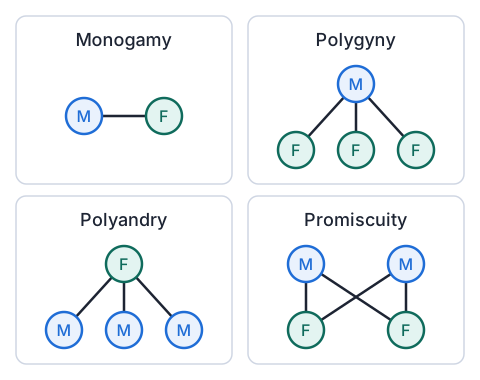
Try it: name the mating system
Writing the Excellence answer
- Describe the behaviour, then explain how it happens (the process: what signal, what response), then why it helps (survival or reproduction), and link that to this species' niche.
- Give the cost as well as the benefit and say why the benefit is bigger in this situation; comparing with the alternative, such as living alone, is often the link that earns Excellence.
- Name the selective advantage in genetic terms: individuals with the behaviour leave more offspring, so the alleles for it become more common.
- Use the example's details: the species, its food, its predators and what the question tells you, rather than a general answer that would fit any animal.
What Achieved, Merit and Excellence look like
- The three answers below are to the same question; each grade adds the next link in the chain.
| Grade | A model answer |
|---|---|
| Achieved | The robin sings and chases other robins away so it keeps its own area with food in it. |
| Merit | Singing from the edge of its territory warns other males the area is taken, so they turn away without a fight. The pair keeps the insects in that patch, so it has enough food to feed its chicks. |
| Excellence | Robins feed on insects in the leaf litter, which are spread evenly and available all year, so a fixed patch can be defended cheaply and supplies food in every season. Song signals ownership and lets known neighbours settle boundaries without fighting, keeping the cost low. A male with a territory attracts a mate and can feed chicks close to the nest, so he raises more young than a male without one, and the alleles for territorial behaviour spread. |
Common mistakes
- Helpers raise their siblings for the good of the species.Kin selection works at the level of alleles: helping relatives passes on copies of the helper's own alleles.
- Low-ranked animals gain nothing from a hierarchy.They avoid costly fights, keep group protection from predators and may rise in rank and breed later.
- A territory is wherever an animal lives and feeds.That is a home range; a territory is the part that is actively defended against others of the same species.
- The kākāpō male booms so that it attracts a female.Say why that works: booming is costly, so only fit males can keep it up, and females choosing them get chicks with better survival.
Record a pecking order
You need: a bird bath, feeder or lawn where birds feed, a notebook and pen, binoculars, if you have them, a phone timer
- Sit quietly 5 to 10 metres from a place where several birds of one species, such as sparrows or mynas, feed together.
- For 20 minutes, record every displacement: one bird flies or hops at another and the other moves away.
- If birds have marks you can tell apart (a missing feather, a pale patch), give each a letter; otherwise record which species or which sex won.
- Make a table of winners against losers and count wins for each bird.
- Look for: a clear order where A displaces B, B displaces C and so on, and fewer contests once the order is settled.
Safety: Do not handle wild birds or their droppings, and wash your hands if you touch a bird bath or feeder.
Your turn
Tadpoles in a drying puddle all feed on the same algae until it runs out. Is this scramble or contest competition?
A helper raises 2 extra full siblings (r = 0.5), or could breed alone and raise 0.6 chicks (r = 0.5). Compare the gene copies passed on.
Why do most red deer contests end in roaring and walking rather than antler fights?
A kekeno bull holds a beach territory where several females give birth and mate with him. Name the mating system.
State Hamilton's rule and say what each letter stands for.
Show answer
1. Scramble competition: no tadpole defends the algae; all share it until it runs out. 2. Helping: 0.5 × 2 = 1.0 gene copies; breeding: 0.5 × 0.6 = 0.3, so helping passes on more. 3. Ritualised displays let stags judge each other's strength, so the weaker one withdraws without injury and the winner avoids wounds; fights happen only between closely matched stags. 4. Polygyny. 5. r × B > C: r is the relatedness to the individuals helped, B the extra offspring they raise because of the help, and C the offspring the helper gives up.
Exam-style question: kākāpō leks
- Kākāpō breed only in years when rimu trees fruit heavily. In those summers males walk to ridgetops, each clears a track-and-bowl system, and booms from its bowl for up to eight hours a night for three to four months. Females travel several kilometres to the lek, mate with one male and raise the chicks alone.
Describe what a lek is and identify the mating system shown.
Explain how booming leads to a female choosing a male.
Discuss why lek mating gives an advantage to the females and to the successful males, compared with males that do not display.
Show answer
1. A lek is a gathering of males at display sites, where they compete only by display and females come to choose; males give no parental care, and a few males mate with many females, so it is a form of polygyny (Achieved). 2. The bowl acts as an amplifier, so the low-frequency boom carries several kilometres at night and leads females to the lek; females compare booming males and choose one, probably on how long and how strongly he can keep booming (Merit). 3. Booming for months costs a male a lot of body fat, so only males in the best condition can keep it up: it is an honest signal. Females raise chicks alone in a rare mast year, so choosing a high-quality male gives chicks better genes for survival; they gain nothing else from males. Successful males father many chicks while weak or silent males father none, so alleles for strong booming spread despite the cost (Excellence links signal, choice and reproductive success).
Recap
- Competition within a species is scramble (shared out) or contest (won by some); territories and hierarchies are contests.
- Defend a territory only when the benefit outweighs the rising cost; ritualised displays keep contests cheap.
- Kin selection explains helping relatives: help when r × B > C.
- Courtship and mating systems follow who cares for the young; Excellence links process, response and reproductive advantage.
| Behaviour | Advantage to the individual | Cost |
|---|---|---|
| Territory | Reliable food and nest site, attracts mates | Energy and risk of defence |
| Hierarchy | Fewer fights, group protection | Low rank eats and breeds last |
| Helping kin | Alleles passed on through relatives | Own breeding delayed |
| Lek display | Many matings for the fittest males | Months of costly booming |
Report a mistake
How is NCEA Level 3 maths going?
See the NCEA Level 3 maths guide