Homeostasis: how animals keep their internal environment stable
What this lesson covers
- Homeostasis, the internal environment, set points and negative feedback, compared with positive feedback.
- The parts of a control system: stimulus, receptors, control centre, effectors and response.
- Thermoregulation in endotherms and ectotherms, including physiological and behavioural responses.
- Blood glucose control by insulin and glucagon, and water balance by ADH and the kidney.
- How a disruption triggers responses, and how a control system breaks down, for Merit and Excellence.
How the assessment works
- This is an internal standard: you research one control system in one animal, often the human, and write a report or annotated diagram explaining it.
- Choose from body temperature, blood glucose, water balance, blood pressure or respiratory gases, and include the purpose, the parts, how they interact and what happens when the system is disrupted.
- A single specific example, such as a swimmer in cold water or a person with type 1 diabetes, gives your explanation something concrete to work through.
| Grade | What the report does |
|---|---|
| Achieved | Describes the control system: what it keeps stable, its receptors, control centre and effectors, and how negative feedback works. |
| Merit | Explains how a specific disruption sets off responses that bring the variable back to its normal range. |
| Excellence | Links ideas: the adaptive advantage of the system, the biochemical or biophysical processes behind it, or an analysis of how a particular influence breaks it down. |
Homeostasis and negative feedback
- Cells are bathed in tissue fluid, the internal environment, and their enzymes and membranes work properly only within narrow limits of temperature, pH, glucose and water.
- Homeostasis keeps each variable within a normal range around a set point, such as a core temperature of about 37 °C.
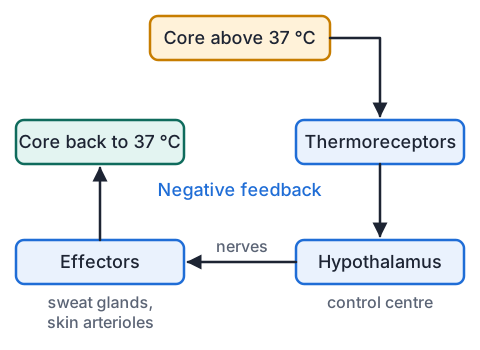
- In negative feedback a change away from the set point triggers responses that reverse the change, so the variable swings slightly above and below the set point rather than staying perfectly still.
- Positive feedback does the opposite and amplifies a change, as when oxytocin strengthens contractions during birth; it ends with an event, not a stable state, and in a homeostatic system it usually means breakdown.
The parts of a control system
- The stimulus is a change in the variable; receptors detect it, such as thermoreceptors in the skin and in the hypothalamus itself.
- The control centre compares the input with the set point and sends signals out by nerves (fast, short-lived) or hormones (slower, longer-lasting); for temperature, water and blood glucose it is the hypothalamus or the pancreas.
- Effectors, muscles and glands, carry out the response, and the changed variable is detected again by the receptors, closing the loop.
- Many systems have separate effectors for each direction, such as insulin and glucagon, which gives finer control than switching one effector on and off.
Body explorer
Endotherms and ectotherms
- Endotherms, birds and mammals, generate most of their body heat from metabolism and keep a high, steady core temperature, so they can stay active in cold air or water.
- The cost is food: an endotherm needs several times the energy of an ectotherm of the same mass, much of it simply to make heat.
- Ectotherms, such as tuatara, skinks and fish, take heat from their surroundings and regulate mostly by behaviour: basking on sunny rocks, pressing against warm surfaces, retreating to burrows.
- Tuatara are active at body temperatures as low as about 5 °C, lower than most reptiles, which suits cool southern islands but means they grow and reproduce very slowly.
Thermoregulation in a mammal
- Too hot: the hypothalamus triggers sweating, so evaporation removes heat, and widens (vasodilates) the arterioles supplying the skin, so more warm blood flows near the surface and loses heat by radiation.
- Too cold: skin arterioles narrow (vasoconstrict), keeping warm blood in the core, skeletal muscles shiver to release heat from respiration, and hair erector muscles raise the hairs to trap air.
- Brown fat releases heat directly because its mitochondria let protons leak back across the inner membrane without making ATP, and thyroxine raises metabolic rate over longer cold spells.
- Kororā (little penguins) cut heat loss in cold water with countercurrent exchange: arteries to the flippers and feet run beside veins coming back, so heat passes into the returning blood instead of the sea.
Try it: negative feedback
Example: core and skin temperature during exercise
- A Year 13 class measured one student's ear (core) temperature and forehead skin temperature every 5 minutes while she cycled on an exercise bike for 20 minutes, then rested for 10.
- Use the data to explain the control system at work.
| Time (min) | Activity | Core (°C) | Skin (°C) |
|---|---|---|---|
| 0 | Rest | 36.8 | 33.0 |
| 5 | Cycling | 37.2 | 33.8 |
| 10 | Cycling | 37.6 | 34.6 |
| 15 | Cycling | 37.8 | 35.0 |
| 20 | Cycling | 37.9 | 35.2 |
| 25 | Rest | 37.5 | 34.4 |
| 30 | Rest | 37.1 | 33.6 |
- core rise during exercise = 37.9 − 36.8 = 1.1 °Crespiration in muscles releases heat
- skin rise = 35.2 − 33.0 = 2.2 °Cvasodilation brings warm blood to the skin
- core rise from 15 to 20 min = 37.9 − 37.8 = 0.1 °Cheat loss now nearly matches heat production
- after exercise the core falls back towards 37 °C
- the core changed by only 1.1 °C while heat output rose many times: negative feedback
Blood glucose: insulin and glucagon
- Blood glucose is normally kept at about 4 to 8 mmol/L: too low and the brain, which relies on glucose, is starved; too high and water is drawn out of cells by osmosis and proteins are damaged.
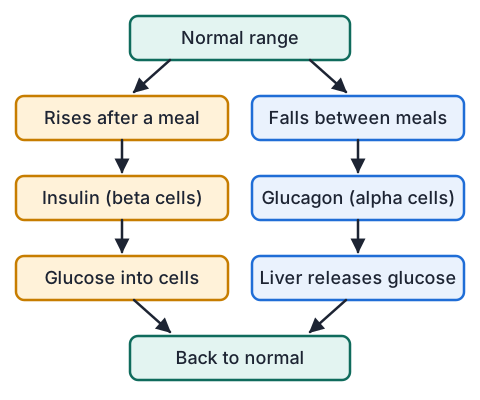
- After a meal beta cells in the islets of the pancreas detect the rise and release insulin; it makes muscle and fat cells move GLUT4 transporter proteins into their membranes so glucose enters, and makes liver cells store glucose as glycogen.
- Between meals alpha cells detect the fall and release glucagon, which makes the liver break glycogen down to glucose and make new glucose from amino acids, releasing it into the blood.
- The pancreas is both receptor and control centre here, and the two hormones act as an antagonistic pair.
Try it: up or down?
Water balance: ADH and the kidney
- Osmoreceptors in the hypothalamus detect when the blood becomes too concentrated, after sweating hard or eating salty food.
- The posterior pituitary releases antidiuretic hormone (ADH), which travels in the blood to the collecting ducts of the kidney.
- ADH makes collecting duct cells insert aquaporin water channels into their membranes, so more water moves back into the blood by osmosis and a small volume of concentrated urine is made; thirst rises too.
- When the blood is too dilute, ADH release falls, aquaporins are removed, and a large volume of dilute urine is made.
When the system breaks down
- In type 1 diabetes the immune system destroys the beta cells, so no insulin is made; glucose stays high after meals, cells switch to burning fat, and acidic ketones build up, which can be fatal without insulin injections.
- In hypothermia, such as a tramper soaked and caught in wind on the Tongariro Alpine Crossing, heat loss outruns heat production and the core drops below 35 °C; judgement fails, and below about 32 °C shivering stops and enzymes slow.
- In heat stroke, during long exertion in hot, humid weather, sweat cannot evaporate fast enough and dehydration cuts sweating, so the core rises above about 40 °C.
- In both temperature cases the extremes drive positive feedback: a cold body makes less heat and a hot one makes more, so the change speeds up instead of correcting.
Example: one disruption explained at three grades
- Each answer explains what happens when a person swims for 20 minutes in 14 °C sea water; notice what is added at each step.
| Grade | What the student wrote |
|---|---|
| Achieved | Thermoreceptors in the skin detect the cold and the hypothalamus makes the body shiver and narrows the blood vessels in the skin, so less heat is lost. This is negative feedback. |
| Merit | Water removes heat about 25 times faster than air, so the skin cools quickly and skin thermoreceptors signal the hypothalamus. It sends nerve impulses that constrict skin arterioles, keeping warm blood in the core, and make skeletal muscles shiver, releasing heat from respiration, so the core temperature stays near 37 °C. |
| Excellence | Shivering releases heat because muscle contraction uses ATP and respiration is far from 100% efficient, but it also burns glucose quickly, so after long immersion falling blood glucose and fatigue reduce shivering. Once the core drops below about 32 °C the hypothalamus itself is too cold to respond, enzymes slow and less heat is made, so heat loss speeds up: negative feedback has given way to positive feedback. Endothermy is an advantage on land, but in cold water the cost of heat production outruns the supply, which is why swimmers should leave the water before shivering becomes violent. |
Common mistakes
- When you are hot, the blood vessels move closer to the skin.Blood vessels do not move; the skin arterioles widen, so more blood flows through the surface capillaries.
- Glucagon is stored in the liver and turned into glucose.Glycogen is the stored carbohydrate; glucagon is the hormone that tells the liver to break glycogen down.
- Negative feedback keeps the temperature at exactly 37 °C.It keeps the temperature within a narrow range, with small swings above and below the set point.
- Ectotherms are cold-blooded, so they cannot control their body temperature.Ectotherms regulate mostly by behaviour, such as basking or sheltering, and can hold a fairly steady temperature.
See your skin's blood vessels respond to cold
You need: a bowl of cold tap water, a hand towel, a phone camera, a phone timer
- Photograph the backs of both hands side by side in good light, and feel how warm each one is against your cheek.
- Put one hand in the bowl of cold tap water for 1 minute, keeping the other hand dry as the control.
- Take the hand out, pat it dry and photograph both hands again straight away.
- Photograph them again after 2, 4 and 6 minutes, comparing warmth against your cheek each time.
- Look for: the cooled hand turning paler at first as skin arterioles constrict, then pinker than the control as they widen and warm blood flows back.
Safety: Use cold tap water only, never ice, and skip this if you have Raynaud's or poor circulation in your hands.
Your turn
Name the control centre for body temperature and for water balance.
In the class's data, by how much did the core temperature fall in the 10 minutes after exercise?
After a big lunch, which hormone rises and which cells release it?
Explain how ADH reduces the volume of urine.
Why does a skink bask on a rock in the morning?
Show answer
1. The hypothalamus controls both. 2. 37.9 − 37.1 = 0.8 °C. 3. Insulin, released by beta cells in the islets of the pancreas. 4. ADH makes collecting duct cells insert aquaporins into their membranes, so more water moves back into the blood by osmosis and less leaves as urine. 5. It is an ectotherm, so it absorbs heat from the sun and the warm rock to raise its body temperature until its enzymes and muscles work well enough to hunt.
Your turn: explain a disruption
A runner loses 2 L of sweat in a hot half marathon. Explain how the body reduces further water loss.
Why does glucose stay high after meals in type 1 diabetes?
Explain why hypothermia gets worse faster once the core falls below about 32 °C.
Show answer
1. Sweating makes the blood more concentrated; osmoreceptors in the hypothalamus detect this and the posterior pituitary releases more ADH, so the collecting ducts reabsorb more water and less urine is made, and thirst makes the runner drink. 2. The beta cells have been destroyed by the immune system, so no insulin is released; muscle and fat cells do not move GLUT4 into their membranes and the liver does not store glycogen, so glucose stays in the blood. 3. The hypothalamus and muscles are too cold to keep up shivering, and enzymes slow, so less heat is made; as heat production falls the core cools faster, a positive feedback that negative feedback can no longer correct.
Recap
- Homeostasis keeps the internal environment within a normal range by negative feedback: stimulus, receptor, control centre, effector, response.
- Endotherms make their own heat at a high food cost; ectotherms regulate mostly by behaviour.
- Insulin and glucagon control blood glucose; ADH and aquaporins control water balance.
- Merit explains a specific disruption and the response; Excellence links in the adaptive advantage, the biochemistry, or how the system breaks down.
| System | Receptor | Control centre | Effectors |
|---|---|---|---|
| Temperature | Skin and hypothalamic thermoreceptors | Hypothalamus | Sweat glands, arterioles, muscles |
| Blood glucose | Alpha and beta cells | Pancreas | Liver, muscle and fat cells |
| Water balance | Hypothalamic osmoreceptors | Hypothalamus and pituitary | Kidney collecting ducts |
Report a mistake
How is NCEA Level 3 maths going?
See the NCEA Level 3 maths guide