Mutation, gene flow, natural selection and genetic drift
What this lesson covers
- Evolution as a change in allele frequencies in a population's gene pool over generations.
- Mutation as the only source of new alleles, and why only germ-line mutations are inherited.
- Gene flow between populations and why it keeps populations alike.
- Stabilising, directional and disruptive selection, with what each does to a phenotype distribution.
- Genetic drift, the founder effect and bottlenecks, and why drift is strongest in small populations.
- How the four processes act together to push isolated populations apart.
Evolution is a change in the gene pool
- A gene pool is every allele carried by the breeding members of a population; an allele frequency is the share of one gene's copies that are a particular allele.
- Evolution, at the scale of a population, is a change in those allele frequencies from one generation to the next.
- Four processes change them: mutation makes new alleles, gene flow moves alleles between populations, natural selection changes them in a direction set by the environment, and genetic drift changes them at random.
- Individuals do not evolve: a possum cannot change its alleles, but the possum population's allele frequencies can change over generations.
- In Level 3 answers each process should be tied to what it does to allele frequencies and to genetic diversity, not just named.
Mutation: the only source of new alleles
- A mutation alters the DNA base sequence for good: a substitution, insertion or deletion of bases, or a larger change to a chromosome's structure or number.
- Only mutations in the germ line (cells that make eggs or sperm) reach the next generation; a mutation in a skin or liver cell dies with the individual.
- Most mutations are neutral or harmful, and a few are beneficial; whether an allele is beneficial depends on the environment, not on the mutation itself.
- Mutations are random: they are not caused by the organism needing them, so antibiotic resistance alleles exist in a bacterial population before the antibiotic arrives.
- Mutation rates per gene are tiny, so mutation adds variation slowly, but across thousands of genes and many individuals it keeps supplying the raw material that selection and drift act on.
Gene flow between populations
- Gene flow is the movement of alleles from one population to another when individuals, or their gametes such as pollen, migrate and breed.
- Immigrants can bring alleles the population lacked, raising its diversity; emigrants take alleles away.
- Gene flow makes the gene pools of connected populations more alike, so it works against divergence; populations only drift or are selected apart when gene flow between them is low.
- A barrier such as Cook Strait, a mountain range or a stretch of farmland reduces gene flow, which is the first step towards allopatric speciation.
- Conservation managers use gene flow on purpose: the Department of Conservation moves some kiwi and hihi between isolated populations so each gets new alleles.
Natural selection: stabilising, directional and disruptive
- Natural selection happens when individuals with some phenotypes survive and reproduce more than others, so the alleles behind those phenotypes become more common.
- Stabilising selection favours the average phenotype and acts against both extremes, so the mean stays the same and the variation narrows, as with human birth weight, where very light and very heavy babies historically had lower survival.
- Directional selection favours one extreme, so the mean shifts, as when an antibiotic kills all but the most resistant bacteria and the population becomes resistant.
- Disruptive selection favours both extremes over the middle, so the population can split into two forms, as in African seedcracker finches, where large-billed and small-billed birds each crack a different seed well and medium bills do neither well.
- Disruptive selection is the one that can drive sympatric speciation, if the two forms also start to mate with their own kind.
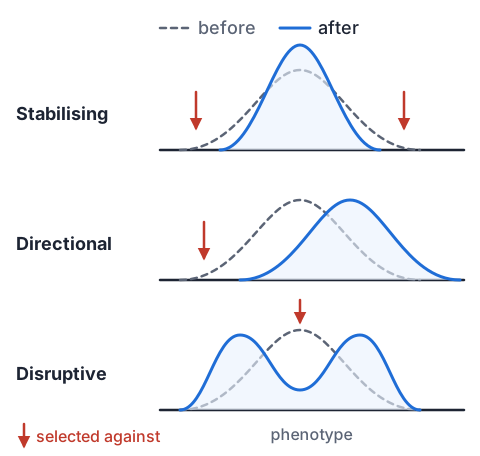
Try it: which kind of selection?
Example: allele frequencies after selection
- A population of 200 beetles has 50 BB, 100 Bb and 50 bb. B gives dark bark-coloured wings and is dominant; bb beetles are pale.
- Birds find pale beetles easily on dark bark and eat 60% of the bb beetles before they breed. Find the frequency of B before and after.
- before: B = (2 × 50) + 100 = 200 of 400 alleles, f(B) = 0.50each beetle carries two alleles
- bb eaten = 0.60 × 50 = 30, so 20 bb surviveonly the pale phenotype is selected against
- survivors: 50 BB, 100 Bb, 20 bb = 170 beetles = 340 alleles
- B = (2 × 50) + 100 = 200, f(B) = 200 ÷ 340 = 0.59
- f(b) = 140 ÷ 340 = 0.41, and 0.59 + 0.41 = 1
- b is not lost: it hides in the 100 Bb beetles, where selection cannot see itwhy a recessive allele falls slowly
Genetic drift, founders and bottlenecks
- Genetic drift is a random change in allele frequencies because only some individuals happen to breed, and which gametes meet is chance.
- Drift does not respond to the environment, so it can make a harmful allele common or lose a useful one.
- In the founder effect a few individuals start a new population, and its gene pool holds only their alleles, at frequencies set by chance; tauhou (silvereyes) that colonised New Zealand's offshore islands carry fewer alleles than the Australian birds they came from.
- In a bottleneck a population crashes, by a disaster or by people, and the survivors' alleles are all that remain; kākāpō fell to 51 known birds in 1995, so today's birds share a narrow gene pool.
- After either event, drift keeps acting strongly while the population stays small, so alleles go on being lost or fixed for generations.
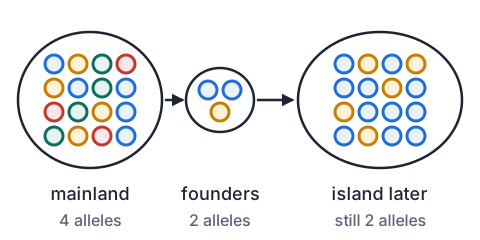
Try it: drift in a small population
Example: why size decides how strong drift is
- When N individuals breed, the next generation is a sample of 2N alleles. The typical chance change in an allele frequency p in one generation is √(p(1 − p) ÷ 2N).
- Compare a population of 10 breeding birds with one of 1000, both starting at p = 0.5.
- N = 10: √(0.5 × 0.5 ÷ 20) = √0.0125 = 0.11a typical swing of 11 percentage points in one generation
- N = 1000: √(0.5 × 0.5 ÷ 2000) = √0.000125 = 0.011about one percentage point
- so p can move from 0.5 to about 0.28 or 0.72 in one generation of the small populationtwo typical swings either way
- drift is ten times stronger in the population 100 times smaller
- a weak selective advantage of a few per cent per generation is swamped by drift when N is small
How the four processes act together
- Mutation supplies new alleles; selection and drift decide which ones become common; gene flow mixes them between populations.
- In a large, connected population gene flow and size keep drift weak, so selection does most of the work and populations stay alike.
- In a small, isolated population drift is strong and gene flow is absent, so the gene pool can change quickly in random directions as well as adaptive ones.
- When two populations are cut off, each gets its own mutations, its own selection pressures and its own drift, and with no gene flow to undo the differences their gene pools diverge.
- That divergence is what can, given enough time, make them unable to interbreed: speciation.
Try it: selection in a large population
What Achieved, Merit and Excellence look like
- Achieved defines the processes; Merit explains how each one changes allele frequencies; Excellence links several processes to each other and to the evidence in the question, saying which matters more and why.
| Grade | A model answer |
|---|---|
| Achieved | Genetic drift is a random change in allele frequency. The island population was started by a few founders, so it has fewer alleles than the mainland. |
| Merit | The founders carried only some of the mainland alleles, at chance frequencies, so the island gene pool differed from the start. Because the population is small, drift keeps changing allele frequencies a lot each generation, so alleles are lost or fixed quickly. |
| Excellence | The island gene pool started different through the founder effect and keeps changing fast because drift is strong in a small population. With the sea blocking gene flow, no mainland alleles arrive to undo those changes. The island's different predators and food also select different phenotypes, so selection and drift push the same isolated gene pool away from the mainland's, while the large, connected mainland population changes slowly because drift there is weak and gene flow keeps it uniform. |
Common mistakes
- The bacteria mutated to become resistant because they were exposed to the antibiotic.Resistance alleles arose by random mutation before exposure; the antibiotic only selected for them by killing the rest.
- Genetic drift means the population moved to a new place.Drift is a random change in allele frequencies; moving between populations is gene flow.
- Natural selection gives organisms what they need to survive.Selection can only act on variation already present; it changes how common existing alleles are.
- A bottleneck only lowers the number of individuals, so diversity returns when numbers recover.Lost alleles do not come back when numbers rise; only new mutation or gene flow can restore diversity, and both are slow.
Model directional selection on the lawn
You need: green and red paper, scissors, a lawn or a green towel, a phone timer, a partner, paper and a pen
- Cut 20 green and 20 red paper squares about 1 cm across and scatter them on the lawn or towel.
- Your partner is the predator: they pick up as many squares as they can, one at a time, in 15 seconds.
- Count the survivors of each colour; each survivor breeds, so add one new square of its colour for every survivor and scatter them all again.
- Repeat for three more generations, recording the number of each colour every time, and work out the frequency of green each generation.
- Look for: the frequency of green rising each generation, because the predator spots red more easily. That is directional selection.
Safety: Collect every paper scrap at the end so birds and pets do not swallow them, and check the lawn for bees on clover first.
Your turn
A mutation happens in a skin cell of a gecko. Can its offspring inherit the new allele?
A population of 50 breeding animals has p = 0.5. Find the typical chance change in p in one generation, √(p(1 − p) ÷ 2N).
Very light and very heavy newborn lambs die more often than average ones. Which type of selection is this?
100 snails are 36 AA, 48 Aa and 16 aa. A thrush eats half of the AA snails. Find f(A) among the survivors, to 2 decimal places.
DOC moves a few kiwi from one population to another every few years. Which process is this, and what does it do to the two gene pools?
Show answer
1. No: a skin cell is a body (somatic) cell, and only mutations in the germ line reach eggs or sperm. 2. √(0.5 × 0.5 ÷ 100) = √0.0025 = 0.05. 3. Stabilising selection: both extremes are selected against, so the average is kept and variation narrows. 4. 18 AA, 48 Aa and 16 aa survive = 82 snails = 164 alleles; A = (2 × 18) + 48 = 84, so f(A) = 84 ÷ 164 = 0.51 (it was 0.60). 5. Gene flow: it adds alleles to each population and makes the two gene pools more alike.
Exam-style question: tauhou on the islands
- Tauhou (silvereyes) crossed the Tasman from Australia on their own and became common in New Zealand from the 1850s. From the mainland, small groups later reached offshore islands such as the Chathams. Genetic studies find that each population founded in this chain carries fewer alleles than the one it came from, and some island birds are now larger than mainland birds.
Describe gene flow and genetic drift.
Explain why each new island population has fewer alleles than its source.
Explain why mutation will only slowly restore the lost diversity.
Discuss how drift, natural selection and the lack of gene flow could together make an island population of tauhou diverge from the mainland population.
Show answer
1. Gene flow is the movement of alleles between populations when individuals migrate and breed; genetic drift is a random change in allele frequencies from one generation to the next (Achieved). 2. Each island was colonised by a few founders, who carried only a sample of their source population's alleles, with rare alleles likely to be missed; this founder effect is a form of drift, and further drift in the small new population loses more alleles (Merit). 3. Mutation is the only source of brand new alleles, but the rate per gene is very low, most new mutations are harmful or neutral, and a new allele starts as a single copy that drift can easily lose in a small population (Merit). 4. The founder effect gave each island a different, smaller gene pool by chance, and drift kept changing it strongly while numbers were low. The sea limits gene flow, so mainland alleles rarely arrive to undo those differences. Island conditions, such as different food and fewer predators, select for different phenotypes, so larger body size may have been favoured by directional selection. Selection and drift both change the isolated island gene pool and gene flow does not oppose them, so the island population diverges further each generation, which could in time lead to reproductive isolation (Excellence: links all three processes to the evidence).
Natural Selection
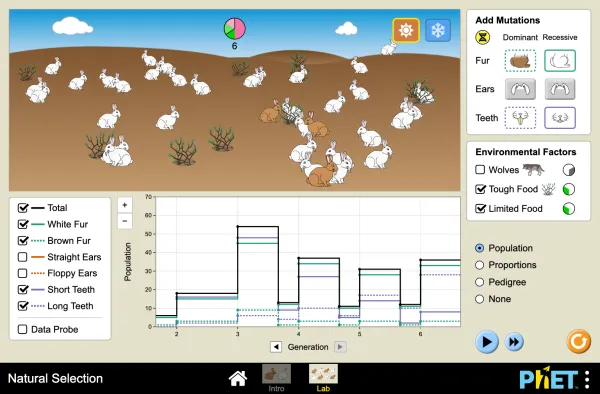
Full screen · PhET Interactive Simulations, University of Colorado Boulder, CC BY 4.0
Recap
- Evolution is a change in allele frequencies in a gene pool over generations.
- Mutation makes new alleles; gene flow moves them between populations and keeps populations alike.
- Selection is stabilising, directional or disruptive; drift is random and strongest in small populations, after a founder event or a bottleneck.
- Isolation removes gene flow, so selection and drift push gene pools apart: the road to speciation.
| Process | Effect on allele frequencies | Effect on diversity |
|---|---|---|
| Mutation | Adds new alleles, very slowly | Increases |
| Gene flow | Makes populations more alike | Usually increases |
| Natural selection | Changes them in an adaptive direction | Usually decreases |
| Genetic drift | Changes them at random, most in small populations | Decreases |
Report a mistake
How is NCEA Level 3 maths going?
See the NCEA Level 3 maths guide