The evidence for evolution: fossils, anatomy, DNA and Gondwana
What this lesson covers
- How fossils form, why the record is incomplete, and what transitional fossils show.
- Relative dating by rock layers and absolute dating by radioactive half-lives.
- Homologous, analogous and vestigial structures as evidence of shared or separate ancestry.
- Comparing DNA and protein sequences, and the idea of a molecular clock.
- Biogeography, the break-up of Gondwana, and what it does and does not explain about New Zealand's biota.
Fossils and what they can show
- A fossil is the remains or trace of an organism preserved in rock; most form when a dead organism is buried quickly in sediment, and its hard parts are slowly replaced by minerals.
- Soft-bodied organisms, land animals and anything in eroding uplands rarely fossilise, so the record is incomplete and biased towards shelled sea creatures.
- Within a sequence of rock layers, lower layers are older (superposition), so fossils show the order in which forms appeared and changed.
- Transitional fossils show mixtures of ancestral and descendant features, such as Tiktaalik (a fish with limb-like fins) and Archaeopteryx (a feathered dinosaur with teeth and wing claws).
- New Zealand has some of the world's oldest penguin fossils: Waimanu, about 60 million years old, from near Waipara, was already flightless and swam with its wings, but its wing bones were less flattened than a modern penguin's flipper and it had a long, slender beak.
Dating rocks and fossils
- Relative dating puts layers and fossils in order (older below, younger above) and uses index fossils, species that lived briefly but widely, to match layers between places.
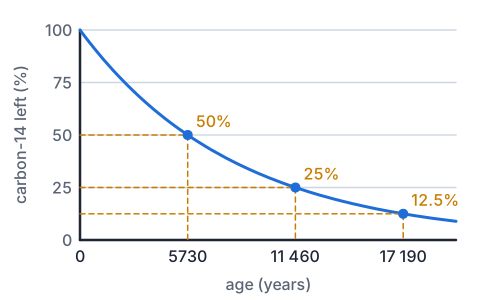
- Absolute (radiometric) dating uses radioactive isotopes, which decay at a fixed rate: the half-life is the time for half the parent atoms in a sample to decay.
- Carbon-14 (half-life 5730 years) dates once-living material up to about 50 000 years old, because after that too little carbon-14 is left to measure.
- Potassium-40 decays to argon-40 with a half-life of 1.25 billion years, so it dates volcanic rock; a fossil between two dated ash layers must be between their ages.
- In New Zealand, volcanic ash layers (tephras) from known eruptions give dated markers in lake and swamp sediments.
Try it: half-lives
Example: dating a moa bone
- A moa bone from a swamp has 12.5% of the carbon-14 a living bird would have. Find its age.
- Then find the age of a volcanic rock with 25.0% of its original potassium-40 left.
- 100% → 50% → 25% → 12.5%: 3 half-liveshalve until you reach the fraction left
- age = 3 × 5730 = 17 190 yearsmultiply by the half-life
- moa bone: about 17 200 years old
- rock: 100% → 50% → 25.0% is 2 half-lives
- age = 2 × 1.25 = 2.50 billion years
- check: 17 190 years is under 50 000, so carbon-14 is a sensible choice for the bone
Homologous structures
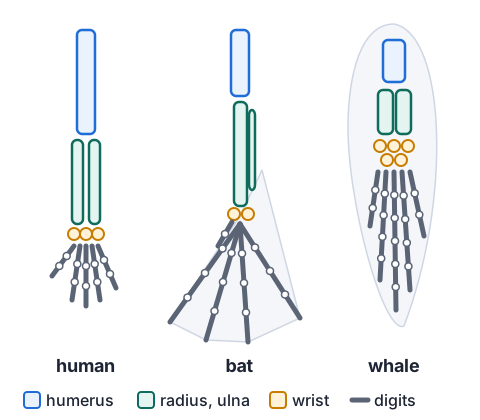
- Homologous structures have the same basic structure and position because they were inherited from a common ancestor, even if they now do different jobs.
- The forelimbs of humans, bats and whales all have one upper arm bone, two forearm bones, wrist bones and five digits, used for grasping, flying and swimming.
- No engineer would build a wing and a flipper from the same set of parts; shared ancestry followed by divergent evolution explains it.
- Vestigial structures are reduced homologous structures with little or no function, such as the tiny wings of kiwi, the hip bones inside whales and the human tailbone; they make sense only as leftovers from ancestors that used them.
Analogous structures
- Analogous structures do the same job but have different structures and origins, because they evolved separately by convergent evolution.
- Insect wings are sheets of chitin with no bones, while bird wings are modified forelimbs with feathers; both fly, but they share no common winged ancestor.
- The eyes of octopuses and humans are both camera-type eyes, but in the octopus the nerve fibres run behind the retina, so it has no blind spot; the eyes were built separately.
- Analogous structures are evidence for natural selection (similar pressures give similar solutions), but they do not show close relationship, so they must not be used to group species.
Try it: homologous, analogous or vestigial?
Molecular evidence: DNA and proteins
- All living things use DNA, the same four bases and almost the same genetic code, which points to a single common origin of life.
- The more closely two species are related, the fewer differences there are in their DNA base sequences and in the amino acid sequences of shared proteins such as cytochrome c and haemoglobin.
- Humans and chimpanzees share about 98.8% of their DNA, more than either shares with gorillas, which matches the order in which their lineages split.
- If differences build up at a roughly steady rate, they act as a molecular clock: the number of differences, divided by the rate, estimates the time since two lineages split, calibrated with dated fossils.
- Molecular evidence can test anatomy, because DNA is not fooled by convergence: it shows that kiwi are not close relatives of moa despite both being flightless New Zealand birds.
Example: a molecular clock
- A 600-base stretch of the same gene is sequenced in two species of wētā (practice numbers, not real data). They differ at 18 bases.
- Earlier work found this gene differs by 1.0% for every million years since two lineages split. Estimate when these two species shared an ancestor.
- difference = 18 ÷ 600 × 100 = 3.0%
- time = 3.0 ÷ 1.0 = 3.0 million yearsdivide by the rate
- common ancestor about 3.0 million years ago
- a clock is only an estimate: rates vary between genes and groups, and it needs fossil calibration
Biogeography and Gondwana
- Biogeography is the study of where species live; related species tend to be found near each other, and islands have species related to those on the nearest mainland.
- About 80 million years ago Zealandia began to split from Gondwana, the southern supercontinent that also held Australia, Antarctica, South America, Africa and India.
- Groups that were on Gondwana before it broke up, such as southern beech (Nothofagus) and podocarps, are now spread across the southern continents, as are fossils of the older Glossopteris flora; this splitting of a range by moving land is called vicariance.
- But much of New Zealand's life arrived later across the sea: about 25 million years ago much of Zealandia was under water, and many plants, birds and insects show DNA links to Australia that are far younger than 80 million years.
- So biogeography shows both ancient Gondwanan groups and later dispersal, and DNA dating is what separates the two.
What Achieved, Merit and Excellence look like
- Achieved describes the evidence; Merit explains how it shows evolution or relationship; Excellence weighs two or more kinds of evidence together, including their limits.
| Grade | A model answer |
|---|---|
| Achieved | Homologous structures have the same basic structure from a common ancestor. Analogous structures do the same job but evolved separately. DNA can be compared between species. |
| Merit | If the animals share homologous structures, such as the same arrangement of limb bones, they probably share a recent ancestor. Fewer differences in their DNA sequences also mean they split more recently, because differences build up over time. |
| Excellence | Anatomy alone can mislead, because similar selection pressures can produce analogous features in animals that are not close relatives, as with flightlessness in kiwi and moa. Checking whether the similar parts are built the same way separates homology from analogy, and DNA gives an independent test: a small number of sequence differences confirms close relationship, while many differences show the likeness is convergent. When fossils, anatomy and DNA agree, the relationship is strongly supported. |
Common mistakes
- Carbon-14 dating showed the dinosaur bones were 70 million years old.Carbon-14 is gone after about 50 000 years; old fossils are dated from volcanic layers using isotopes such as potassium-40.
- After two half-lives all of the isotope has decayed.Each half-life halves what is left: after two half-lives a quarter (25%) remains.
- Bird wings and insect wings are homologous because both are used for flying.They are analogous: same job, different structure and origin, produced by convergent evolution.
- New Zealand's plants and animals are all here because they rode Zealandia away from Gondwana.Some groups are Gondwanan, but DNA shows many arrived later across the sea, after much of Zealandia had been under water.
Find homologous bones in a chicken wing
You need: a cooked chicken wing, left over from a meal, a paper plate, paper towels, a toothpick, a pen and paper
- After the meal, pull the meat off a cooked chicken wing and lay the bones out on a plate in the order they were joined.
- Find the single upper wing bone, then the two thinner bones beside each other below it, then the small fused bones at the tip.
- Feel your own arm and hand and find the matching bones: humerus, radius and ulna, wrist and fingers.
- Draw both limbs side by side and colour matching bones the same colour.
- Look for: one bone, then two, then small bones, in both the wing and your arm, even though one flies and one grasps. That shared plan is homology.
Safety: Use only cooked chicken, wash your hands after touching it, and throw the bones away, because cooked bones splinter and can choke pets.
Your turn
A bone has 25% of its original carbon-14. Using a half-life of 5730 years, find its age.
Explain why carbon-14 cannot date a 2-million-year-old fossil.
Are a bat's wing and a human arm homologous or analogous?
Are a butterfly's wing and a bird's wing homologous or analogous?
Two species differ at 12 of 400 bases in a gene that changes by 1.0% per million years. Find the percentage difference and the time since they split.
Show answer
1. 100% → 50% → 25% is 2 half-lives, so 2 × 5730 = 11 460 years. 2. After about 50 000 years (nearly 9 half-lives) too little carbon-14 is left to measure, so far older fossils need a long half-life isotope such as potassium-40 in nearby volcanic rock. 3. Homologous: the same bones from a common ancestor, used for different jobs. 4. Analogous: same job, different structure and origin. 5. 12 ÷ 400 × 100 = 3.0%, so 3.0 ÷ 1.0 = 3.0 million years.
Exam-style question: where did kiwi come from?
- Zealandia began separating from Gondwana about 80 million years ago. Kiwi and moa were long thought to descend from flightless birds that were on the land when it split. A 2014 study of ancient DNA found that the closest relatives of kiwi are the extinct elephant birds of Madagascar, and that moa are most closely related to tinamous, South American birds that can fly. A small fossil kiwi relative from St Bathans in Central Otago, about 19 to 16 million years old, may have been able to fly.
Describe what biogeographic and molecular evidence are.
Explain the vicariance hypothesis for the origin of kiwi and moa.
Explain how the DNA results challenge that hypothesis.
Discuss how the fossil, molecular and biogeographic evidence together support a different origin for kiwi, and one limitation of the evidence.
Show answer
1. Biogeographic evidence is the pattern of where species and their relatives are found; molecular evidence compares DNA or protein sequences, where fewer differences mean a more recent common ancestor (Achieved). 2. Vicariance says the ancestors of kiwi and moa lived on Gondwana and were carried away on Zealandia when it split off about 80 million years ago, so they evolved in isolation from flightless ancestors already there (Merit). 3. If kiwi had been isolated since the split, their closest relatives should be other ancient New Zealand birds such as moa, but DNA shows kiwi are closest to elephant birds of Madagascar and moa to flying tinamous, so the two New Zealand groups are not each other's relatives, and flightlessness evolved separately in each (Merit). 4. Madagascar separated from the other land long before kiwi and elephant birds split, so the shared ancestor most likely flew to both places, and flight was lost later in each by convergent evolution; the St Bathans fossil fits this, as a kiwi relative that may still have flown. The tinamou link shows the same for moa ancestors. Together the evidence supports dispersal by flight after Zealandia separated, rather than vicariance. A limitation is that molecular clock dates depend on assumed rates and fossil calibration, and the St Bathans fossil is known from only a few bones, so whether it flew is uncertain (Excellence: links all three lines of evidence and evaluates them).
Recap
- Fossils show change over time; superposition gives order and radioactive half-lives give absolute ages.
- Homologous and vestigial structures show shared ancestry; analogous structures show convergence.
- Fewer DNA and protein differences mean a more recent common ancestor, and a molecular clock estimates when.
- Biogeography shows both Gondwanan groups and later arrivals, and the strongest conclusions use all the evidence together.
| Evidence | What it shows | Main limitation |
|---|---|---|
| Fossils and dating | Order and timing of change, transitional forms | Incomplete, biased record |
| Comparative anatomy | Shared ancestry (homology) or convergence (analogy) | Analogy can be mistaken for homology |
| DNA and proteins | How closely species are related, and when they split | Clock rates vary and need calibrating |
| Biogeography | Where groups arose and how they spread | Needs dating to tell old splits from later dispersal |
Report a mistake
How is NCEA Level 3 maths going?
See the NCEA Level 3 maths guide