Trends in human biological evolution
What this lesson covers
- Hominids and hominins, and where living apes and fossil species fit.
- Skeletal changes for bipedalism in the skull, spine, pelvis, femur, knee and foot.
- Trends in the skull: cranial capacity, face, jaw, teeth and brow ridge.
- The hand: opposable thumb, precision and power grips, and the link to tool use.
- Advantages and disadvantages of bipedalism, and the selection pressures that may have favoured it.
Hominids and hominins
- Hominids (the family Hominidae) are the great apes and humans: orangutans, gorillas, chimpanzees, bonobos and humans, plus their extinct relatives.
- Hominins are the narrower group: modern humans and every extinct species on our side of the split from the chimpanzee line, about 6 to 7 million years ago.
- So a chimpanzee is a hominid but not a hominin, and Australopithecus afarensis is both.
- Key hominins in order: Australopithecus afarensis (about 3.9 to 2.9 million years ago), Homo habilis (about 2.4 to 1.4 million), Homo erectus (about 1.9 million to 110 000 years ago), Homo neanderthalensis (about 400 000 to 40 000) and Homo sapiens (from about 300 000 years ago).
- Bipedalism came first; large brains came much later, so the trends did not all happen together.
Bipedalism: skull and spine
- The foramen magnum, the hole where the spinal cord leaves the skull, moved forward to sit centrally under the skull, so the head balances on top of an upright spine instead of hanging forward.
- That needs smaller neck muscles, so the bony ridges at the back of the skull where they attach are smaller in hominins.
- The human spine has an S-shape, with an inward (lumbar) curve in the lower back that brings the trunk's weight over the hips; an ape's spine is a single C-shaped curve.
- Lumbar vertebrae are larger and wedge-shaped in hominins, because they carry the whole upper body's weight when upright.
Bipedalism: pelvis, femur and knee
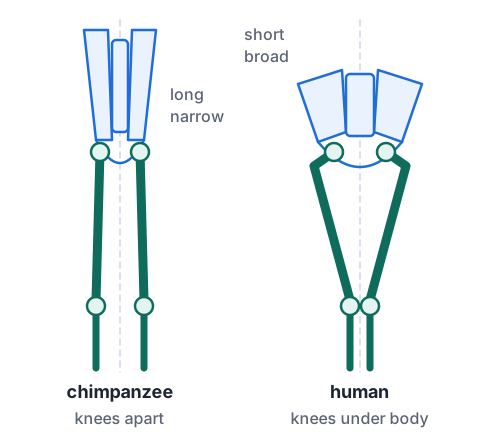
- The hominin pelvis is short, broad and bowl-shaped, which supports the guts from below and lowers the centre of gravity; the ape pelvis is long and narrow.
- The blades of the ilium curve round to the sides, so the gluteal muscles can hold the pelvis level while the body stands on one leg in each stride.
- The femur angles inwards from hip to knee (the carrying angle), putting the knees and feet under the body's centre of gravity, so the body does not sway side to side as an ape's does.
- The knee joint is larger and can lock straight, so the leg works like a pillar and standing costs little muscle energy; the femoral head is larger too, to carry all the weight on two legs.
- Legs became long relative to arms, lengthening the stride.
Bipedalism: the foot
- The big toe lines up with the other toes and cannot grasp, so it can push the body off the ground at the end of each step.
- Arches along and across the foot act as springs that absorb shock and return energy; an ape's foot is flat and flexible, for grasping branches.
- A large heel bone takes the impact of each heel strike.
- Footprints preserved in volcanic ash at Laetoli in Tanzania, about 3.6 million years old, show an arch and an in-line big toe, so hominins were walking upright by then.
Try it: ape or modern human?
Why bipedalism was selected
- Advantages: walking on two legs uses less energy than knuckle-walking over long distances, frees the hands to carry food, tools and infants, lifts the eyes above tall grass to spot predators, and exposes less of the body to the overhead sun while catching more breeze, which helps keep cool.
- Disadvantages: slower sprinting and poorer climbing, more strain on the back, knees and hips, and a narrower birth canal that makes birth difficult.
- Selection pressures thought to favour it include a cooler, drier climate in East Africa that replaced continuous forest with open woodland and grassland, so food was more spread out and long walks between trees were needed.
- Individuals that walked upright more efficiently found more food and kept cooler, so survived and reproduced more, and the alleles behind those skeletal features increased.
Try it: advantage or disadvantage of walking upright?
Trends in the skull and teeth
- Cranial capacity roughly tripled from australopithecines to modern humans, and the skull became higher and rounder, with a near-vertical forehead.
- The face became flatter (less prognathism), and the jaw and teeth smaller, as food was cut with tools and cooked rather than chewed hard.
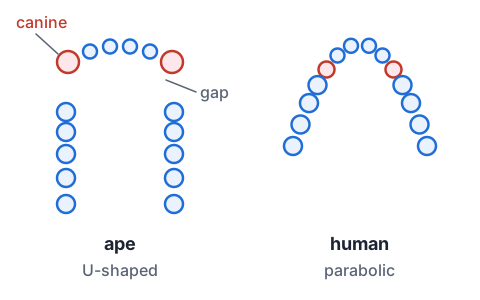
- The tooth rows changed from a U-shape with parallel sides to a curved, parabolic arch; canines shrank to the size of the other teeth, so the gap (diastema) that ape jaws need for the opposite canine disappeared.
- Brow ridges became smaller, and Homo sapiens alone has a chin; the bony sagittal crest that anchors large chewing muscles in gorillas and Paranthropus is missing in Homo.
Example: how much bigger did the brain get?
- The table gives typical cranial capacities. Find how many times bigger the Homo sapiens brain is than the A. afarensis brain, and the percentage increase.
| Species | Average cranial capacity (cm³) |
|---|---|
| Australopithecus afarensis | 430 |
| Homo habilis | 610 |
| Homo erectus | 1050 |
| Homo neanderthalensis | 1500 |
| Homo sapiens | 1300 |
- ratio = 1300 ÷ 430 = 3.0how many times bigger
- increase = 1300 − 430 = 870 cm³
- percentage increase = 870 ÷ 430 × 100 = 202%
- a tripling is a 200% increase, so 3.0 times and 202% agree
- Neanderthals had larger brains than ours, so size alone does not rank speciesbody size and brain structure matter too
The hand: precision and power
- The human thumb is long, strong and fully opposable: it can rotate to meet the tip of every finger, which gives the precision grip used to hold a needle, a pen or a small stone flake.
- The power grip wraps the fingers and thumb around an object, such as a hammerstone or a spear shaft; both grips need a powerful thumb muscle (flexor pollicis longus) that apes barely have.
- Hominin fingers became shorter and straighter with broad fingertip pads; A. afarensis still had long, curved fingers, a sign it still climbed trees.
- Freed from walking, the hand could be selected for making and using tools, and better tool use selected for a better hand and a bigger brain to plan with it: a positive feedback between biology and culture.
What Achieved, Merit and Excellence look like
- Achieved describes the feature; Merit explains how its structure helps bipedal walking; Excellence links the change to its function, the advantage it gave, and the selection pressure behind it, comparing with an ape.
| Grade | A model answer |
|---|---|
| Achieved | Humans have an arch in the foot and a big toe in line with the other toes. Apes have a flat foot with a grasping big toe. |
| Merit | The arch acts like a spring, absorbing the shock of each step and giving back energy, and the in-line big toe pushes the body forward at the end of each stride, so walking on two legs uses less energy. |
| Excellence | An ape's grasping toe and flexible flat foot suit holding branches, but on open ground they waste energy. As forests thinned and food spread out, hominins with arched feet and in-line big toes walked further for the same energy, so they found more food and reproduced more, and these features increased. The cost was losing the grasping foot, so hominins became poorer climbers, which shows a trade-off between walking and climbing. |
Common mistakes
- Humans evolved from chimpanzees.Humans and chimpanzees share a common ancestor that lived about 6 to 7 million years ago; neither is the other's ancestor.
- The foramen magnum moved to the back of the skull in bipeds.It moved forward to a central position under the skull, so the head balances on top of the spine.
- Hominins became bipedal because their brains got bigger.Bipedalism came first: australopithecines walked upright with brains of about 430 cm³, millions of years before brains expanded.
- The opposable thumb means apes cannot grip at all.Apes have opposable thumbs too, but they are short and weak, so apes lack the strong, precise grip of the fingertip pads.
Test the precision grip
You need: paper medical tape or a soft hair tie, a shirt with buttons, a pen and paper, a few grains of dry rice, a shoelace, a timer on a phone
- Time yourself doing four tasks: doing up three buttons, writing your full name, picking up five grains of rice one at a time, and tying a shoelace bow.
- Loosely tape your thumb flat against the side of your hand, or hold it there with a soft hair tie, so it cannot rotate to meet your fingertips.
- Repeat the four tasks and time them again.
- Remove the tape and compare the times in a table.
- Look for: the biggest slowdown in tasks that need the thumb tip pressed against a fingertip. That is the precision grip, and tool-making depends on it.
Safety: Keep the tape loose enough that your thumb stays warm and pink, and peel it off slowly so it does not tear the skin.
Your turn
Using the table, find the percentage increase in cranial capacity from Homo habilis to Homo erectus, to the nearest whole number.
Where is the foramen magnum in a fully bipedal hominin?
Explain how the angled femur helps bipedal walking.
Which grip is used to hold a pen?
Is a chimpanzee a hominid, a hominin, or both?
Show answer
1. 1050 − 610 = 440, and 440 ÷ 610 × 100 = 72%. 2. Central, underneath the skull, so the head balances on the spine. 3. It brings the knees and feet under the body's centre of gravity, so the body does not sway sideways with each step. 4. The precision grip: thumb tip against the fingertips. 5. A hominid only: hominins are the human line after the split from chimpanzees.
Exam-style question: three skulls
- Skull A has a cranial capacity of about 430 cm³, a projecting face, large canines and a U-shaped tooth row. Skull B has about 1050 cm³, a large brow ridge, a lower, longer braincase and no chin. Skull C has about 1300 cm³, a flat face, a high rounded braincase, a small brow ridge and a chin.
Describe two trends shown by the teeth and jaws from A to C.
Calculate the percentage increase in cranial capacity from B to C, to the nearest whole number.
Explain why the brain could only enlarge after the diet changed.
Discuss one advantage and one disadvantage of a larger brain for hominins, linking each to a selection pressure.
Show answer
1. The tooth row changed from a U-shape with parallel sides to a parabolic curve; canines became smaller with no diastema; jaws and teeth became smaller and the face flatter (Achieved for two). 2. 1300 − 1050 = 250, and 250 ÷ 1050 × 100 = 24% (Achieved). 3. Brain tissue uses a lot of energy (about 20% of a resting human's energy for about 2% of body mass), so a bigger brain could only be supported once hominins ate energy-rich food such as meat and marrow, cut with tools and later cooked, which also meant smaller teeth and jaws were enough (Merit). 4. Advantage: a larger brain allowed planning, better tools, cooperation and language, so individuals could hunt, share food and survive changing climates, and these were selected in a variable, competitive environment. Disadvantage: the large head makes birth difficult through a pelvis narrowed for bipedal walking, so babies are born helpless and need long care, and the brain's energy demand risks starvation when food is short. The trend continued because the survival benefit outweighed these costs (Excellence: links both sides to selection and to bipedalism).
Recap
- Hominids are great apes and humans; hominins are the human line after the chimpanzee split.
- Bipedalism changed the whole skeleton: a central foramen magnum, S-shaped spine, broad bowl pelvis, angled femur, locking knee and arched foot.
- Later the brain roughly tripled while the face, jaw, teeth and brow ridge shrank.
- A strong opposable thumb and precision grip linked biological change to tool use.
| Feature | Ape | Modern human |
|---|---|---|
| Foramen magnum | Towards the back | Central, under the skull |
| Spine | C-shaped | S-shaped with a lumbar curve |
| Pelvis | Long and narrow | Short, broad, bowl-shaped |
| Femur | Straight down, knees apart | Angled in, knees under the body |
| Foot | Flat, grasping big toe | Arched, in-line big toe |
| Tooth row | U-shaped, big canines, diastema | Parabolic, small canines, no gap |
Report a mistake
How is NCEA Level 3 maths going?
See the NCEA Level 3 maths guide