Patterns of evolution: divergence, convergence and radiation
What this lesson covers
- Divergent evolution from a common ancestor, and the homologous structures it leaves.
- Convergent evolution in unrelated groups under similar selection pressures, and analogous structures.
- Adaptive radiation into many niches, and why New Zealand has so many examples.
- Co-evolution between species that act as selection pressures on each other.
- Gradualism and punctuated equilibrium, and what fossil evidence each predicts.
Divergent evolution
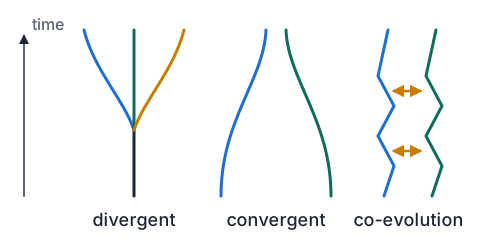
- In divergent evolution, populations of one ancestral species are exposed to different selection pressures, so they change in different directions and become more different over time.
- It usually follows a split in the population (by a barrier or a new niche), so the gene pools can no longer mix and each adapts to its own environment.
- Divergence leaves homologous structures: the same underlying structure, from the shared ancestor, modified for different jobs, such as the five-fingered limb in a human arm, a bat wing and a whale flipper.
- Kea and kākā are close relatives from one ancestor: kea adapted to the cold, open alpine zone and kākā to lowland forest, so they differ in behaviour, diet and plumage.
Convergent evolution
- In convergent evolution, unrelated species living in similar environments face similar selection pressures, so natural selection favours similar features in each.
- The similar features are analogous structures: they do the same job but are built differently and come from different ancestors, like the wings of birds and insects.
- Sharks (fish) and dolphins (mammals) both have streamlined bodies and fins, because water resists fast movement in the same way for both, yet a dolphin's skeleton, lungs and flipper bones are those of a mammal.
- Kiwi fill a niche taken by small mammals elsewhere: they are nocturnal, forage on the ground by smell, have nostrils at the tip of the bill and whisker-like feathers, and have a lower body temperature than most birds.
- Convergence can mislead: moa and emu were once grouped together because both are flightless, but DNA shows flightlessness evolved separately in different ratite lineages.
Adaptive radiation
- Adaptive radiation is rapid divergent evolution of one ancestral species into many species, each adapted to a different niche.
- It is triggered when many niches are open at once: a founder reaches islands with few competitors, new habitats form, or a mass extinction removes the competition (as mammals radiated after the dinosaurs died out 66 million years ago).
- Each group that moves into a new niche faces its own selection pressures, often with small populations and little gene flow, so divergence and speciation are fast.
- New Zealand examples include hebes (about a hundred species), mountain daisies (Celmisia), moa (nine species) and Kikihia cicadas, many of which radiated as the Southern Alps rose over the last few million years and created alpine habitats that had not existed before.
Example: tracing the hebe radiation
- Hebes range from coastal trees to tiny alpine cushions and conifer-like whipcords, but their DNA sequences differ very little from species to species.
- Build the explanation step by step.
- little DNA difference between speciesthey share a recent common ancestor
- many forms in many habitatsone lineage diverged into many niches
- mountain uplift made new alpine and subalpine habitats with few competitorsopen niches trigger radiation
- populations on separate ranges and in different habitats had little gene flowselection and drift could split them
- rapid divergence of one ancestor into many niches: an adaptive radiation
- hebes still hybridise where species meet, which fits a young radiation with mostly habitat barriers
Co-evolution
- Co-evolution is when two species are each a selection pressure on the other, so a change in one selects for a change in the other, over many generations.
- It can be mutualistic (flowers and pollinators), or an arms race (predator and prey, parasite and host), where each improvement in one is answered by the other.
- Pua o te reinga (Dactylanthus, the wood rose) is a parasitic plant that flowers at ground level with strong-smelling, nectar-rich flowers, and is pollinated mainly by the short-tailed bat (pekapeka-tou-poto), unusual among bats in folding its wings to forage on the ground.
- Many New Zealand shrubs grow a tangled, small-leaved divaricating form when young and lose it above about 3 metres, the height a moa could reach; one hypothesis is that this evolved as a defence against moa browsing.
Try it: name the pattern
Gradualism and punctuated equilibrium
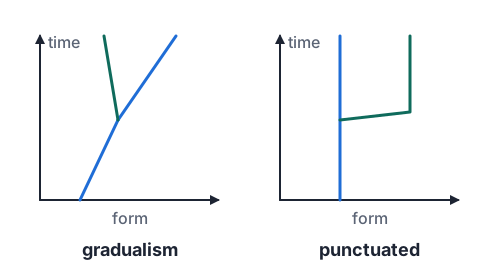
- Gradualism is the idea that species change slowly and steadily, by small changes building up over long periods, so the fossil record should show many intermediate forms.
- Punctuated equilibrium, proposed by Eldredge and Gould in 1972, is the idea that species stay much the same for long periods (stasis) and change in short bursts, usually when a small population splits off and speciates.
- Under punctuated equilibrium, few intermediate fossils are expected, because the change happens quickly in a small, local population that rarely fossilises.
- Polyploidy is an extreme punctuated event: a new species appears in one generation.
- Both patterns occur; which one fits a lineage depends on how stable its environment was and how the population split, and a gap in the fossil record can also make gradual change look sudden.
Try it: gradualism or punctuated equilibrium?
Example: comparing rates of change
- Two fossil snail lineages (practice numbers, not a real record) both grew from 12.0 mm to 18.0 mm shell length over 3.0 million years.
- In lineage A every layer shows a slightly larger shell. In lineage B the shells stay at 12.0 mm for 2.95 million years, then reach 18.0 mm within 50 000 years. Compare the rates.
- A: 6.0 mm ÷ 3.0 million years = 2.0 mm per million years, steadygradualism
- B: 50 000 years = 0.050 million yearssame units before dividing
- B, during the burst: 6.0 ÷ 0.050 = 120 mm per million years
- B, stasis: 0 mm per million years for 2.95 million years
- the average rates are equal, but B changes 60 times faster during its burst: punctuated equilibrium
- 120 ÷ 2.0 = 60
What Achieved, Merit and Excellence look like
- Achieved defines the pattern and gives an example; Merit explains how selection produces it in the context; Excellence compares it with the pattern it could be confused with, using evidence to justify the choice.
| Grade | A model answer |
|---|---|
| Achieved | Convergent evolution is when unrelated species evolve similar features because they live in similar environments. Kiwi and small mammals both forage at night on the ground by smell. |
| Merit | Kiwi are birds and mammals are not closely related, but both were selected to find food on the forest floor at night. Individuals with a better sense of smell and touch found more food and left more offspring, so these features became common in both groups separately. |
| Excellence | This is convergence, not divergence: the shared features are analogous, built differently from different ancestors, such as whisker-like feathers in kiwi but hairs in mammals. Divergence would give homologous features from a recent shared ancestor, but DNA and anatomy put kiwi firmly among birds. With no ground mammals in New Zealand, the same night-time foraging niche produced the same selection pressures, and natural selection arrived at similar solutions in two unrelated lineages. |
Common mistakes
- Dolphins and sharks look alike, so they must share a recent common ancestor.Their similarity is convergent: they are distantly related, and similar selection pressures in water produced analogous body shapes.
- Adaptive radiation and divergent evolution are the same thing.Adaptive radiation is divergent evolution that happens rapidly, from one ancestor into many species filling many niches.
- Co-evolution is when two species evolve at the same time.Co-evolution needs each species to be a selection pressure on the other, so changes in one cause changes in the other.
- Punctuated equilibrium means evolution happens overnight.The bursts take thousands of years, which is quick only compared with the millions of years of stasis around them.
Model an adaptive radiation with kitchen beaks
You need: kitchen tongs, a clothes peg, a teaspoon, a pair of chopsticks, dry rice, raisins, dry breakfast cereal, 4 bowls
- Put a different food in three bowls (rice, raisins, cereal) and keep one empty bowl as the nest.
- For each beak tool in turn, move as much of one food as you can into the nest in 20 seconds, then count or weigh it.
- Test every tool on every food and record the results in a table.
- Imagine one ancestral bird with a spoon-like beak arriving on an island with all three foods and no competitors, and decide which beak shapes its descendants would evolve for each food.
- Look for: each food has a best tool, so a single ancestor could diverge into several specialists, one per niche.
Safety: Use dry foods only, do not eat food that has been handled by everyone, and keep the chopsticks and peg away from faces.
Your turn
Sharks and dolphins have similar streamlined bodies. Which pattern of evolution is this?
Kea and kākā evolved from one ancestor into an alpine bird and a forest bird. Which pattern is this?
A fossil shell grows from 20.0 mm to 26.0 mm in 0.20 million years. Find the rate in mm per million years.
Pua o te reinga is pollinated by the short-tailed bat, which feeds on its nectar. Name the pattern.
Fossils show a species unchanged for 2 million years, then replaced quickly by a new form. Which model fits?
Show answer
1. Convergent evolution: they are unrelated, and similar selection pressures produced analogous features. 2. Divergent evolution: one ancestor, different selection pressures in different habitats. 3. 6.0 ÷ 0.20 = 30 mm per million years. 4. Co-evolution (a mutualism): each species is a selection pressure on the other. 5. Punctuated equilibrium: long stasis, then a short burst of change.
Exam-style question: the hebes
- New Zealand has about a hundred species of hebe, from coastal trees to alpine cushions. DNA differences between species are small. Whipcord hebes of the high mountains have tiny scale-like leaves pressed against the stem, and look so like conifers that one species is named cupressoides, meaning cypress-like.
Define adaptive radiation and divergent evolution.
Explain two factors that allowed hebes to radiate rapidly in New Zealand.
Explain why the likeness of whipcord hebes to conifers is convergent evolution.
Discuss whether the hebe radiation better fits gradualism or punctuated equilibrium, using the evidence given.
Show answer
1. Adaptive radiation is the rapid divergent evolution of one ancestral species into many species, each adapted to a different niche; divergent evolution is the process by which related populations become more different as they adapt to different selection pressures (Achieved). 2. The rise of the Southern Alps created many new habitats (alpine scree, bog, cushion field) with few competing plants, so open niches were available; populations on separate ranges and in different habitats had little gene flow, so selection and drift could split them into species quickly (Merit for each factor explained). 3. Whipcord hebes and conifers are not closely related, but both face cold, dry, windy conditions, so selection favoured small, tough leaves with little surface for water loss in both; the scale leaves are analogous structures built independently (Merit, Excellence if linked to the selection pressure and contrasted with homologous features). 4. Small DNA differences show the species split recently and fast, so the radiation looks like a burst of speciation rather than slow, steady change, which fits punctuated equilibrium at the scale of the group. However, there is little fossil evidence for hebes, so the pattern cannot be checked layer by layer, and each species could still have changed gradually after it formed; the DNA evidence supports a rapid burst but cannot fully rule out gradual change (Excellence: evaluates the evidence for both models).
Recap
- Divergent evolution makes related species different and leaves homologous structures.
- Convergent evolution makes unrelated species similar and leaves analogous structures.
- Adaptive radiation is fast divergence into many niches; co-evolution is two species selecting each other.
- Gradualism is slow, steady change; punctuated equilibrium is stasis broken by short bursts.
| Pattern | Ancestry | Evidence it leaves | New Zealand example |
|---|---|---|---|
| Divergent | Shared, recent | Homologous structures | Kea and kākā |
| Convergent | Not shared | Analogous structures | Kiwi and small mammals |
| Adaptive radiation | One ancestor, many species | Many forms, little DNA difference | Hebes, Celmisia, moa |
| Co-evolution | Two interacting species | Matched traits in both | Pua o te reinga and the short-tailed bat |
Report a mistake
How is NCEA Level 3 maths going?
See the NCEA Level 3 maths guide