Speciation and reproductive isolating mechanisms
What this lesson covers
- The biological species concept, and speciation as the build-up of reproductive isolation.
- Allopatric speciation after a geographic barrier, and sympatric speciation with none.
- Prezygotic isolating mechanisms: habitat, temporal, behavioural, structural and gametic.
- Postzygotic isolating mechanisms: hybrid inviability, hybrid sterility and hybrid breakdown.
- Polyploidy in plants and why a doubled hybrid is a new species at once.
- New Zealand examples: kiwi, wētā and hebes.
What a species is
- Under the biological species concept, a species is a group of populations whose members can interbreed in nature and produce fertile offspring, and cannot do so with other groups.
- Speciation is the process that turns one species into two: the gene pools stop exchanging alleles and become different enough that they could not mix again.
- A reproductive isolating mechanism (RIM) is anything that stops two groups producing fertile offspring together; speciation is complete when the isolation holds even where the groups meet.
- The concept struggles with bacteria and other asexual organisms, with fossils that cannot be tested, and with groups that still hybridise now and then, so biologists also use shared DNA and shared features to define species.
Allopatric speciation: split by a barrier
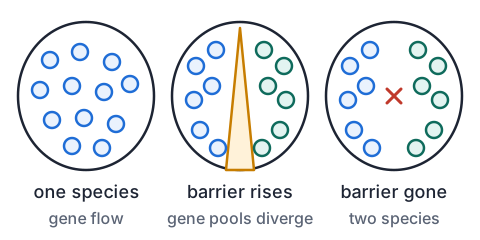
- A geographic barrier, such as a rising mountain range, a sea strait or advancing glaciers, splits one population into two and stops gene flow.
- Each side gets its own mutations, its own drift and its own selection pressures, so the two gene pools change in different directions.
- Over many generations the differences build up in mating behaviour, timing, body shape and chromosomes, and these become isolating mechanisms.
- If the barrier later disappears and the groups meet, they no longer interbreed, or their hybrids fail: they are separate species.
- Allopatric speciation is thought to be the most common mode in animals, and the uplift of the Southern Alps and the Pleistocene glaciations split many New Zealand populations this way.
Sympatric speciation: no barrier at all
- In sympatric speciation a new species forms inside the range of its parent species, with no geographic barrier to stop gene flow.
- In plants the main route is polyploidy, which isolates offspring from their parents in a single generation.
- In animals it usually starts with disruptive selection on a new food or habitat in the same place, plus mating within the group, so gene flow between the two forms falls even though they live side by side.
- Examples include cichlid fish in small crater lakes, where open-water and bottom-feeding forms have split, and insects that switch to a new host plant and then mate on it.
- Sympatric speciation is harder than allopatric because any interbreeding mixes the gene pools again, so isolation has to evolve while the groups are still in contact.
Try it: allopatric or sympatric?
Prezygotic and postzygotic isolating mechanisms
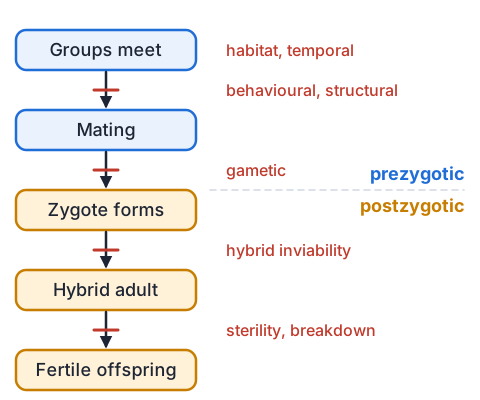
- Prezygotic mechanisms stop mating or fertilisation, so no zygote forms; they waste no energy on hybrids and so are favoured by selection.
- Postzygotic mechanisms act after fertilisation: the hybrid dies, is sterile, or its offspring are weak or sterile.
- When hybrids are less fit, selection favours individuals that avoid mating with the other group, so prezygotic barriers grow stronger; this is called reinforcement.
| Mechanism | Type | What happens |
|---|---|---|
| Habitat (ecological) | Prezygotic | The groups live or breed in different places in the same area, so rarely meet |
| Temporal | Prezygotic | They breed at different times of day or year |
| Behavioural | Prezygotic | Courtship songs, calls, dances or scents are not recognised |
| Structural (mechanical) | Prezygotic | Genitals or flower parts do not fit, so mating or pollination fails |
| Gametic | Prezygotic | Sperm and egg meet but cannot fuse |
| Hybrid inviability | Postzygotic | The hybrid embryo dies or is weak |
| Hybrid sterility | Postzygotic | The hybrid lives but makes no viable gametes, like a mule |
| Hybrid breakdown | Postzygotic | The first hybrids are fertile, but their offspring are weak or sterile |
Try it: prezygotic or postzygotic?
Example: why a mule is sterile
- A horse has 2n = 64 chromosomes and a donkey has 2n = 62. A male donkey mated with a female horse gives a mule.
- Find the mule's chromosome number and explain why it cannot make normal gametes.
- horse egg = 64 ÷ 2 = 32 chromosomesgametes are haploid
- donkey sperm = 62 ÷ 2 = 31 chromosomes
- mule = 32 + 31 = 63 chromosomes
- 63 is odd and the two sets come from different species, so many chromosomes have no matching partnerhomologous pairs are needed in meiosis I
- unpaired chromosomes separate unevenly, so gametes get the wrong numbers and failhybrid sterility, a postzygotic barrier
- the mule is healthy, so this is not hybrid inviability
Polyploidy: a new species in one generation
- A polyploid has more than two full sets of chromosomes, such as 3n, 4n or 6n; it usually arises when chromosomes fail to separate in meiosis (non-disjunction), giving a gamete with a full diploid set.
- Autopolyploidy doubles the chromosomes of one species; allopolyploidy follows a hybrid between two species, whose sets cannot pair, so the hybrid is sterile until its chromosome number doubles.
- After doubling, every chromosome has an identical partner, so meiosis works and the plant is fertile, but it cannot breed back with either parent: a cross gives an odd-numbered, sterile offspring.
- That is instant reproductive isolation in the same place, so polyploidy is sympatric speciation, and it is a sudden jump, not a slow change.
- It is common in plants because many self-pollinate or reproduce asexually, so a single new polyploid can found a population; cord grass, Spartina anglica, a weed of New Zealand estuaries, arose this way in England in the 1800s.
Example: the chromosome numbers of bread wheat
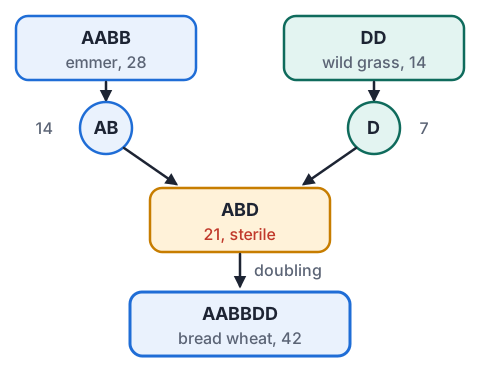
- Emmer wheat is a tetraploid with two genomes, AABB, and 28 chromosomes in total. A wild grass, Aegilops tauschii, is a diploid DD with 14.
- Work out the hybrid's chromosomes, why it is sterile, and what doubling gives.
- emmer gamete = AB = 28 ÷ 2 = 14 chromosomes
- grass gamete = D = 14 ÷ 2 = 7 chromosomes
- hybrid = ABD = 14 + 7 = 21three different single sets, no pairs
- no chromosome has a homologue, so meiosis fails and the hybrid is sterile
- doubling gives AABBDD = 2 × 21 = 42, which pairs normally: bread wheat
- bread wheat is 6n = 42, so one set (n) = 7, matching 14 ÷ 2
New Zealand examples: kiwi
- There are five kiwi species, and DNA studies show they split within the last few million years as their populations were repeatedly cut apart.
- During cold periods of the Pleistocene, glaciers and treeless land divided South Island forests into isolated refuges, stopping gene flow; each refuge population drifted and was selected separately.
- Rowi at Ōkārito and the tokoeka further south live on the same island but stayed genetically distinct, which supports allopatric splits followed by little gene flow.
- Kiwi of different species can hybridise when people put them together, which is why conservation managers keep species and even regional forms apart.
| Kiwi species | Where it lives |
|---|---|
| North Island brown kiwi | North Island forests and scrub |
| Rowi | Ōkārito forest, South Westland |
| Tokoeka | Fiordland, Haast and Rakiura (Stewart Island) |
| Great spotted kiwi (roroa) | North-west Nelson, the Paparoa Range and Arthur's Pass |
| Little spotted kiwi (kiwi pukupuku) | Predator-free islands and fenced sanctuaries |
New Zealand examples: wētā and hebes
- Tree wētā (Hemideina) have different species in Auckland, Wellington and Canterbury, and Auckland tree wētā have several chromosome races that meet in narrow zones, a possible early stage of speciation by chromosome change.
- Mountain stone wētā live on separate South Island ranges, and populations on different ranges have diverged genetically, because the valleys between act as barriers, like islands in the sky.
- Hebes (Veronica) radiated into about a hundred species in New Zealand as the mountains rose, many of them separated by habitat: coast, forest edge, bog or alpine rock.
- Hebes hybridise readily where species meet, so their isolation is mostly prezygotic and ecological, and several hebes are polyploids with double or triple the usual chromosome number.
What Achieved, Merit and Excellence look like
- Achieved defines the terms and names the isolating mechanism; Merit explains how it stops gene flow in this context; Excellence links the mechanism to the mode of speciation and compares it with the alternative.
| Grade | A model answer |
|---|---|
| Achieved | Polyploidy is having more than two sets of chromosomes. A species is a group that can interbreed and produce fertile offspring. |
| Merit | A cross between the tetraploid and a diploid gives triploid offspring. Their three sets cannot pair evenly in meiosis, so they are sterile, and no genes flow between the two groups. |
| Excellence | The tetraploid makes diploid gametes and the diploid plants haploid ones, so any hybrid is triploid and sterile: a postzygotic barrier formed in one generation. The tetraploid can still breed with itself or other tetraploids, so it is reproductively isolated from its parents and counts as a new species. Because it arose among its parent plants with no geographic barrier, this is sympatric speciation, sudden rather than the slow build-up of differences seen in allopatric speciation. |
Common mistakes
- The geographic barrier is the reason they are now different species.The barrier only stops gene flow; different mutations, selection and drift then change the gene pools until isolating mechanisms form.
- A mule is an example of hybrid inviability.A mule lives a normal life, so it shows hybrid sterility; inviability means the hybrid dies or is too weak to reach adulthood.
- Geographic isolation is a postzygotic mechanism because the animals never meet.Anything that stops mating or fertilisation is prezygotic; postzygotic means a zygote forms and the hybrid then fails.
- A polyploid plant evolves slowly over many generations.Polyploidy isolates a plant from its parents in one generation, which is why it is called instant or sudden speciation.
Model why a hybrid is sterile, and how doubling fixes it
You need: paper in two colours, scissors, a ruler, a pen
- Species A has 2n = 4: cut two long strips and two short strips from one colour. Species B has 2n = 4 too: cut two medium strips and two tiny strips from the other colour.
- Make one gamete from each species by taking one strip of each pair, and put the two gametes together: this is the hybrid, with 4 chromosomes.
- Try to line the hybrid's chromosomes up in matching pairs, as in meiosis I.
- Now cut a copy of each of the hybrid's strips to double it to 8 chromosomes, and try to pair them again.
- Look for: no matches in the hybrid, so its gametes would be unbalanced and sterile, but a perfect partner for every strip once it is doubled.
Safety: Scissors are the only sharp tool here: cut away from your fingers and keep them out of reach of small children.
Your turn
A zebra (2n = 44) and a horse (2n = 64) produce a zorse. How many chromosomes does the zorse have?
Two frog species breed in the same ponds, one in early spring and the other in summer. Name the isolating mechanism.
Two plant species with 2n = 14 and 2n = 18 hybridise. Give the hybrid's chromosome number, and its number after doubling.
Rowi and tokoeka were separated by glaciers into different forest refuges. Which mode of speciation is this?
A mule is healthy but cannot breed. Is this a prezygotic or postzygotic mechanism, and which one?
Show answer
1. 22 + 32 = 54 chromosomes. 2. Temporal isolation, a prezygotic mechanism: they breed at different times, so never mate. 3. 7 + 9 = 16 chromosomes, sterile because none pair; doubled, 2 × 16 = 32, and fertile. 4. Allopatric speciation: a geographic barrier stopped gene flow between the populations. 5. Postzygotic: hybrid sterility.
Exam-style question: cichlids in a crater lake
- Lake Apoyo in Nicaragua is a small, isolated crater lake that formed less than about 23 000 years ago. It was colonised by the Midas cichlid, a deep-bodied fish that feeds near the lake bottom. A second species, the arrow cichlid, now also lives there: it is slender, feeds in open water, and mates only with other arrow cichlids. DNA shows the arrow cichlid evolved from Midas cichlids inside the lake.
Define speciation and a reproductive isolating mechanism.
Name two isolating mechanisms that could keep the two cichlids apart, and explain how each reduces gene flow.
Explain why this is sympatric rather than allopatric speciation.
Discuss the role of natural selection in the split, and why it happened quickly.
Show answer
1. Speciation is the process by which one species splits into two or more; a reproductive isolating mechanism is anything that prevents members of two groups producing fertile offspring together (Achieved). 2. Habitat isolation: arrow cichlids live and feed in open water and Midas cichlids near the bottom, so they rarely meet to breed. Behavioural isolation: each fish chooses mates of its own body shape, so even when they meet they do not mate. Both are prezygotic and cut the flow of alleles between the groups (Merit for each linked to the fish). 3. The lake is small and isolated with no barrier inside it, both species live in the same water, and DNA shows the arrow cichlid came from Midas cichlids within the lake, so the split happened without geographic separation (Merit). 4. The open-water niche was empty, so disruptive selection favoured both slender fish that fed well in open water and deep-bodied fish that fed well on the bottom, while intermediate fish did poorly at both. Because fish also chose mates like themselves, the two forms stopped exchanging alleles, so selection could push each gene pool further apart instead of being undone by interbreeding. Strong selection on an empty niche, plus assortative mating, explains how speciation happened in under about 23 000 years, a short time in evolutionary terms (Excellence).
Recap
- A species can interbreed and produce fertile offspring; speciation is the build-up of reproductive isolation.
- Allopatric speciation follows a geographic barrier; sympatric speciation happens in the same place, by polyploidy or disruptive selection with mate choice.
- Prezygotic mechanisms stop mating or fertilisation; postzygotic ones make hybrids die or be sterile.
- Polyploidy doubles a sterile hybrid's chromosomes into a fertile, instantly isolated plant species.
| Mode | Barrier | Speed | Example |
|---|---|---|---|
| Allopatric | Geographic | Gradual, many generations | Kiwi in glacial refuges |
| Sympatric (polyploidy) | Chromosome number | One generation | Bread wheat, Spartina anglica |
| Sympatric (ecological) | Habitat and mate choice | Fast, thousands of years | Crater lake cichlids |
Report a mistake
How is NCEA Level 3 maths going?
See the NCEA Level 3 maths guide