Trends in human cultural evolution
What this lesson covers
- Cultural evolution as learned change passed on by teaching and imitation, and why it is faster than biological evolution.
- Stone tool industries from Oldowan to Upper Palaeolithic, and the trend in skill and planning.
- Fire, clothing and shelter, and how they let hominins live in colder places.
- Abstract thought: language, art and burial.
- The change from hunting and gathering to farming, and its effects.
- Positive feedback between biological and cultural evolution.
What cultural evolution is
- Cultural evolution is change in learned behaviour, knowledge and technology, passed from person to person by teaching, imitation and later language, rather than in genes.
- It can spread sideways to unrelated people in one generation and build on itself, so it is far faster than biological evolution, which needs alleles to change frequency over many generations.
- Culture lets people change their environment instead of waiting to adapt to it: clothes and fire, not thick fur, let Homo sapiens live in cold climates.
- Culture and biology interact: culture changes the selection pressures acting on bodies, and new bodies (hands, brains) make new culture possible.
Stone tool industries
- Oldowan tools are pebbles with a few flakes knocked off to make a sharp edge, and the flakes themselves were used to cut meat and smash bones for marrow.
- Acheulean hand axes are flaked all over both faces into a symmetrical teardrop, so the maker had to picture the finished shape in the stone before starting.
- Mousterian (Middle Palaeolithic) toolmakers used prepared cores: they shaped a core first, then struck off a flake of a planned size and shape (the Levallois technique), and often fixed points onto wooden shafts.
- Upper Palaeolithic toolmakers struck many long, thin blades from one core and made specialised tools from bone, antler and ivory as well, such as needles, harpoons and spear-throwers.
- The trends are more planning and more steps, more cutting edge from each kilogram of stone, more specialised tools, more materials, and faster change, as each industry lasted a shorter time than the one before.
| Industry | Began, about | Mainly made by | Key features |
|---|---|---|---|
| Oldowan | 2.6 million years ago | Homo habilis | Simple choppers and sharp flakes |
| Acheulean | 1.76 million years ago | Homo erectus | Symmetrical hand axes and cleavers |
| Mousterian | 250 000 years ago | Neanderthals, early H. sapiens | Prepared cores, scrapers, hafted points |
| Upper Palaeolithic | 50 000 years ago | Homo sapiens | Blades, bone and antler tools, needles |
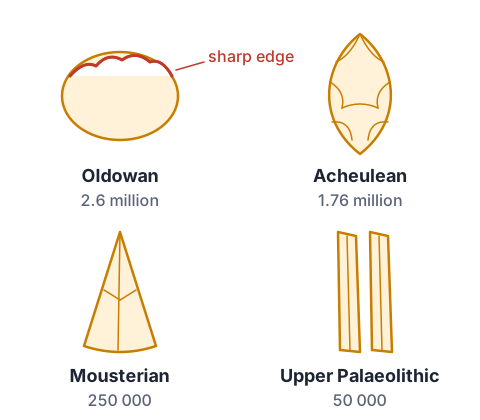
Try it: which tool industry?
Example: how fast did tool culture change?
- Use the table, taking the end of each industry as the start of the next (and 12 000 years ago as the end of the Upper Palaeolithic). Compare how long the Oldowan and the Upper Palaeolithic each lasted.
- Oldowan: 2.6 − 1.76 = 0.84 million years = 840 000 years
- Upper Palaeolithic: 50 000 − 12 000 = 38 000 years
- 840 000 ÷ 38 000 = 22how many times longer
- the Oldowan lasted about 22 times as long: change speeds up as culture builds on culture
- industries overlap in time and place, so these are rough boundaries
Fire
- Burnt bone and plant ash deep in Wonderwerk Cave in South Africa suggest Homo erectus controlled fire about 1 million years ago; regular use of hearths is clear from about 400 000 years ago.
- Cooking breaks down tough plant fibres and meat, kills parasites and releases more energy from food, which may have supported larger brains, smaller teeth and jaws, and a shorter gut.
- Fire gave warmth, light after dark and protection from predators, and let hominins live in caves and colder regions.
- It also changed social life: people gathered around hearths, which may have encouraged sharing and communication, and later fire was used to harden spear points and clear land.
Clothing and shelter
- Clothing rarely survives, so the evidence is indirect: hide scrapers and awls, eyed bone needles from about 40 000 years ago, and DNA showing that body lice (which live in clothing) split from head lice at least 83 000 years ago.
- Tailored, sewn clothing let Homo sapiens survive in the cold of northern Europe and Siberia, and eventually cross into the Americas.
- Shelter trends run from natural caves and rock shelters, to temporary camps with windbreaks and huts (including dwellings framed with mammoth bones in Ukraine), to permanent villages once people farmed.
- Each step let people stay longer in one place and spread into habitats their bodies alone could not cope with.
Abstract thought: language, art and burial
- Abstract thought is thinking about things that are not present (the past, the future, symbols and beliefs), and it shows up in language, art and ritual.
- Language leaves no fossils, but the Neanderthal hyoid bone (which supports the tongue) is like ours, and both share the human form of the FOXP2 gene, so complex speech may be older than Homo sapiens.
- Engraved ochre and shell beads at Blombos Cave in South Africa date to about 75 000 years ago; cave paintings of animals in Sulawesi are at least 51 000 years old, and Chauvet Cave in France about 36 000.
- Deliberate burials, some with grave goods such as shells and antlers, appear from about 100 000 years ago, which suggests ideas about death and identity.
- Shared symbols helped large groups cooperate, trade over long distances and pass on knowledge, which made culture much more powerful.
From hunter-gatherers to farmers
- For almost all of human history people were hunter-gatherers, moving with the seasons in small groups.
- From about 11 500 years ago people in the Fertile Crescent (south-west Asia) domesticated wheat, barley, goats and sheep, and farming arose separately in China, New Guinea, Mesoamerica and the Andes.
- Farming produced more food per hectare, so populations grew, villages became permanent, food could be stored, and some people could specialise as toolmakers, builders or leaders.
- It also brought disease from crowding and from animals, a narrower diet, harder work and, at first, shorter people with worse teeth than their hunter-gatherer ancestors.
- Māori brought kūmara, taro, uwhi and hue to Aotearoa, and adapted tropical crops to a cooler climate by storing kūmara in underground pits (rua) and warming garden soils with added gravel and sand.
Try it: hunter-gatherers or farmers?
Example: culture and biology in a feedback loop
- Explain, step by step, how a change in the hand and a change in culture can each drive the other.
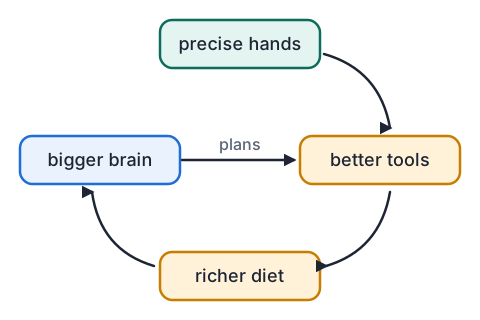
- bipedalism frees the hands; a stronger, opposable thumb allows a precision gripbiological change
- a precise grip makes sharper, more planned stone toolscultural change
- tools open up meat and marrow, a richer energy supplynew food
- extra energy can support a bigger brain, and better toolmakers survive and reproduce moreselection
- a bigger brain plans more complex tools, which again favours skilled hands
- lactase persistence spread in dairy-farming peoples: culture selecting genes, much more recently
What Achieved, Merit and Excellence look like
- Achieved describes the cultural change; Merit explains how it helped hominins survive or spread; Excellence links it to biological evolution and weighs an advantage against a disadvantage.
| Grade | A model answer |
|---|---|
| Achieved | Farming is growing crops and keeping domesticated animals. It began about 11 500 years ago in the Fertile Crescent, and people began living in permanent villages. |
| Merit | Farming gave more food from the same land, and food could be stored, so populations grew and some people could specialise in crafts other than finding food. |
| Excellence | Farming raised the food supply and let people settle, so populations and specialised skills grew quickly, a cultural change far faster than any biological one. But crowding and living with animals spread disease, and a narrow cereal diet left early farmers shorter with more tooth decay than hunter-gatherers. Culture also changed selection: in dairying peoples, the allele that keeps lactase working into adulthood became common, so a cultural change drove a biological one. |
Common mistakes
- Cultural evolution is the same as biological evolution, just about tools.Cultural evolution passes on learned behaviour by teaching and imitation; it changes no alleles directly and is much faster.
- Each tool industry was used only by one species.Industries overlapped: early Homo sapiens and Neanderthals both made Mousterian-style tools, so link tools to the main makers, not only one.
- Farming made people healthier straight away.Early farmers were often shorter, with more tooth decay and disease than hunter-gatherers, even though there were more of them.
- Fire was used to cook as soon as Homo habilis appeared.The earliest likely evidence for controlled fire is about 1 million years ago, linked to Homo erectus, long after Homo habilis appeared.
Twist a cord from garden fibres
You need: long grass, harakeke (flax) strips or raffia, scissors, a small water spray or damp cloth, a 1 litre plastic bottle with a handle, a ruler
- Cut or collect a handful of long fibres, and dampen them so they bend without snapping.
- Hold two bundles together at one end, twist each bundle the same way, then twist the two bundles around each other the opposite way, adding new fibres as each runs out.
- Make a 30 cm cord, and a second cord of the same length with the fibres just laid side by side and tied at the ends.
- Fill the bottle with water a little at a time and hang it from each cord until the cord breaks or slips, noting how much water each held.
- Look for: the twisted cord holding much more, because twisting locks short fibres together. Cordage like this made nets, bags, bindings and sewn clothing possible.
Safety: Harakeke leaf edges and grass blades can cut fingers, so pull fibres slowly, ask before cutting a plant, and keep the hanging bottle low over the floor.
Your turn
Put these in order, oldest first: Mousterian, Oldowan, Upper Palaeolithic, Acheulean.
Which tool industry first shows a symmetrical shape planned before making?
The Acheulean began about 1.76 million years ago and the Mousterian about 250 000. About how long did the Acheulean last, in years?
Give the indirect evidence that clothing is at least 83 000 years old.
Name one biological change that cooking may have allowed.
Show answer
1. Oldowan, Acheulean, Mousterian, Upper Palaeolithic. 2. Acheulean (the hand axe). 3. 1 760 000 − 250 000 = 1 510 000 years, about 1.51 million years. 4. DNA shows body lice, which live in clothing, split from head lice at least 83 000 years ago. 5. Smaller teeth and jaws (or a shorter gut, or a larger brain supported by more energy).
Exam-style question: fire
- Ash and burnt bone in Wonderwerk Cave suggest hominins were controlling fire by about 1 million years ago, and hearths are common at sites from about 400 000 years ago.
Describe two uses of fire other than cooking.
Explain how fire helped hominins move into colder environments.
Explain how cooking could have affected the biological evolution of hominins.
Discuss fire as an example of positive feedback between biological and cultural evolution, including one disadvantage of relying on it.
Show answer
1. Warmth and light at night; protection from predators; hardening wooden spear tips; a social centre where people gathered (Achieved for two). 2. Fire kept people warm without thick body hair, so they could survive cold nights and winters and live in caves in cooler regions, which let them spread to places their bodies alone could not cope with (Merit). 3. Cooked food is softer and gives more energy for less chewing and digestion, so individuals with smaller teeth, jaws and guts were not at a disadvantage, and the extra energy could support a larger, energy-hungry brain; these traits could then be selected (Merit). 4. Using fire is a cultural change that altered selection pressures: with cooked food, smaller jaws and bigger brains became possible, and a bigger brain in turn allowed better control of fire, planning, and teaching others how to make and keep it, which spread fire use further. Each change reinforced the other, so biology and culture drove each other. A disadvantage is dependence: once bodies had smaller teeth and guts, people relied on fire and fuel to eat well, and smoke in caves and hearths exposed them to lung irritation and burns (Excellence: links cause and effect both ways and weighs a disadvantage).
Recap
- Cultural evolution is learned and shared, so it is fast and can change the environment people live in.
- Tools went from Oldowan choppers to Acheulean hand axes, Mousterian prepared cores and Upper Palaeolithic blades and bone tools: more planning, more efficiency, faster change.
- Fire, clothing and shelter let hominins live in colder places; art, burial and language show abstract thought.
- Farming brought settlement and population growth, with new diseases, and culture and biology kept driving each other.
| Trend | Early | Later |
|---|---|---|
| Tools | Simple choppers and flakes | Blades, bone needles, spear-throwers |
| Fire | Occasional use | Hearths, cooking, land clearing |
| Shelter | Caves and rock shelters | Huts, then permanent villages |
| Food | Hunting and gathering | Farming and domestication |
| Abstract thought | No clear evidence | Art, ornaments, burial, language |
Report a mistake
How is NCEA Level 3 maths going?
See the NCEA Level 3 maths guide