How hominins spread across the world
What this lesson covers
- Homo erectus as the first hominin to leave Africa, and why it could.
- The Out of Africa (replacement) and multiregional models for Homo sapiens, and the evidence for each.
- Mitochondrial DNA and the Y chromosome as records of maternal and paternal ancestry.
- The serial founder effect: why genetic diversity falls with distance from Africa.
- Interbreeding with Neanderthals and Denisovans, and the DNA they left in living people.
- The settlement of the Pacific and Aotearoa, and the evidence used to trace it.
Out of Africa, the first time: Homo erectus
- All the earliest hominin fossils are African; the oldest hominin fossils outside Africa are Homo erectus, at Dmanisi in Georgia, about 1.8 million years ago, followed by sites in Java and China.
- Homo erectus had long legs and a body built for walking long distances, a larger brain, and Acheulean tools, and probably used fire later in its history, so it could follow game into new habitats.
- A diet with more meat gave it a food source available in many environments, unlike the narrow plant diets of earlier hominins.
- Its descendants in Asia lasted until about 110 000 years ago, and small island hominins such as Homo floresiensis on Flores may descend from it.
Where did Homo sapiens come from? Two models
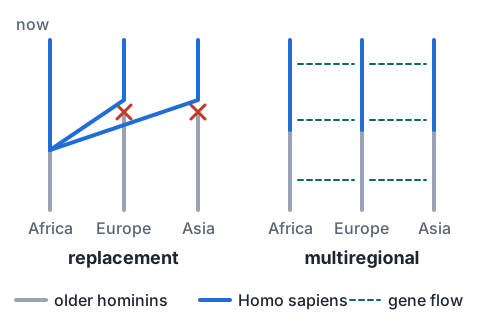
- The Out of Africa (replacement) model says Homo sapiens evolved in Africa only, then spread out across the world and replaced the older hominins (such as Neanderthals) with little or no interbreeding.
- The multiregional model says Homo erectus populations in Africa, Europe and Asia each evolved into modern humans, held together as one species by gene flow between regions.
- The oldest Homo sapiens fossils are African (Jebel Irhoud in Morocco, about 300 000 years ago), and modern humans appear much later elsewhere, which supports an African origin.
- DNA now shows that some interbreeding did happen, so most scientists accept a modified version: a recent African origin with a small amount of mixing with the hominins already outside Africa (sometimes called the assimilation model).
The spread of Homo sapiens
- Small groups left Africa earlier, reaching the Levant by about 180 000 years ago, but the main dispersal that gave rise to all living non-Africans happened about 70 000 to 50 000 years ago.
- People moved along the coast of southern Asia and reached Australia, by boat across open sea, by at least 50 000 years ago; Europe was reached by about 45 000 years ago.
- The Americas were reached across the Bering land bridge from Siberia, by at least 15 000 years ago and possibly earlier.
- Remote Oceania, the islands out of sight of each other, was the last region reached: Aotearoa was settled only about 750 years ago.
Try it: when did it happen?
Evidence from mtDNA and the Y chromosome
- Mitochondrial DNA (mtDNA) is passed only from mother to child, does not recombine, has many copies per cell and mutates fairly fast, so its changes record the maternal line over tens of thousands of years.
- The Y chromosome is passed only from father to son, and most of it does not recombine, so it records the paternal line in the same way.
- All living people's mtDNA traces back to one woman (nicknamed mitochondrial Eve) who lived in Africa roughly 150 000 to 200 000 years ago, and the deepest Y chromosome lineages are also African.
- African populations hold the most diversity in both, and all non-African lineages form one branch inside the African tree, which fits a small group leaving Africa and founding everyone else.
- She was not the only woman alive; other women's mtDNA lines simply died out when they had no daughters, by chance.
Try it: mtDNA or the Y chromosome?
The serial founder effect
- Each time a small group split off and moved on, it carried only part of its parent population's alleles: a founder effect.
- Repeated step after step across the world, this means genetic diversity falls the further a population is from East Africa, measured along likely walking routes.
- Studies of many populations find exactly this pattern, with the lowest diversity in the Americas and the Pacific, the last places settled.
- The same pattern would not appear if modern humans had evolved separately in each region, so it is strong evidence for an African origin.
Example: dating a split with mtDNA
- Two mtDNA lineages differ by 0.60% in a stretch of sequence (practice numbers, not a real study). Lineages diverge at 3.0% per million years in this stretch. Estimate when they shared a common ancestor.
- time = difference ÷ rate
- time = 0.60 ÷ 3.0 = 0.20 million years
- common ancestor about 200 000 years ago
- this fits the age of the oldest Homo sapiens fossils in Africa, so two kinds of evidence agree
Interbreeding with Neanderthals and Denisovans
- Neanderthals lived in Europe and western Asia from about 400 000 to 40 000 years ago; Denisovans are known mostly from DNA, first read from a finger bone in Denisova Cave in Siberia in 2010, and lived across Asia.
- Comparing their genomes with ours shows that people of non-African descent carry about 1 to 2% Neanderthal DNA, so Homo sapiens interbred with Neanderthals soon after leaving Africa, probably in the Middle East.
- People in Papua New Guinea and Aboriginal Australians carry about 4 to 6% Denisovan DNA, and smaller amounts are found across East Asia and among Pacific peoples, including Māori.
- Some inherited alleles were selected because they helped: a Denisovan version of the EPAS1 gene helps Tibetans cope with low oxygen at high altitude, and some immune genes came from Neanderthals.
- A bone from Denisova Cave belonged to a girl with a Neanderthal mother and a Denisovan father, so these groups also met and bred with each other.
Settling the Pacific and Aotearoa
- Near Oceania (New Guinea, the Bismarck Archipelago and the Solomons), where islands are in sight of each other, was settled more than 40 000 years ago.
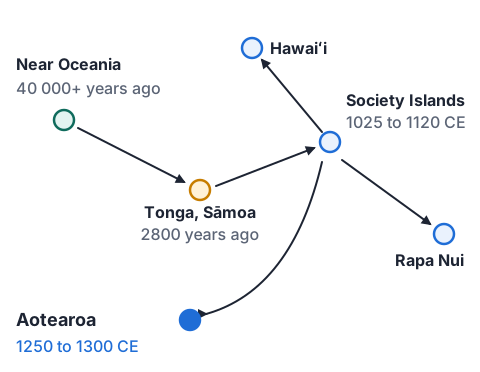
- About 3000 years ago, people of the Lapita culture, known from their stamped pottery and speaking Austronesian languages whose roots trace back to Taiwan, sailed into Remote Oceania and reached Fiji, Tonga and Sāmoa.
- After a gap of about 1800 years, voyagers settled the Society Islands and then, in a rapid burst, the far points of East Polynesia: Hawaiʻi, Rapa Nui and Aotearoa.
- They sailed double-hulled waka, navigating by stars, swells and birds, and carried kūmara, taro, hue, kiore and kurī.
- The evidence includes radiocarbon dates on short-lived seeds and on kiore-gnawed seeds and bones, the DNA of kiore (which could only travel with people), human mtDNA, pottery and language.
| Islands | First settled (CE) |
|---|---|
| Society Islands | 1025 to 1120 |
| Remote East Polynesia: Hawaiʻi, Rapa Nui, Aotearoa | 1190 to 1290 |
Example: how long was the voyage?
- Rarotonga, in the southern Cook Islands, is about 3000 km from the north of Aotearoa. Assume a waka averaged 150 km a day.
- Estimate the voyage time and the waka's average speed in km/h.
- time = 3000 ÷ 150 = 20 days
- speed = 150 ÷ 24 = 6.25 km/h, about 6 km/ha brisk walking pace, all day and night
- 20 days needs water and food for everyone aboard, plus plants and animals to start a settlementwhy voyages were planned
- rat DNA and dates fit deliberate voyages with settlers and supplies, not drifting canoes
What Achieved, Merit and Excellence look like
- Achieved describes the evidence; Merit explains what it shows about where people came from; Excellence combines several lines of evidence and judges how far each supports the conclusion.
| Grade | A model answer |
|---|---|
| Achieved | Kiore are Pacific rats that travelled on waka with people. Their bones and the seeds they gnawed can be radiocarbon dated. |
| Merit | Kiore cannot swim between distant islands, so they only arrived with people. Dating kiore bones and kiore-gnawed seeds shows when people first reached each island, and comparing kiore mtDNA between islands shows which islands were linked by voyages. |
| Excellence | Because kiore travelled only with people, their arrival dates the arrival of humans, and short-lived seeds they gnawed give tighter radiocarbon dates than long-lived materials, which pointed to settlement of Aotearoa around 1250 to 1300 CE rather than much earlier. Kiore mtDNA traces repeated voyages between islands, adding to human mtDNA and language evidence that settlers came from East Polynesia. Each line has limits (dates have error ranges, and DNA shows links but not direction), but together they agree on a late, rapid, deliberate settlement. |
Common mistakes
- Homo sapiens was the first hominin to leave Africa.Homo erectus left Africa about 1.8 million years ago, long before Homo sapiens evolved.
- Mitochondrial Eve was the only woman alive at the time.Many women lived then; only her mtDNA line happens to survive, because other lines ended with women who had no daughters.
- Mitochondrial DNA comes from both parents.mtDNA comes only from the mother, through the egg's mitochondria; the Y chromosome traces the father's line.
- The Out of Africa model is wrong because people carry Neanderthal DNA.The origin was still African; the DNA shows a small amount of interbreeding, so the replacement was not complete.
Model the serial founder effect
You need: Lego bricks or buttons in 8 colours, about 15 of each, 2 bowls, a cloth or tea towel to cover a bowl, paper and a pen
- Put 3 pieces of each colour (24 in all) into a bowl: this is the population in Africa. Record that it has 8 colours.
- Without looking, take out 6 pieces: these are the founders who move on. Record how many colours they have.
- Make the next population by putting 4 pieces into the empty bowl for every founder piece, matching colours, so it has 24 pieces again.
- Repeat the founding step four more times, each new population founded from the last, recording the number of colours each time.
- Look for: colours lost at most steps and never regained, so the last population has the fewest. Human genetic diversity falls with distance from Africa in the same way.
Safety: Small bricks and buttons are a choking hazard, so do this away from children under three and count every piece back into the box.
Your turn
Which hominin was the first known to leave Africa, and about when?
From which parent do you inherit your mitochondrial DNA?
A haploid human genome is about 3.1 billion bases. How many bases is 4% Denisovan DNA?
Explain why African populations are the most genetically diverse.
Put these in order of first settlement: Aotearoa, Tonga, the Society Islands.
Show answer
1. Homo erectus, about 1.8 million years ago (Dmanisi, Georgia). 2. Your mother only. 3. 0.04 × 3.1 billion = 0.124 billion = 124 million bases. 4. Humans have lived in Africa longest, so more mutations have built up there, and everyone outside Africa descends from small groups that carried only part of that diversity (founder effects). 5. Tonga (Lapita, about 2800 years ago), the Society Islands (about 1025 to 1120 CE), then Aotearoa (about 1250 to 1300 CE).
Exam-style question: our mixed ancestry
- Fossils show that Homo sapiens lived in Africa from about 300 000 years ago, while Neanderthals lived in Europe and western Asia and Denisovans in Asia. Living people of European and Asian descent carry about 1 to 2% Neanderthal DNA, and Papuans carry about 4 to 6% Denisovan DNA. African populations have the greatest mtDNA diversity of any region.
Describe the Out of Africa (replacement) model.
Explain how mtDNA evidence supports an African origin for Homo sapiens.
Explain why Papuans carry Denisovan DNA but most Europeans do not.
Discuss whether the evidence supports a strict replacement model, the multiregional model, or something between.
Show answer
1. Homo sapiens evolved in Africa only, then spread to the rest of the world and replaced the earlier hominins living there, with little or no interbreeding (Achieved). 2. mtDNA is inherited from the mother without recombination, so lineages can be traced back; all human mtDNA traces to an ancestor in Africa, African populations hold the most diversity because people have lived there longest, and non-African lineages form one branch within the African ones, fitting a small founding group leaving Africa (Merit). 3. The ancestors of Papuans travelled east through Asia, where Denisovans lived, and interbred with them before reaching New Guinea; the ancestors of Europeans moved west, where there were Neanderthals but few or no Denisovans, so they gained Neanderthal DNA but not Denisovan (Merit). 4. The African fossils, the mtDNA tree and the fall in diversity away from Africa support a recent African origin, which the multiregional model cannot explain, because separate regional evolution would not produce a single African-rooted tree or the serial founder pattern. But the 1 to 2% Neanderthal and 4 to 6% Denisovan DNA shows that the replacement was not total: Homo sapiens interbred with the hominins it met. So the evidence supports something between, a mostly African origin with limited interbreeding (assimilation), with the small percentages showing that most of our genome is still African in origin (Excellence).
Recap
- Homo erectus left Africa about 1.8 million years ago; Homo sapiens evolved in Africa and spread out mainly 70 000 to 50 000 years ago.
- Fossils, mtDNA (maternal), the Y chromosome (paternal) and falling diversity with distance all point to an African origin.
- Non-Africans carry 1 to 2% Neanderthal DNA, and Papuans 4 to 6% Denisovan DNA, so the replacement was not complete.
- Remote Oceania was settled last, with Aotearoa reached about 1250 to 1300 CE by deliberate voyaging.
| Event | About when |
|---|---|
| Homo erectus at Dmanisi | 1.8 million years ago |
| Earliest Homo sapiens fossils, Morocco | 300 000 years ago |
| Main dispersal out of Africa | 70 000 to 50 000 years ago |
| Australia reached | At least 50 000 years ago |
| Lapita reach Fiji, Tonga and Sāmoa | About 2800 years ago |
| Aotearoa settled | About 1250 to 1300 CE |
Report a mistake
How is NCEA Level 3 maths going?
See the NCEA Level 3 maths guide