Definite integrals: 7 exam questions solved step by step
What this lesson covers
- A definite integral gives a signed area, so regions below the axis count as negative.
- The area between two curves is the integral of the top curve minus the bottom one.
7 questions, one method
- 1. Integrate: show F(x), no + c.
- 2. F(b) − F(a), with brackets.
- 3. Areas: split at the roots.
- 4. Two curves: top minus bottom.
Question 1 · Achieved
- Evaluate ∫₋₁² (4x³ − 6x + 2) dx
Q1: ∫₋₁² (4x³ − 6x + 2) dx
- Integrate each term.
- Brackets around F(−1).
- F(x) = x⁴ − 3x² + 2xintegrate
- F(2) = 16 − 12 + 4 = 8top limit
- F(−1) = 1 − 3 − 2 = −4bottom limit
- F(2) − F(−1) = 8 − (−4)brackets
- = 12
- 8 − 1 − 3 − 2 = 2brackets dropped
Question 2 · Achieved
- Evaluate exactly
- ∫ from 0 to π/6 of 4 sin 2x dx
Q2: 4 sin 2x, from 0 to π/6
- Reverse chain rule: ÷ 2.
- Radians, not degrees.
- ∫ sin 2x dx = −(1/2)cos 2xreverse chain rule
- ∫ 4 sin 2x dx = −2 cos 2x× 4
- = [−2 cos 2x] from 0 to π/6
- x = π/6: −2 cos(π/3) = −1top limit
- x = 0: −2 cos 0 = −2bottom limit
- −1 − (−2) = 1brackets
Question 3 · Merit
- Find the area enclosed by
- y = x² − 2x − 3 and the x-axis.
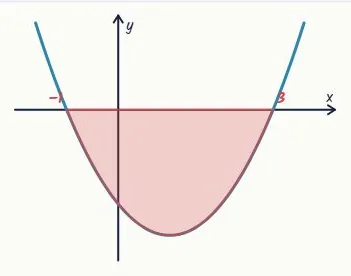
Q3: a region below the axis
- The roots are the limits.
- An area is positive.
- x² − 2x − 3 = (x − 3)(x + 1)factorise
- x = −1 or x = 3
- F(x) = x³/3 − x² − 3xintegrate
- F(3) = 9 − 9 − 9 = −9top limit
- F(−1) = −1/3 − 1 + 3 = 5/3bottom limit
- ∫₋₁³ = −9 − 5/3 = −32/3below the axis
- Area = 32/3 ≈ 10.7 units²
Question 4 · Merit
- y = x³ − 3x² + 2x
- Find the total area between the curve
- and the x-axis from x = 0 to x = 2.
- Careful: the curve crosses the axis.
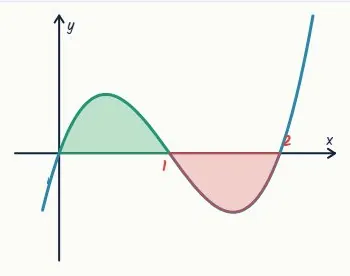
Q4: roots, then F at each one
- Split where it crosses.
- F at 0, 1 and 2.
- x³ − 3x² + 2x = x(x − 1)(x − 2)
- roots: x = 0, 1, 2
- F(x) = x⁴/4 − x³ + x²integrate
- F(0) = 0
- F(1) = 1/4 − 1 + 1 = 1/4
- F(2) = 4 − 8 + 4 = 0
- ∫₀² = F(2) − F(0) = 0not the area
Q4: add the sizes
- One integral per region.
- Add sizes, not signs.
- F(0) = 0, F(1) = 1/4, F(2) = 0
- ∫₀¹ = 1/4 − 0 = 1/4above the axis
- ∫₁² = 0 − 1/4 = −1/4below the axis
- Area = 1/4 + 1/4add the sizes
- = 1/2 unit²
- 1/4 + (−1/4) = 0pieces give ∫₀²
Question 5 · Merit, in context
- A garden bed is the region between
- y = x² and y = 8 − x², in metres.
- Find the area of the bed.
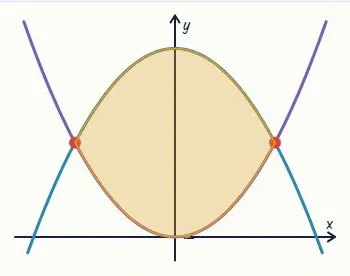
Q5: between two curves
- Limits: where they meet.
- Top minus bottom.
- x² = 8 − x²set equal
- 2x² = 8, x² = 4, x = ±2
- A = ∫₋₂² ((8 − x²) − x²) dxtop − bottom
- = ∫₋₂² (8 − 2x²) dx
- = [8x − 2x³/3]₋₂²integrate
- F(2) = 16 − 16/3 = 32/3
- F(−2) = −16 + 16/3 = −32/3
- A = 32/3 − (−32/3) = 64/3
- ≈ 21.3 m²
Question 6 · Excellence
- The line y = kx, with k > 0, and
- the curve y = x² enclose an area
- of 36 square units. Find k.
Q6: y = kx and y = x²
- The limits depend on k.
- Area in k, then solve.
- x² = kxset equal
- x(x − k) = 0, so x = 0 or k
- kx ≥ x² for 0 ≤ x ≤ kthe line is on top
- A = ∫₀ᵏ (kx − x²) dxtop − bottom
- = [kx²/2 − x³/3]₀ᵏk is a constant
- = k³/2 − k³/3 = k³/6
- k³/6 = 36, so k³ = 216
- k = 6
- 6³/6 = 216/6 = 36
Question 7 · Excellence
- Find a > 0 so that
- ∫₀ᵃ (3x² − 6x) dx = 0.
- Explain what this means for area.
Q7: solve for a
- Integrate, set to 0.
- Reject with a reason.
- [x³ − 3x²]₀ᵃ = 0integrate
- a³ − 3a² = 0F(0) = 0
- a²(a − 3) = 0factorise
- a = 0a > 0, no width
- a = 3
Q7: what the zero means
- Find where it crosses.
- Signed areas cancel.
- a = 3
- 3x² − 6x = 3x(x − 2): roots 0, 2
- ∫₀² = 8 − 12 = −4below the axis
- ∫₂³ = 0 − (−4) = 4above the axis
- area below = area above = 4
- total area 8 units², not 0
The method that solved all seven
- Integrate, substitute with brackets, split at roots.
| Step | How |
|---|---|
| Integrate | show F(x), no + c |
| Substitute | F(b) − F(a), with brackets |
| Below axis | split at the roots |
| Add areas | add sizes, not signs |
| Two curves | top minus bottom |
| Unknown | reject a root with a reason |
More in AS 91579
 The integration toolkit: surds, e, trig and the chain rule6 min
 Integrating fractions: when it is ln, and when it is not6 min
 The constant of integration: find c, never assume it6 min
 Definite integrals and area, including between two curves6 min
 Trapezium and Simpson's rules: numerical areas6 min
 Differential equations: growth, decay and Newton's cooling6 min
 Integration toolkit: 7 exam questions solved step by step10 min
 Integrating fractions: 7 exam questions solved step by step10 min
 Constant of integration: 7 exam questions solved step by step11 minDefinite integrals: 7 exam questions solved step by step11 min
 Numerical integration: 6 exam questions solved step by step11 min
 Differential equations: 6 exam questions solved step by step11 min
Is your child on track?
Take the free placement test