Numerical integration: 6 exam questions solved step by step

What this lesson covers
- When a function cannot be integrated, or only data is given, the area is estimated from ordinates.
- The strip width h is the interval width divided by the number of strips, not the number of ordinates.
6 questions, one method
- 1. h = (b − a) ÷ number of strips.
- 2. Every ordinate, to 4 d.p.
- 3. The booklet rule, with weights.
- 4. Round only at the end.
Question 1 · Achieved
- Use the trapezium rule with 4 strips
- to estimate ∫₀² √(1 + x³) dx.
Q1: h and the ordinates
- 4 strips: 5 ordinates.
- Write each one down.
- h = (2 − 0)/4 = 0.54 strips
- x = 0, 0.5, 1, 1.5, 25 ordinates
- y₀ = √1 = 1
- y₁ = √1.125 = 1.0607
- y₂ = √2 = 1.4142
- y₃ = √4.375 = 2.0917
- y₄ = √9 = 3
Q1: the trapezium rule
- Ends once, middle twice.
- Then multiply by h/2.
- y: 1, 1.0607, 1.4142, 2.0917, 3
- A ≈ (h/2)[ends + 2 × middle]
- h/2 = 0.25
- ends: 1 + 3 = 4
- middle: 1.0607 + 1.4142 + 2.0917
- = 4.5666
- bracket = 4 + 2(4.5666) = 13.1332
- A ≈ 0.25 × 13.1332 = 3.2833
- ≈ 3.283 s.f.
Question 2 · Achieved
- Now use Simpson's rule with 4 strips
- for the same ∫₀² √(1 + x³) dx.
Q2: Simpson's rule
- Odd ordinates × 4.
- Even ordinates × 2.
- y: 1, 1.0607, 1.4142, 2.0917, 3
- A ≈ (h/3)[ends + 4 odd + 2 even]
- h/3 = 0.5/3 = 1/6
- ends: 1 + 3 = 4
- 4(1.0607 + 2.0917) = 12.6096y₁, y₃
- 2(1.4142) = 2.8284y₂
- bracket = 4 + 12.6096 + 2.8284
- A ≈ 19.4380 ÷ 6 = 3.2397
- ≈ 3.243 s.f.
Question 3 · Merit
- Use Simpson's rule with 5 ordinates
- to estimate ∫₀¹ e^(−x²) dx.
- Careful: 5 ordinates is not 5 strips.
Q3: strips, not ordinates
- Strips = ordinates − 1.
- x² first, then e.
- h = (1 − 0)/5 = 0.25 is the ordinates
- h = (1 − 0)/4 = 0.254 strips
- x = 0, 0.25, 0.5, 0.75, 1
- y₀ = e⁰ = 1
- y₁ = e^(−0.0625) = 0.9394
- y₂ = e^(−0.25) = 0.7788
- y₃ = e^(−0.5625) = 0.5698
- y₄ = e^(−1) = 0.3679
Q3: Simpson's rule
- Weights 1, 4, 2, 4, 1.
- Then multiply by h/3.
- h = 0.25, so h/3 = 1/12
- ends: 1 + 0.3679 = 1.3679y₀ + y₄
- 4(0.9394 + 0.5698) = 6.0368y₁, y₃
- 2(0.7788) = 1.5576y₂
- bracket = 8.9623
- A ≈ 8.9623 ÷ 12 = 0.7469
- ≈ 0.7473 s.f.
- h = 0.2 gives 0.597wrong h
Question 4 · Merit, in context
- Depths across a 12 m wide stream,
- every 2 m. Use Simpson's rule to
- estimate the cross-section area.
| Across (m) | Depth (m) |
|---|---|
| 0 | 0 |
| 2 | 0.8 |
| 4 | 1.5 |
| 6 | 1.9 |
| 8 | 1.6 |
| 10 | 0.9 |
| 12 | 0 |
Q4: the stream
- 7 depths: 6 strips, even.
- Area in m².
- h = 2, so h/3 = 2/36 strips
- ends: 0 + 0 = 0banks
- 4(0.8 + 1.9 + 0.9) = 14.4x = 2, 6, 10
- 2(1.5 + 1.6) = 6.2x = 4, 8
- bracket = 0 + 14.4 + 6.2 = 20.6
- A ≈ (2/3)(20.6) = 13.733
- about 13.7 m²3 s.f.
Question 5 · Excellence
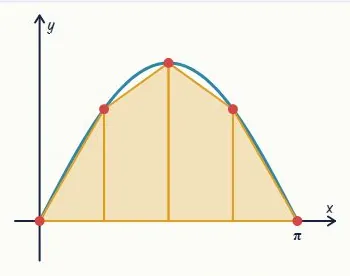
- Use the trapezium rule with 4 strips
- to estimate ∫₀^π sin x dx.
- Compare it with the exact value,
- and explain the difference.
Q5: the estimate
- h = π/4, in radians.
- Exact values first.
- h = (π − 0)/4 = π/44 strips
- y: 0, √2/2, 1, √2/2, 0sin x, radians
- ends: 0 + 0 = 0
- middle: √2/2 + 1 + √2/2 = 1 + √2
- A ≈ (π/8)[0 + 2(1 + √2)]h/2 = π/8
- = π(1 + √2)/4 ≈ 1.8961
- ≈ 1.903 s.f.
Q5: compare and explain
- Integrate exactly.
- Why under, not over?
- trapezium ≈ 1.8961
- ∫₀^π sin x dx = [−cos x]₀^πexact
- = −cos π − (−cos 0)
- = 1 + 1 = 2
- 1.8961 < 2: an under-estimate
- error ≈ 0.104, about 5.2%
- concave down on 0 < x < π(sin x)″ = −sin x < 0
- strip tops sit below the curve
Question 6 · Excellence, in context
- Water flows into a farm tank at r L/min.
- Estimate the volume in 50 minutes,
- using Simpson's rule where you can.
| t (min) | r (L/min) |
|---|---|
| 0 | 0 |
| 10 | 40 |
| 20 | 64 |
| 30 | 72 |
| 40 | 60 |
| 50 | 36 |
Q6: count the strips
- 6 readings: 5 strips.
- Simpson's needs even.
- volume = area under the r graph
- 6 readings, so 5 stripsh = 10 min
- Simpson's on all 5 stripsneeds an even number
- Simpson's for t = 0 to 404 strips
- trapezium for t = 40 to 50the last strip
Q6: two rules, then add
- Weights 1, 4, 2, 4, 1.
- Litres = L/min × min.
- h = 10, so h/3 = 10/3
- ends: 0 + 60 = 60t = 0, 40
- 4(40 + 72) = 448t = 10, 30
- 2(64) = 128t = 20
- (10/3)(636) = 2120 LSimpson's, 0 to 40
- (10/2)(60 + 36) = 480 Ltrapezium, 40 to 50
- V ≈ 2120 + 480 = 2600 L
- about 2600 litres in 50 min
The method that solved all six
- h from the strips, every ordinate, the right weights.
| Step | How |
|---|---|
| Strip width | h = (b − a) ÷ strips |
| Ordinates | one more than the strips |
| Trapezium | (h/2)[ends + 2 × middle] |
| Simpson's | (h/3)[ends + 4 odd + 2 even] |
| Odd strips | Simpson's on an even part |
| Accuracy | round only at the end |
More in AS 91579
 The integration toolkit: surds, e, trig and the chain rule6 min
 Integrating fractions: when it is ln, and when it is not6 min
 The constant of integration: find c, never assume it6 min
 Definite integrals and area, including between two curves6 min
 Trapezium and Simpson's rules: numerical areas6 min
 Differential equations: growth, decay and Newton's cooling6 min
 Integration toolkit: 7 exam questions solved step by step10 min
 Integrating fractions: 7 exam questions solved step by step10 min
 Constant of integration: 7 exam questions solved step by step11 min
 Definite integrals: 7 exam questions solved step by step11 minNumerical integration: 6 exam questions solved step by step11 min
 Differential equations: 6 exam questions solved step by step11 min
Is your child on track?
Take the free placement test