De Moivre's theorem: 7 exam questions solved step by step

What this lesson covers
- Raising r cis θ to the power n raises the modulus to n and multiplies the argument by n.
- The n roots of a complex number are equally spaced around a circle, so one wrong starting argument makes every root wrong.
7 questions, one theorem
- 1. Polar form first: sketch it.
- 2. (r cis θ)ⁿ = rⁿ cis(nθ).
- 3. Roots: nth root of r, (θ + 2πk)/n.
- 4. Bring every argument into range.
Question 1 · Achieved
- Write (3 cis(π/12))⁴
- in the form a + bi, exactly.
Q1: (3 cis(π/12))⁴
- Raise r, multiply θ.
- Then exact values.
- (3 cis(π/12))⁴
- = 3⁴ cis(4 × π/12)de Moivre
- = 81 cis(π/3)
- cos(π/3) = 1/2, sin(π/3) = √3/2
- 81(1/2) + 81(√3/2)i
- = 81/2 + (81√3/2)i
Question 2 · Achieved
- Use de Moivre to write (√3 − i)⁴
- in the form a + bi, exactly.
Q2: (√3 − i)⁴
- Below the axis: θ < 0.
- Exact cos and sin.
- √3 − i: x > 0, y < 0fourth quadrant
- r = √(3 + 1) = 2modulus
- θ = −tan⁻¹(1/√3) = −π/6below the axis
- (2 cis(−π/6))⁴ = 2⁴ cis(−4π/6)
- = 16 cis(−2π/3)
- cos(−2π/3) = −1/2
- sin(−2π/3) = −√3/2
- 16(−1/2) + 16(−√3/2)i
- = −8 − 8√3i
Question 3 · Merit
- Use de Moivre to write (−2 + 2i)⁵
- in the form a + bi.
Q3: (−2 + 2i)⁵
- Second quadrant.
- Subtract 2π twice.
- −2 + 2i: x < 0, y > 0second quadrant
- r = √(4 + 4) = √8 = 2√2modulus
- θ = π − π/4 = 3π/4reference π/4
- (2√2)⁵ = 32 × 4√2 = 128√2
- arg: 5 × 3π/4 = 15π/4de Moivre
- 15π/4 − 4π = −π/4subtract 2π twice
- = 128√2 cis(−π/4)
- 128√2(√2/2) − 128√2(√2/2)i
- = 128 − 128i
Question 4 · Merit
- Solve z⁴ = −16.
- Give the roots in the form a + bi,
- plot them, and find the side of
- the shape they make.
Q4: the four arguments
- Let z = s cis α.
- Four values of k.
- −16 = 16 cis πnegative real axis
- s⁴ = 16, so s = 2modulus
- 4α = π + 2πk
- α = π/4 + πk/2divide by 4
- k = 0: π/4, k = 1: 3π/4
- k = 2: 5π/4 − 2π = −3π/4into range
- k = 3: 7π/4 − 2π = −π/4into range
- z = 2 cis α, all four α
Q4: check on the Argand diagram
- All on the circle |z| = 2.
- A quarter turn apart.
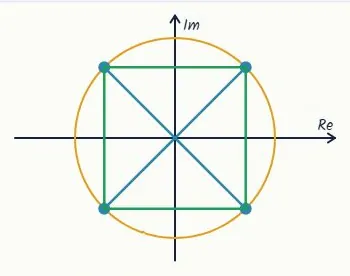
Q4: a + bi, and the square
- Exact cos and sin.
- Answer with units.
- 2 cis(π/4) = √2 + √2i
- 2 cis(3π/4) = −√2 + √2i
- 2 cis(−3π/4) = −√2 − √2i
- 2 cis(−π/4) = √2 − √2i
- (√2 + √2i)² = 2 + 4i − 2 = 4i
- (4i)² = 16i² = −16
- side: √2 − (−√2) = 2√2top two roots
- a square of side 2√2 units
Question 5 · Merit
- Solve z³ = −4√3 + 4i.
- Give every root in polar form.
- Careful: sketch before tan⁻¹.
Q5: the starting argument
- Second quadrant.
- Not the calculator angle.
- −4√3 + 4i: x < 0, y > 0second quadrant
- r = √(48 + 16) = √64 = 8modulus
- tan⁻¹(4/(−4√3)) = −π/6fourth quadrant
- reference: tan⁻¹(1/√3) = π/6
- θ = π − π/6 = 5π/6second quadrant
- z³ = 8 cis(5π/6)
Q5: the three roots
- Cube root of 8.
- 2π/3 = 12π/18 apart.
- z³ = 8 cis(5π/6)
- s³ = 8, so s = 2modulus
- 3α = 5π/6 + 2πk
- α = 5π/18 + 2πk/3divide by 3
- k = 0: α = 5π/18
- k = 1: 5π/18 + 12π/18 = 17π/18
- k = −1: 5π/18 − 12π/18 = −7π/18
- z = 2 cis(5π/18), 2 cis(17π/18)
- or z = 2 cis(−7π/18)
Question 6 · Excellence
- Find the smallest positive integer n
- for which (−√3 + i)ⁿ is real.
- Give the value of that power.
Q6: when is it real?
- Real: imaginary part 0.
- Reason, do not guess.
- −√3 + i: x < 0, y > 0second quadrant
- r = √(3 + 1) = 2modulus
- θ = π − π/6 = 5π/6reference π/6
- (2 cis(5π/6))ⁿ = 2ⁿ cis(5nπ/6)
- sin(5nπ/6) = 0imaginary part 0
- 5nπ/6 = kπ, so 5n = 6k
- 6 divides 5n, so 6 divides n5 and 6: no common factor
- smallest n = 6
Q6: the value
- n = 6 in de Moivre.
- Smaller n: not real.
- 2⁶ cis(6 × 5π/6) = 64 cis(5π)
- 5π − 4π = πsubtract 2π twice
- 64 cis π = 64(−1 + 0i) = −64
- n = 3: 8 cis(5π/2) = 8iimaginary, not real
Question 7 · Excellence
- Solve (z + 2i)³ = −27i.
- Give every solution in the form a + bi.
Q7: substitute, then roots
- Let w = z + 2i.
- Cube roots of −27i.
- w = z + 2i: w³ = −27i
- −27i = 27 cis(−π/2)negative Im axis
- s³ = 27, so s = 3modulus
- 3α = −π/2 + 2πk
- α = −π/6 + 2πk/3divide by 3
- k = 0: α = −π/6
- k = 1: −π/6 + 4π/6 = π/2
- k = −1: −π/6 − 4π/6 = −5π/6
Q7: back to z
- w first, in a + bi.
- Then z = w − 2i.
- w = 3 cis(−π/6) = 3√3/2 − (3/2)i
- w = 3 cis(π/2) = 3i
- w = 3 cis(−5π/6) = −3√3/2 − (3/2)i
- z = w − 2iundo the substitution
- z = 3√3/2 − (7/2)i
- z = i
- z = −3√3/2 − (7/2)i
- z = i: (3i)³ = 27i³ = −27i
The method that solved all seven
- Polar form from a sketch, de Moivre, every k, into range.
| Step | How |
|---|---|
| Polar form | sketch, then r and θ |
| Power | rⁿ cis(nθ) |
| Into range | ± 2π until −π < θ ≤ π |
| Roots | nth root of r |
| Arguments | (θ + 2πk)/n, all n |
| Check | circle, equal spacing |
More in AS 91577
 Complex arithmetic, conjugates and equating parts7 min
 Polar form by hand: modulus, argument and quadrants7 min
 De Moivre's theorem: powers and roots of complex numbers6 min
 Complex roots of polynomials: factor theorem and conjugates6 min
 Algebra with k: quadratics, discriminants and surd equations6 min
 Complex loci, purely real conditions and proofs7 min
 Complex arithmetic: 7 exam questions solved step by step11 min
 Polar form: 7 exam questions solved step by step11 minDe Moivre's theorem: 7 exam questions solved step by step11 min
 Complex polynomials: 7 exam questions solved step by step12 min
 Algebra with constants: 7 exam questions solved step by step12 min
 Complex loci and proof: 7 exam questions solved step by step12 min
Is your child on track?
Take the free placement test