Complex loci and proof: 7 exam questions solved step by step
What this lesson covers
- A locus condition on z becomes an equation in x and y once z = x + iy is substituted.
- Purely real means the imaginary part is zero; purely imaginary means the real part is zero.
7 questions, one method
- 1. Substitute z = x + iy.
- 2. Group real and imaginary parts.
- 3. Square a modulus: no i, no root.
- 4. Set the right part to zero.
Question 1 · Achieved
- Find the Cartesian equation of
- |z − 3 + 2i| = 4
- and describe the locus.
Q1: |z − 3 + 2i| = 4
- Modulus squared: no i.
- Watch the centre’s signs.
- z − 3 + 2i = (x − 3) + (y + 2)i
- (x − 3)² + (y + 2)² = 16modulus squared
- x² − 6x + 9 + y² + 4y + 4 = 16
- x² + y² − 6x + 4y = 3expanded form
- z − (3 − 2i): centre 3 − 2inot −3 + 2i
- circle, centre (3, −2), radius 4
- |(7 − 2i) − (3 − 2i)| = |4| = 4
Question 2 · Achieved
- Find the Cartesian equation of
- |z + 1 − 2i| = |z − 3|
- and sketch it on the Argand diagram.
Q2: |z + 1 − 2i| = |z − 3|
- Square both sides.
- x² and y² cancel.
- (x + 1)² + (y − 2)²
- = (x − 3)² + y²
- x² + 2x + 1 + y² − 4y + 4expand left
- = x² − 6x + 9 + y²expand right
- 2x − 4y + 5 = −6x + 9x², y² cancel
- 8x − 4y − 4 = 0
- y = 2x − 1
- midpoint (1, 1): 2(1) − 1 = 1
- 2 × (−1/2) = −1perpendicular
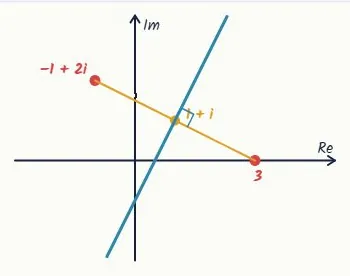
Q2: the sketch
- Mark −1 + 2i and 3.
- Join them, find the midpoint.
- The perpendicular bisector.
Question 3 · Merit
- k is real and w = (3 + ki)/(2 − i).
- w is purely imaginary.
- Find k, and then w.
Q3: w = (3 + ki)/(2 − i)
- Conjugate first.
- Purely imaginary: Re = 0.
- × (2 + i)/(2 + i)conjugate
- (2 − i)(2 + i) = 4 − i² = 5
- (3 + ki)(2 + i)
- = 6 + 3i + 2ki + ki²expand
- = (6 − k) + (3 + 2k)ii² = −1, group
- w = ((6 − k) + (3 + 2k)i)/5
- 6 − k = 0, so k = 6purely imaginary
- Im: 3 + 12 = 15 ≠ 0so w is not 0
- w = 15i/5 = 3i
Question 4 · Merit
- w = (z − 4i)/(z − 2), z ≠ 2
- w is purely real.
- Find and describe the locus of z.
Q4: the imaginary part
- The new bottom is real.
- Only the top decides.
- z = x + iy, z ≠ 2bottom not 0
- w = (x + (y − 4)i)/((x − 2) + yi)
- × ((x − 2) − yi) top and bottom
- bottom: (x − 2)² + y² > 0real
- Im(top) = (y − 4)(x − 2) − xy
- = xy − 2y − 4x + 8 − xyexpand
- = 8 − 4x − 2yxy cancels
Q4: purely real, so Im = 0
- Set Im = 0.
- Leave out z = 2.
- Im(top) = 8 − 4x − 2y
- 8 − 4x − 2y = 0purely real
- y = 4 − 2x
- x = 0: y = 4, the point 4i
- x = 2: y = 0, the point 2
- z = 2w undefined there
- z = 1 + 2i: w = (1 − 2i)/(−1 + 2i)
- = −1, real
- line through 4i and 2, z ≠ 2
Question 5 · Merit
- Prove that x² + (k − 3)x − k = 0
- has real roots for every real k.
Q5: a proof for every k
- Examples do not prove it.
- Complete the square in k.
- trying k = 1, 2, 3not a proof
- a = 1, b = k − 3, c = −k
- b² − 4ac = (k − 3)² − 4(1)(−k)
- = k² − 6k + 9 + 4kexpand
- = k² − 2k + 9collect
- = (k − 1)² + 8complete the square
- (k − 1)² ≥ 0, so b² − 4ac ≥ 8 > 0
- two distinct real roots, all k
Question 6 · Excellence
- Find the Cartesian equation of
- |z − 2| = 2|z + 1|
- and describe the locus.
- Careful: it is not a bisector.
Q6: |z − 2| = 2|z + 1|
- Square the 2 as well.
- The squares stay: a circle.
- (x − 2)² + y² = 4((x + 1)² + y²)
- x² − 4x + 4 + y²expand left
- = 4x² + 8x + 4 + 4y²expand right
- 0 = 3x² + 12x + 3y²all to the right
- x² + 4x + y² = 0÷ 3
- (x + 2)² + y² = 4complete the square
- circle: centre −2, radius 2
- z = 0: |−2| = 2 = 2|1|
Question 7 · Excellence
- |z| = 1 and z ≠ ±1.
- Prove that (z − 1)/(z + 1)
- is purely imaginary.
Q7: set up the proof
- Use |z| = 1 as x² + y² = 1.
- Need Re = 0.
- z = x + iy, x² + y² = 1|z| = 1
- w = ((x − 1) + iy)/((x + 1) + iy)
- × ((x + 1) − iy) top and bottom
- bottom: (x + 1)² + y² > 0z ≠ −1
- need Re(top) = 0purely imaginary
- Re(top) = (x − 1)(x + 1) + y²
Q7: finish the proof
- Use x² + y² = 1.
- End with the sentence.
- Re(top) = (x − 1)(x + 1) + y²
- = x² − 1 + y²
- = (x² + y²) − 1regroup
- = 1 − 1 = 0x² + y² = 1
- Im(top) = y(x + 1) − y(x − 1) = 2y
- w = 2yi/((x + 1)² + y²)
- Re(w) = 0, w ≠ 0y ≠ 0 as z ≠ ±1
- so w is purely imaginary
The method that solved all seven
- Substitute, group, square the modulus, set the right part to zero.
| Step | How |
|---|---|
| Substitute | z = x + iy, group the parts |
| Modulus | square it: a² + b², no i |
| Equal moduli | perpendicular bisector |
| Purely real | set Im = 0 |
| Imaginary | purely imaginary: Re = 0 |
| Proof | every case, then a sentence |
More in AS 91577
 Complex arithmetic, conjugates and equating parts7 min
 Polar form by hand: modulus, argument and quadrants7 min
 De Moivre's theorem: powers and roots of complex numbers6 min
 Complex roots of polynomials: factor theorem and conjugates6 min
 Algebra with k: quadratics, discriminants and surd equations6 min
 Complex loci, purely real conditions and proofs7 min
 Complex arithmetic: 7 exam questions solved step by step11 min
 Polar form: 7 exam questions solved step by step11 min
 De Moivre's theorem: 7 exam questions solved step by step11 min
 Complex polynomials: 7 exam questions solved step by step12 min
 Algebra with constants: 7 exam questions solved step by step12 minComplex loci and proof: 7 exam questions solved step by step12 min
Is your child on track?
Take the free placement test