Polar form: 7 exam questions solved step by step

What this lesson covers
- Modulus is a distance, so it is never negative; argument is an angle measured from the positive real axis.
- The quadrant decides the argument, so a sketch comes before the calculator.
7 questions, one method
- 1. Sketch it: name the quadrant.
- 2. r = √(x² + y²), never negative.
- 3. Reference angle, then adjust.
- 4. Keep −π < θ ≤ π.
Question 1 · Achieved
- Write 8 cis(−5π/6)
- in the form a + bi, exactly.
Q1: 8 cis(−5π/6)
- x = r cos θ, y = r sin θ.
- Exact values only.
- x = r cos θ, y = r sin θ
- −5π/6: third quadrantreference π/6
- cos(−5π/6) = −√3/2
- sin(−5π/6) = −1/2
- x = 8(−√3/2) = −4√3
- y = 8(−1/2) = −4
- 8 cis(−5π/6) = −4√3 − 4i
- √(48 + 16) = √64 = 8modulus
Question 2 · Achieved
- Write z = 3 + 3√3i
- in polar form, exactly.
Q2: z = 3 + 3√3i
- Quadrant first.
- Check by converting back.
- x > 0, y > 0first quadrant
- r = √(3² + (3√3)²)modulus
- = √(9 + 27) = √36 = 6
- θ = tan⁻¹(3√3/3) = tan⁻¹(√3)
- = π/3first quadrant: keep
- z = 6 cis(π/3)
- 6(1/2) + 6(√3/2)i = 3 + 3√3i
Question 3 · Merit
- Write w = −√2 − √6i
- in polar form, exactly.
- Careful: sketch it before tan⁻¹.
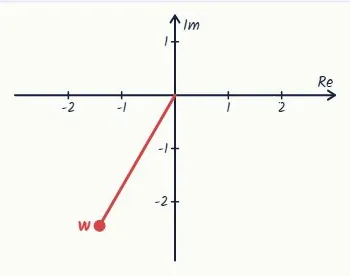
Q3: w = −√2 − √6i
- The calculator gives π/3.
- The sketch says no.
- x < 0, y < 0third quadrant
- r = √((−√2)² + (−√6)²)modulus
- = √(2 + 6) = √8 = 2√2
- tan⁻¹(−√6/−√2) = π/3first quadrant
- reference angle π/3
- θ = −(π − π/3) = −2π/3below the real axis
- w = 2√2 cis(−2π/3)
- 2√2(−1/2) = −√2, 2√2(−√3/2) = −√6
Question 4 · Merit
- u = 4 cis(2π/3), v = 2 cis(−3π/4)
- Find uv and u/v in polar form,
- with −π < θ ≤ π.
Q4: uv and u/v
- × moduli, + arguments.
- ÷ moduli, − arguments.
- |uv| = 4 × 2 = 8multiply moduli
- arg = 2π/3 + (−3π/4)add arguments
- = 8π/12 − 9π/12 = −π/12in range
- uv = 8 cis(−π/12)
- |u/v| = 4 ÷ 2 = 2divide moduli
- arg = 2π/3 − (−3π/4)subtract arguments
- = 8π/12 + 9π/12 = 17π/12more than π
- 17π/12 − 24π/12 = −7π/12subtract 2π
- u/v = 2 cis(−7π/12)
Question 5 · Merit, in context
- A kayaker leaves a jetty. East is real,
- north is imaginary, in km.
- She is at −5√3 + 5i.
- How far away is she, and which way?
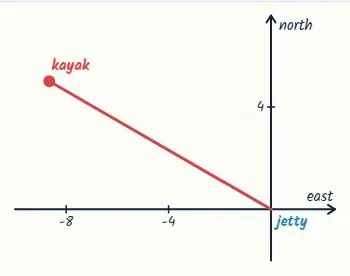
Q5: distance and direction
- Modulus: the distance.
- Argument: the direction.
- x < 0, y > 0second quadrant
- r = √((−5√3)² + 5²)modulus
- = √(75 + 25) = √100 = 10
- reference: tan⁻¹(5/(5√3)) = π/6
- θ = π − π/6 = 5π/6second quadrant
- z = 10 cis(5π/6)
- 5π/6 = 150°: 30° north of west
- 10 km away, 30° north of west
Question 6 · Excellence
- z = (−1 + i)/(√3 + i)
- a) Write z in polar form.
- b) Write z in the form a + bi.
- c) Hence find cos(7π/12) exactly.
Q6 a): z in polar form
- Top and bottom separately.
- ÷ moduli, − arguments.
- −1 + i: r = √(1 + 1) = √2
- θ = π − π/4 = 3π/4second quadrant
- √3 + i: r = √(3 + 1) = 2
- θ = tan⁻¹(1/√3) = π/6first quadrant
- |z| = √2 ÷ 2 = √2/2divide moduli
- arg z = 3π/4 − π/6subtract arguments
- = 9π/12 − 2π/12 = 7π/12
- z = (√2/2) cis(7π/12)
Q6 b): z in the form a + bi
- Conjugate of the bottom.
- Group, then split.
- × (√3 − i)/(√3 − i)conjugate of the bottom
- bottom: 3 + 1 = 4
- top: (−1 + i)(√3 − i)
- = −√3 + i + √3i − i²expand
- = (1 − √3) + (1 + √3)ii² = −1, group
- z = (1 − √3)/4 + ((1 + √3)/4)i
Q6 c): cos(7π/12)
- Same z, two forms.
- Equate the real parts.
- z = (√2/2) cis(7π/12)
- z = (1 − √3)/4 + ((1 + √3)/4)i
- (√2/2) cos(7π/12) = (1 − √3)/4
- cos(7π/12) = (1 − √3)/(2√2)divide by √2/2
- = (√2 − √6)/4rationalise
- cos(7π/12) = (√2 − √6)/4
- 7π/12 > π/2, so cos < 0
- (√2 − √6)/4 ≈ −0.2588
Question 7 · Excellence
- w = (a + i)/(1 + i), where a is real.
- arg w = π/3.
- Find the exact value of a.
Q7: w in the form x + iy
- Conjugate of the bottom.
- Keep a in each part.
- × (1 − i)/(1 − i)conjugate of the bottom
- bottom: 1 + 1 = 2
- top: (a + i)(1 − i)
- = a − ai + i − i²expand
- = (a + 1) + (1 − a)ii² = −1, group
- w = (a + 1)/2 + ((1 − a)/2)i
Q7: use the argument
- tan θ = y/x.
- Check the quadrant.
- w = (a + 1)/2 + ((1 − a)/2)i
- arg w = π/3: x > 0, y > 0first quadrant
- tan(π/3) = y/x = (1 − a)/(a + 1)
- √3(a + 1) = 1 − atan(π/3) = √3
- √3a + a = 1 − √3collect a terms
- a = (1 − √3)/(1 + √3)
- = (4 − 2√3)/(−2)× (1 − √3) top, bottom
- = √3 − 2
- a + 1 > 0 and 1 − a > 0first quadrant
The method that solved all seven
- Sketch, find r, find θ from the quadrant, keep it in range.
| Step | How |
|---|---|
| Sketch | name the quadrant first |
| Modulus | √(x² + y²), never negative |
| Argument | reference angle, adjust |
| Below axis | negative argument |
| × and ÷ | × or ÷ r, + or − θ |
| Range | −π < θ ≤ π |
More in AS 91577
 Complex arithmetic, conjugates and equating parts7 min
 Polar form by hand: modulus, argument and quadrants7 min
 De Moivre's theorem: powers and roots of complex numbers6 min
 Complex roots of polynomials: factor theorem and conjugates6 min
 Algebra with k: quadratics, discriminants and surd equations6 min
 Complex loci, purely real conditions and proofs7 min
 Complex arithmetic: 7 exam questions solved step by step11 minPolar form: 7 exam questions solved step by step11 min
 De Moivre's theorem: 7 exam questions solved step by step11 min
 Complex polynomials: 7 exam questions solved step by step12 min
 Algebra with constants: 7 exam questions solved step by step12 min
 Complex loci and proof: 7 exam questions solved step by step12 min
Is your child on track?
Take the free placement test