Normal distribution: 7 exam questions solved step by step
What this lesson covers
- A normal probability is an area under the curve, found from the mean and standard deviation.
- Working backwards from a probability finds an unknown value, mean or standard deviation.
7 questions, one method
- 1. Sketch the curve, shade the area.
- 2. Forwards: z, then the area.
- 3. Backwards: area to the left, then z.
- 4. Round at the end, in context.
Question 1 · Achieved
- Hawke's Bay apple weights are normal:
- mean 172 g, sd 18 g.
- Apples under 150 g go to juice.
- Find P(an apple goes to juice).
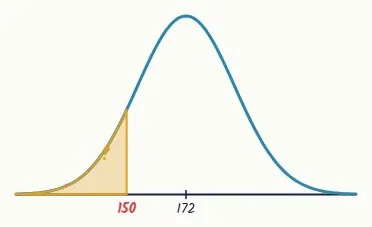
Q1: P(X < 150)
- Below the mean: z < 0.
- A small left tail.
- X ~ N(172, 18²)grams
- P(X < 150)
- z = (150 − 172) ÷ 18
- = −22 ÷ 18 = −1.2222below: negative
- P(X < 150) = 0.110812
- = 0.11084 d.p.
- about 11% go to juice
Question 2 · Achieved
- The same apples: mean 172 g, sd 18 g.
- The heaviest 10% are sold as premium.
- Find the lightest premium weight.
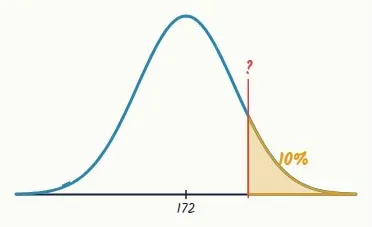
Q2: the top 10%
- Backwards: area to z.
- Use the area to the left.
- P(X > H) = 0.1
- P(X < H) = 0.9area to the left
- z = 1.2816inverse normal
- H = 172 + 1.2816 × 18
- = 172 + 23.0688 = 195.0688
- about 195.07 gabove the mean
- 172 − 23.0688 = 148.93wrong tail
Question 3 · Merit
- Avocado weights are normal:
- mean 215 g, sd 22 g.
- Find P(an avocado is 190 g to 250 g).
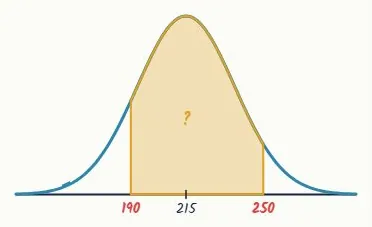
Q3: P(190 < X < 250)
- Two values, two z-values.
- Left area minus left area.
- X ~ N(215, 22²)
- P(190 < X < 250)
- z = (190 − 215) ÷ 22 = −1.1364
- z = (250 − 215) ÷ 22 = 1.5909
- P(X < 250) = 0.944185
- P(X < 190) = 0.127902
- 0.944185 − 0.127902 = 0.816283
- = 0.81634 d.p.
Question 4 · Merit
- Times to finish a long day walk are
- normal with mean 6.5 hours.
- 12% take longer than 8 hours.
- Find the standard deviation.
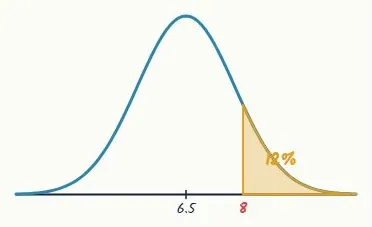
Q4: find σ
- Area to the left: 0.88.
- Substitute, solve for σ.
- μ = 6.5, σ unknown
- P(X > 8) = 0.12
- P(X < 8) = 0.88area to the left
- z = 1.1750inverse normal
- 1.1750 = (8 − 6.5) ÷ σ
- σ = 1.5 ÷ 1.1750
- = 1.2766 hours4 d.p.
- about 77 minutes
- σ = 1.2766: P(X > 8) = 0.1200
Question 5 · Merit, in context
- An e-scooter range is normal, sd 3.2 km.
- Only 4% may fall under 30 km.
- What mean range is needed?
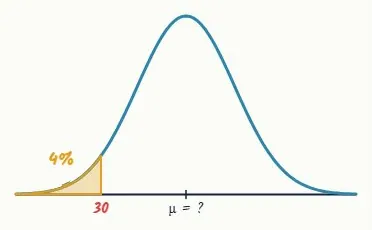
Q5: find μ
- 30 is below: z < 0.
- Solve for μ.
- σ = 3.2, μ unknown
- P(X < 30) = 0.04
- z = −1.7507below: negative
- −1.7507 = (30 − μ) ÷ 3.2
- −1.7507 × 3.2 = 30 − μ
- −5.6022 = 30 − μ
- μ = 30 + 5.6022 = 35.6022
- a mean range of about 35.6 km
- μ = 35.6022: P(X < 30) = 0.0400
Question 6 · Excellence
- The apples again: mean 172 g, sd 18 g.
- An apple is not for juice (over 150 g).
- Find P(it is over 205 g).
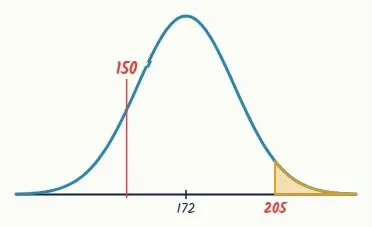
Q6: given over 150 g
- "Given" shrinks the total.
- Over 205 is over 150.
- P(X > 205 | X > 150)
- = P(X > 205) ÷ P(X > 150)over 205 is over 150
- z = (205 − 172) ÷ 18 = 1.8333
- P(X > 205) = 0.033377
- P(X > 150) = 1 − 0.110812from question 1
- = 0.889188the reduced total
- 0.033377 ÷ 0.889188 = 0.037536
- = 0.03754 d.p.
- about 1 in 27 of these apples
Question 7 · Excellence
- The apples: 11% go to juice (Q1).
- A bag holds 8 apples picked at random.
- Find P(at least 2 in the bag
- would go to juice).
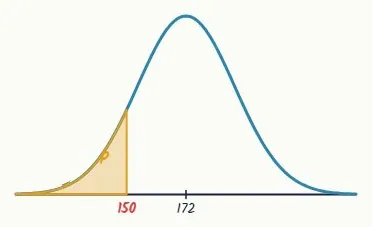
Q7: normal, then binomial
- Normal gives p.
- Binomial counts the bag.
- p = P(X < 150) = 0.110812from question 1
- Y ~ Bin(8, 0.110812)8 apples, independent
- P(Y ≥ 2) = 1 − P(Y ≤ 1)
- P(Y = 0) = 0.889188⁸ = 0.390795
- P(Y = 1) = 8 × p × (1 − p)⁷
- = 0.389612
- 1 − (0.390795 + 0.389612)
- = 1 − 0.780407 = 0.219593
- = 0.21964 d.p.
The method that solved all seven
- Sketch, z or inverse normal, solve, check, say it in context.
| Step | How |
|---|---|
| Sketch | shade the area you want |
| Forwards | z = (x − μ) ÷ σ, then area |
| Backwards | area to the left gives z |
| Unknown | z = (x − μ) ÷ σ, solve |
| Given that | divide by the reduced total |
| Two stages | normal p into a binomial |
More in AS 91586
 Choosing a distribution, and naming it every time7 min
 Discrete random variables: mean and standard deviation6 min
 Binomial and Poisson: at least, at most, and the rate7 min
 The normal distribution: forwards, backwards and conditional7 min
 Uniform and triangular distributions, and judging a model7 min
 Choosing a distribution: 7 exam questions solved step by step10 min
 Discrete random variables: 7 exam questions solved step by step11 min
 Binomial and Poisson: 7 exam questions solved step by step10 minNormal distribution: 7 exam questions solved step by step10 min
 Uniform and triangular: 7 exam questions solved step by step10 min
Is your child on track?
Take the free placement test