Uniform and triangular: 7 exam questions solved step by step
← Previous10 of 10
What this lesson covers
- Continuous uniform and triangular probabilities are areas of rectangles and triangles.
- A model is judged by comparing its probabilities with the data's relative frequencies.
7 questions, one method
- 1. Sketch the pdf, shade the area.
- 2. Height: 1 ÷ (b − a), or 2 ÷ (b − a).
- 3. Area of a rectangle or triangle.
- 4. Judge the model against data.
Question 1 · Achieved
- Pizza delivery times are uniform
- between 20 and 45 minutes.
- Find P(a delivery takes under 30 min).
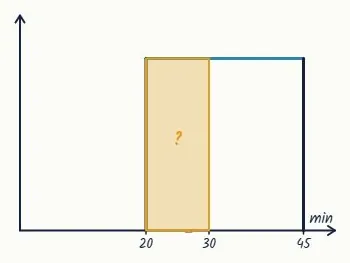
Q1: a rectangle
- Flat pdf: height 1 ÷ (b − a).
- Width × height.
- X ~ U(20, 45)minutes
- height = 1 ÷ (45 − 20) = 1/25
- 25 × 1/25 = 1total area 1
- P(X < 30) = width × height
- = (30 − 20) × 1/25
- = 10/25 = 0.4
- 30 × 1/25 = 1.2over 1: impossible
- a 40% chanceunder 30 min
Question 2 · Achieved
- Cross-country times are triangular:
- a = 12, c = 15, b = 24 minutes.
- Find the peak height and
- P(a runner takes over 20 min).
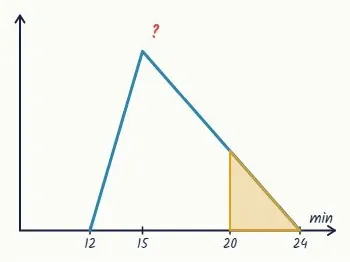
Q2: the peak, then a triangle
- Total area 1 fixes the peak.
- ½ × base × height.
- a = 12, c = 15, b = 24
- peak = 2 ÷ (24 − 12) = 1/6
- ½ × 12 × 1/6 = 1total area 1
- f(20) = (4/9) × (1/6)similar triangles
- = 4/54 = 2/27
- P(X > 20) = ½ × base × height
- = ½ × 4 × 2/27
- = 4/27 = 0.14814 d.p.
Question 3 · Merit
- The same run: a = 12, c = 15, b = 24.
- Find P(14 < X < 20).
- Careful: the middle is not a triangle.
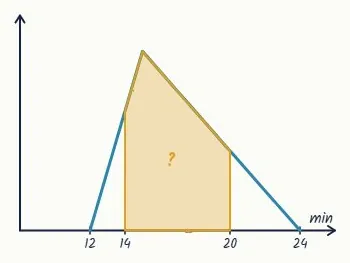
Q3: 1 minus both tails
- The tails are triangles.
- Take them off 1.
- P(14 < X < 20)
- = 1 − P(X < 14) − P(X > 20)not a triangle
- f(14) = (2/3) × (1/6) = 1/9similar triangles
- P(X < 14) = ½ × 2 × 1/9 = 1/9
- P(X > 20) = 4/27from question 2
- 1 − 1/9 − 4/27
- = 27/27 − 3/27 − 4/27
- = 20/27 = 0.74074 d.p.
Question 4 · Merit, in context
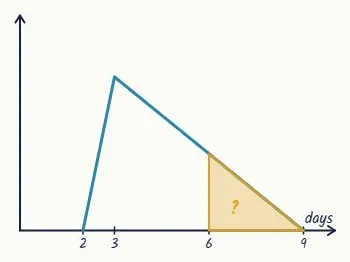
- A garden centre says a delivery takes
- at least 2 days, at most 9,
- and most often 3. Use a triangular
- model to find P(over 6 days).
Q4: choose a, c, b
- Least, most likely, most.
- Then the right tail.
- a = 2, c = 3, b = 9least, likeliest, most
- peak = 2 ÷ (9 − 2) = 2/7
- f(6) = (3/6) × (2/7) = 1/7similar triangles
- P(X > 6) = ½ × 3 × 1/7
- = 3/14 = 0.21434 d.p.
- about 21% take over 6 days
Question 5 · Merit, in context
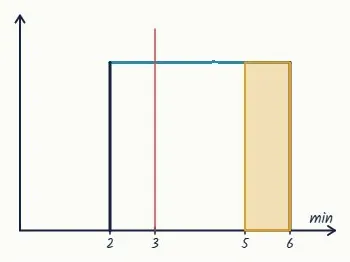
- A learner shearer's times are uniform,
- from 2 to 6 minutes a sheep.
- Of 200 sheep, how many over 5 min?
- A sheep has taken 3 min: P(over 5)?
Q5: count, then given
- n × probability.
- "Given" shrinks the total.
- X ~ U(2, 6), height 1/4
- P(X > 5) = (6 − 5) × 1/4 = 1/4
- 200 × 1/4 = 50 sheep
- P(X > 5 | X > 3)
- = P(X > 5) ÷ P(X > 3)over 5 is over 3
- P(X > 3) = (6 − 3) × 1/4 = 3/4
- (1/4) ÷ (3/4) = 1/3
- = 0.33334 d.p.
- about 1 in 3 of those sheep
Question 6 · Excellence
- The garden centre: model a = 2, c = 3, b = 9.
- Their records for 60 deliveries are below.
- Compare model and data at both tails.
| Under 3 days | Over 6 days | Total | |
|---|---|---|---|
| Deliveries | 11 | 9 | 60 |
Q6: model against data
- Model: an area.
- Data: a relative frequency.
- P(X < 3) = ½ × 1 × 2/7 = 1/7
- = 0.1429model
- data: 11/60 = 0.1833
- P(X > 6) = 3/14 = 0.2143from question 4
- data: 9/60 = 0.15
- 0.1429 < 0.1833model too low
- 0.2143 > 0.15model too high
- too many long waits: b too big
Question 7 · Excellence
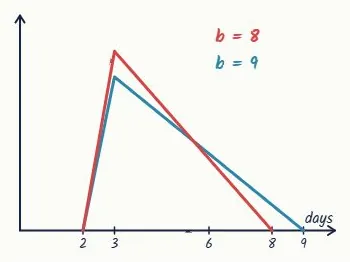
- Change the model to b = 8.
- Recalculate both tails and
- judge: is b = 8 a better model?
Q7: try b = 8
- Smaller b: taller peak.
- Compare both tails again.
- a = 2, c = 3, b = 8
- peak = 2 ÷ (8 − 2) = 1/3
- P(X < 3) = ½ × 1 × 1/3 = 1/6
- = 0.1667data 0.1833
- f(6) = (2/5) × (1/3) = 2/15similar triangles
- P(X > 6) = ½ × 2 × 2/15 = 2/15
- = 0.1333data 0.15
- both gaps now about 0.017were 0.04 and 0.06
- b = 8 is the better model
The method that solved all seven
- Sketch, find the height, find the area, then judge the model against the data.
| Step | How |
|---|---|
| Uniform | height 1 ÷ (b − a) |
| Triangular | peak 2 ÷ (b − a) |
| Heights | similar triangles |
| Middle | 1 minus both tails |
| Choose | a least, c most likely, b most |
| Judge | model against data, each tail |
More in AS 91586
 Choosing a distribution, and naming it every time7 min
 Discrete random variables: mean and standard deviation6 min
 Binomial and Poisson: at least, at most, and the rate7 min
 The normal distribution: forwards, backwards and conditional7 min
 Uniform and triangular distributions, and judging a model7 min
 Choosing a distribution: 7 exam questions solved step by step10 min
 Discrete random variables: 7 exam questions solved step by step11 min
 Binomial and Poisson: 7 exam questions solved step by step10 min
 Normal distribution: 7 exam questions solved step by step10 minUniform and triangular: 7 exam questions solved step by step10 min
Is your child on track?
Take the free placement test