Limits and continuity: 7 exam questions solved step by step
What this lesson covers
- A function is continuous where its graph has no break, and differentiable where it also has no sharp corner.
- Reading these from a piecewise graph is Achieved-level work that is often left blank.
7 questions, one checklist
- 1. Limit: both sides head to one value.
- 2. Continuous: limit = value.
- 3. Differentiable: continuous, one gradient.
- 4. A reason with every answer.
Question 1 · Achieved
- The graph of y = f(x) is shown.
- Find the limit of f(x) as x → 2
- from the left, and from the right.
- Find lim(x→2) f(x), and f(2).
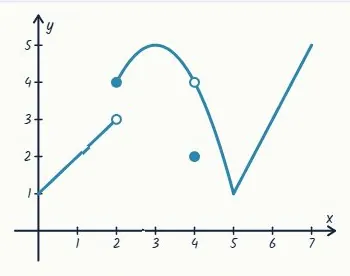
Q1: limits at x = 2
- Follow each piece in.
- Value: the closed dot.
- from the left: f(x) → 3along the line
- from the right: f(x) → 4along the curve
- 3 ≠ 4the sides disagree
- lim(x→2) f(x) does not exist
- f(2) = 4the closed dot
- f(2) = 3open dot: not on it
Question 2 · Achieved
- The same graph.
- Find lim(x→4) f(x), and f(4).
- Is f continuous at x = 4? Give a reason.
- Careful: two dots sit above x = 4.
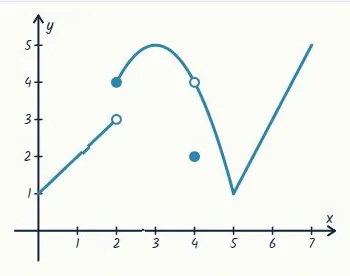
Q2: at x = 4
- Limit: where it heads.
- Value: the closed dot.
- from the left: f(x) → 4
- from the right: f(x) → 4
- lim(x→4) f(x) = 4both sides agree
- f(4) = 4open dot: a hole
- f(4) = 2the closed dot
- 4 ≠ 2limit ≠ value
- not continuous at x = 4
Question 3 · Merit
- The same graph.
- For 0 < x < 7, where is f
- not differentiable? Give reasons.
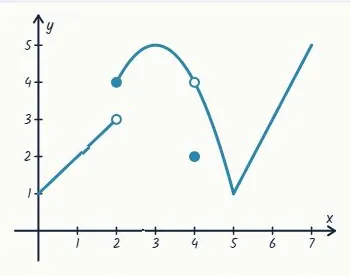
Q3: not differentiable where?
- Continuous first.
- Then one gradient.
- x = 2: a jumpnot continuous
- x = 4: a holenot continuous
- x = 5: lim f(x) = 1 = f(5)continuous
- left of 5: falling, f′ < 0
- right: (5 − 1) ÷ (7 − 5) = 2rise over run
- f′ < 0 and f′ = 2: a cornergradients differ
- x = 3: smooth, f′(3) = 0differentiable
- not differentiable at x = 2, 4, 5
Question 4 · Merit
- The same graph.
- For which values of x is f′(x) > 0?
- Where is f′(x) < 0, and f′(x) = 0?
- Careful at x = 2 and x = 4.
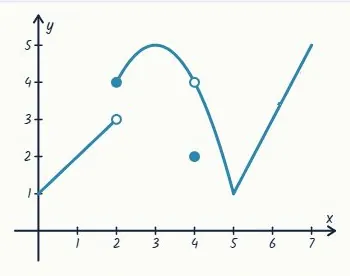
Q4: the sign of f′(x)
- Rising: f′ > 0.
- Falling: f′ < 0.
- 0 < x < 2: rising, gradient 1
- 2 < x < 3: rising
- x = 3: maximum, f′(3) = 0
- 3 < x < 5, x ≠ 4: falling
- 5 < x < 7: rising, gradient 2
- f′(x) > 0: 0 < x < 2, 2 < x < 3
- and 5 < x < 7
- f′(x) < 0: 3 < x < 4, 4 < x < 5
- f′(x) = 0: x = 3
Question 5 · Merit, in context
- A drone's height h m after t s is
- h = t² + 3 for 0 ≤ t ≤ 1,
- h = 6t − 2 for 1 < t ≤ 4.
- Is h continuous and differentiable at t = 1?
Q5: the drone at t = 1
- Do the heights meet?
- Do the rates match?
- left: h(1) = 1² + 3 = 4the first piece
- right: 6(1) − 2 = 4as t → 1 from above
- lim h(t) = 4 = h(1)continuous
- left: h′(t) = 2t, h′(1) = 2
- right: h′(t) = 6
- 2 ≠ 6the rates differ
- not differentiable at t = 1
- height 4 m both sides: no jump
- climb rate jumps 2 to 6 m/s
Question 6 · Excellence
- f(x) = a√x for 0 ≤ x ≤ 4,
- f(x) = x + b for x > 4.
- f is differentiable at x = 4.
- Find a and b.
Q6: find a and b
- The pieces meet.
- The gradients match.
- a√4 = 4 + bpieces meet at 4
- 2a = 4 + b
- d/dx a√x = a/(2√x)a√x = ax^(1/2)
- d/dx (x + b) = 1
- a/(2√4) = 1gradients match
- a/4 = 1, so a = 4
- 2(4) = 4 + b, so b = 4substitute a
- a = 4, b = 4
- 4√4 = 8 = 4 + 4
Question 7 · Excellence
- The graph of f(x) = |x² − 4x| is shown.
- Find where f is not differentiable,
- and where f′(x) = 0. Justify both.
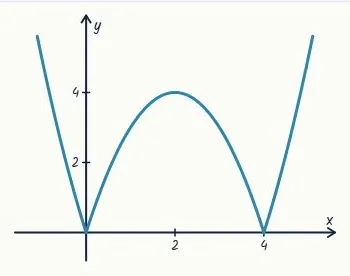
Q7: write f in pieces
- Where is x² − 4x negative?
- There, change its sign.
- x² − 4x = x(x − 4)
- x(x − 4) < 0 for 0 < x < 4between the roots
- f(x) = x² − 4x, x ≤ 0 or x ≥ 4
- f(x) = 4x − x², 0 < x < 4sign changed
- f′(x) = 2x − 4 outsidedifferentiate
- f′(x) = 4 − 2x inside
- f is continuous everywherepieces meet at 0, 4
Q7: corners, and f′(x) = 0
- Gradients at 0 and at 4.
- Reject a root off its piece.
- x = 0: left 2(0) − 4 = −4
- right 4 − 2(0) = 4
- x = 4: left 4 − 2(4) = −4
- right 2(4) − 4 = 4
- −4 ≠ 4 at both: cornersgradients differ
- not differentiable at x = 0, 4
- 2x − 4 = 0: x = 2not in x ≤ 0, x ≥ 4
- 4 − 2x = 0: x = 2, f(2) = 4the inside piece
- f′(x) = 0 only at (2, 4)
The checklist that solved all seven
- Both sides, then the value, then the gradients, with a reason each time.
| Step | How |
|---|---|
| Limit | both sides agree |
| Value | the closed dot |
| Continuous | limit equals value |
| Corner | gradients differ |
| Sign of f′ | rising +, falling − |
| Constants | meet, then match |
More in AS 91578
 The derivative toolkit: chain, product and quotient rules7 min
 Stationary points, concavity and points of inflection6 min
 Tangents and normals: from gradient to finished equation6 min
 Parametric differentiation, and the second derivative7 min
 Related rates of change: spheres, cones and the chain rule6 min
 Optimisation: building the model and finding the max or min6 min
 Limits, continuity and differentiability from a graph6 min
 Derivative toolkit: 7 exam questions solved step by step11 min
 Stationary points: 7 exam questions solved step by step12 min
 Tangents and normals: 7 exam questions solved step by step12 min
 Parametric curves: 7 exam questions solved step by step11 min
 Related rates of change: 7 exam questions solved step by step11 min
 Optimisation: 7 exam questions solved step by step11 minLimits and continuity: 7 exam questions solved step by step11 min
Is your child on track?
Take the free placement test