Optimisation: 7 exam questions solved step by step
What this lesson covers
- Optimising means writing the quantity as a function of one variable, then finding its stationary point.
- At Achieved and Merit the question tells you whether it is a maximum or minimum.
7 questions, one method
- 1. Model the quantity from the words.
- 2. Use the constraint: one variable.
- 3. Derivative = 0, and solve.
- 4. Answer the question asked.
Question 1 · Achieved, in context
- A harbour ferry trip costs
- C = 2v + 800/v dollars at v km/h.
- Find the speed for the least cost,
- and that cost. Assume it is a minimum.
Q1: the cheapest speed
- Power form first.
- A speed is positive.
- C = 2v + 800v⁻¹power form
- dC/dv = 2 − 800v⁻²differentiate
- = 2 − 800/v²
- 2 − 800/v² = 0stationary
- 2v² = 800, so v² = 400× v²
- v = −20a speed is positive
- v = 20: C = 40 + 800/20
- = 40 + 40 = 80
- 20 km/h, costing $80 a trip
Question 2 · Achieved, in context
- A medicine in the blood t hours after
- a dose: C = 20te⁻ᵗ mg/L.
- When is C greatest, and what is it?
- Assume it is a maximum.
Q2: the highest concentration
- Product rule.
- e⁻ᵗ is never 0.
- u = 20t, v = e⁻ᵗproduct rule
- u′ = 20, v′ = −e⁻ᵗchain rule
- dC/dt = 20e⁻ᵗ − 20te⁻ᵗu′v + uv′
- = 20e⁻ᵗ(1 − t)factorise
- e⁻ᵗ > 0, so 1 − t = 0stationary
- t = 1
- C = 20(1)e⁻¹ = 20/e
- ≈ 7.36 mg/L3 s.f.
- greatest after 1 h: 7.36 mg/L
Question 3 · Merit, in context
- A rectangular paddock of 1800 m² is
- fenced on three sides; a river is the
- fourth. Find the least fence needed.
Q3: the paddock by the river
- Area fixes y.
- Fence: two x, one y.
- x out from the river, y along it
- xy = 1800, so y = 1800/xarea
- L = 2x + y = 2x + 1800/x
- dL/dx = 2 − 1800/x²differentiate
- 2 − 1800/x² = 0stationary
- x² = 900, so x = 30x > 0
- y = 1800/30 = 60
- L = 60 + 60 = 120
- 30 m by 60 m: 120 m of fence
Question 4 · Merit, in context
- A closed food tin is a cylinder
- holding 128π cm³.
- Find the radius and height that use
- the least metal. Assume it is a minimum.
Q4: surface area in r only
- Metal = surface area.
- Volume gives h.
- πr²h = 128πvolume
- h = 128/r²÷ πr²
- S = 2πr² + 2πrhtwo ends + side
- = 2πr² + 2πr(128/r²)substitute h
- = 2πr² + 256π/rone variable
Q4: the least metal
- Derivative = 0.
- Give both dimensions.
- S = 2πr² + 256π/r
- dS/dr = 4πr − 256π/r²differentiate
- 4πr − 256π/r² = 0stationary
- 4πr³ = 256π× r²
- r³ = 64, so r = 4÷ 4π
- h = 128/16 = 8
- S = 32π + 64π = 96π
- ≈ 302 cm²3 s.f.
- radius 4 cm, height 8 cm
Question 5 · Merit, in context
- A poster has 384 cm² of print,
- margins 3 cm top and bottom,
- 2 cm each side. Find the paper size
- that uses the least paper.
Q5: paper area in x only
- Add the margins.
- Print area gives y.
- print: x wide, y high
- xy = 384, so y = 384/xprint area
- paper: (x + 4) by (y + 6)
- A = (x + 4)(y + 6)
- = xy + 6x + 4y + 24expand
- = 384 + 6x + 1536/x + 244y = 1536/x
- = 408 + 6x + 1536/x
Q5: the least paper
- Derivative = 0.
- Answer for the paper.
- A = 408 + 6x + 1536/x
- dA/dx = 6 − 1536/x²differentiate
- 6 − 1536/x² = 0stationary
- x² = 256, so x = 16x > 0
- y = 384/16 = 24
- 16 cm by 24 cmthe print, not the paper
- paper 20 cm by 30 cmx + 4, y + 6
- A = 20 × 30 = 600 cm²
Question 6 · Excellence
- Find the point on y = √x nearest
- to A(2, 0), and its distance.
- Justify that it is the nearest.
Q6: distance as a function of x
- A point on the curve.
- Work with D².
- point P(x, √x) on the curve
- D² = (x − 2)² + (√x − 0)²distance formula
- = x² − 4x + 4 + xexpand
- = x² − 3x + 4
- D least when D² leastD ≥ 0
Q6: nearest, and why
- Excellence: justify the min.
- Square root at the end.
- D² = x² − 3x + 4
- d(D²)/dx = 2x − 3differentiate
- 2x − 3 = 0, so x = 3/2stationary
- d²(D²)/dx² = 2 > 0a minimum
- D² = 9/4 − 9/2 + 4 = 7/4
- D = √7/2 ≈ 1.323 s.f.
- P(1.5, √1.5) ≈ (1.5, 1.22)
- nearest distance ≈ 1.32 units
Question 7 · Excellence, in context
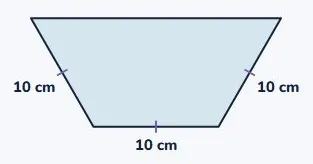
- A 30 cm sheet is folded 10 cm from
- each edge to make a gutter. Each side
- makes angle θ with the horizontal.
- Find θ for the greatest cross-section.
Q7: the area in θ
- A rectangle and two triangles.
- Trig for each length.
- height = 10sin θside 10 cm
- overhang = 10cos θeach side
- middle: 10 × 10sin θ = 100sin θ
- ends: 2 × (1/2)(10cos θ)(10sin θ)
- = 100sin θ cos θ
- A = 100sin θ + 100sin θ cos θ
Q7: the best angle
- A quadratic in cos θ.
- Justify the maximum.
- A = 100sin θ + 100sin θ cos θ
- dA/dθ = 100(cos θ + cos²θ − sin²θ)
- = 100(2cos²θ + cos θ − 1)sin²θ = 1 − cos²θ
- = 100(2cos θ − 1)(cos θ + 1)factorise
- cos θ = 1/2, so θ = π/3stationary
- cos θ = −1: θ = πfolded flat, A = 0
- dA/dθ: + before π/3, − aftera maximum
- A = 100(√3/2)(1 + 1/2) = 75√3
- θ = π/3 (60°): A ≈ 130 cm²
The method that solved all seven
- Model, one variable, derivative, answer.
| Step | How |
|---|---|
| Name | the variables, with units |
| Model | the quantity to optimise |
| Constraint | down to one variable |
| Derivative | set it equal to 0 |
| Reject | values that cannot happen |
| Answer | what was asked, units |
More in AS 91578
 The derivative toolkit: chain, product and quotient rules7 min
 Stationary points, concavity and points of inflection6 min
 Tangents and normals: from gradient to finished equation6 min
 Parametric differentiation, and the second derivative7 min
 Related rates of change: spheres, cones and the chain rule6 min
 Optimisation: building the model and finding the max or min6 min
 Limits, continuity and differentiability from a graph6 min
 Derivative toolkit: 7 exam questions solved step by step11 min
 Stationary points: 7 exam questions solved step by step12 min
 Tangents and normals: 7 exam questions solved step by step12 min
 Parametric curves: 7 exam questions solved step by step11 min
 Related rates of change: 7 exam questions solved step by step11 minOptimisation: 7 exam questions solved step by step11 min
 Limits and continuity: 7 exam questions solved step by step11 min
Is your child on track?
Take the free placement test