Related rates of change: 7 exam questions solved step by step

What this lesson covers
- When two quantities change with time, the chain rule links their rates.
- Write every rate you know and the one you want before differentiating anything.
7 questions, one method
- 1. Write the given and wanted rates.
- 2. A formula linking the two variables.
- 3. Differentiate, then substitute.
- 4. Chain rule, then answer in words.
Question 1 · Achieved
- y = x³ − 2x, and x increases at
- 3 units per second.
- Find dy/dt when x = 2.
Q1: dy/dt when x = 2
- Given dx/dt, want dy/dt.
- dy/dx links them.
- given: dx/dt = 3
- want: dy/dt when x = 2
- dy/dx = 3x² − 2differentiate
- x = 2: dy/dx = 12 − 2 = 10
- dy/dt = dy/dx × dx/dtchain rule
- = 10 × 3 = 30
- y increases at 30 units/s
Question 2 · Achieved, in context
- A farm water tank is a cylinder
- of radius 2 m. Water flows in at
- 0.5 m³ per minute.
- How fast is the water level rising?
Q2: the water tank
- The radius stays 2 m.
- Divide to undo.
- given: dV/dt = 0.5 m³/min
- want: dh/dt
- V = π(2)²h = 4πhcylinder, r = 2
- dV/dh = 4πdifferentiate
- dV/dt = dV/dh × dh/dtchain rule
- 0.5 = 4π × dh/dtsubstitute
- dh/dt = 0.5/(4π) = 1/(8π)
- ≈ 0.0398 m/min3 s.f.
- rising about 4 cm a minutein words
Question 3 · Merit
- A spherical balloon is let down.
- Its radius falls at 0.2 cm/s.
- How fast is the volume changing
- when the radius is 10 cm?
Q3: a shrinking balloon
- Falling: a negative rate.
- Differentiate, then r = 10.
- given: dr/dt = −0.2 cm/sfalling
- want: dV/dt when r = 10
- V = (4/3)πr³sphere
- dV/dr = 4πr²(4/3) × 3 = 4
- r = 10: dV/dr = 400π
- dV/dt = dV/dr × dr/dtchain rule
- = 400π × (−0.2) = −80π
- ≈ −251 cm³/s3 s.f.
- volume falls at 251 cm³/s
Question 4 · Merit, in context
- A 5 m ladder leans on a wall.
- Its foot slides away at 0.3 m/s.
- How fast is the top sliding down
- when the foot is 3 m from the wall?
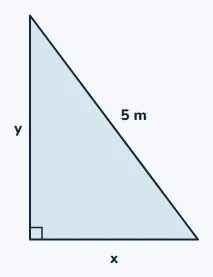
Q4: the sliding ladder
- Pythagoras links x and y.
- Chain rule twice.
- given: dx/dt = 0.3 m/s
- want: dy/dt when x = 3
- x² + y² = 25, y = √(25 − x²)
- dy/dx = −x/√(25 − x²)chain rule
- x = 3: y = 4, dy/dx = −3/4
- dy/dt = dy/dx × dx/dtchain rule
- = (−3/4) × 0.3 = −0.225
- top slides down at 0.225 m/s
Question 5 · Merit, in context
- A conical tank, point down, has radius
- 2 m at the top and depth 8 m.
- Water flows in at 3 m³ per minute.
- How fast does the depth rise at 6 m?
Q5: V in terms of h only
- Similar triangles: r = h/4.
- Substitute before differentiating.
- given: dV/dt = 3 m³/min
- want: dh/dt when h = 6
- V = (1/3)πr²hcone
- r/h = 2/8, so r = h/4similar triangles
- V = (1/3)π(h/4)²hsubstitute r
- = (1/3)π(h²/16)h
- = πh³/48one variable
Q5: chain the rates
- Differentiate, then h = 6.
- Divide to undo.
- V = πh³/48
- dV/dh = 3πh²/48 = πh²/16differentiate
- h = 6: dV/dh = 36π/16 = 9π/4
- dV/dt = dV/dh × dh/dtchain rule
- 3 = (9π/4) × dh/dtsubstitute
- dh/dt = 12/(9π) = 4/(3π)3 × 4/(9π)
- ≈ 0.424 m/min3 s.f.
- depth rises at 0.424 m/minin words
Question 6 · Excellence, in context
- Mere, 1.8 m tall, walks away from a
- 6 m street light at 1.5 m/s.
- How fast is her shadow lengthening?
- Does it depend on where she is?
Q6: link shadow and distance
- Name both lengths.
- Similar triangles.
- x = distance from the post
- s = length of the shadow
- given: dx/dt = 1.5 m/s
- want: ds/dt
- s/1.8 = (x + s)/6similar triangles
- 6s = 1.8x + 1.8scross-multiply
- 4.2s = 1.8x− 1.8s
- s = 1.8x/4.2 = 3x/7
Q6: the rate, and the reason
- Chain rule.
- Look for x in the answer.
- s = 3x/7
- ds/dx = 3/7differentiate
- ds/dt = ds/dx × dx/dtchain rule
- = (3/7) × 1.5 = 9/14
- ≈ 0.643 m/s3 s.f.
- no x in ds/dta constant rate
- the same at every distance
Question 7 · Excellence, in context
- A plane flies level at a height of 3 km,
- towards an observer, at 0.2 km/s.
- θ is its angle of elevation. Find dθ/dt
- when it is 3 km away horizontally.
Q7: x in terms of θ
- Trig links x and θ.
- Radians throughout.
- given: dx/dt = −0.2 km/sx is decreasing
- want: dθ/dt when x = 3
- tan θ = 3/xopposite ÷ adjacent
- x = 3/tan θ = 3cot θ
- dx/dθ = −3cosec²θd/dθ cot θ = −cosec²θ
- x = 3: tan θ = 1, θ = π/4
- cosec²(π/4) = 1 ÷ (1/2) = 2
- dx/dθ = −3 × 2 = −6
Q7: chain the rates
- Divide to undo.
- Say what the sign means.
- x = 3: dx/dθ = −6
- dx/dt = dx/dθ × dθ/dtchain rule
- −0.2 = −6 × dθ/dtsubstitute
- dθ/dt = −0.2 ÷ −6 = 1/30
- ≈ 0.0333 rad/s3 s.f.
- positive: θ is increasinghigher in the sky
The method that solved all seven
- Rates, link, differentiate, chain, answer.
| Step | How |
|---|---|
| Given | the rate you know, with units |
| Want | the rate you need, and when |
| Link | one formula, one variable |
| Derivative | before you substitute |
| Chain | multiply, or divide to undo |
| Answer | sign, units, in words |
More in AS 91578
 The derivative toolkit: chain, product and quotient rules7 min
 Stationary points, concavity and points of inflection6 min
 Tangents and normals: from gradient to finished equation6 min
 Parametric differentiation, and the second derivative7 min
 Related rates of change: spheres, cones and the chain rule6 min
 Optimisation: building the model and finding the max or min6 min
 Limits, continuity and differentiability from a graph6 min
 Derivative toolkit: 7 exam questions solved step by step11 min
 Stationary points: 7 exam questions solved step by step12 min
 Tangents and normals: 7 exam questions solved step by step12 min
 Parametric curves: 7 exam questions solved step by step11 minRelated rates of change: 7 exam questions solved step by step11 min
 Optimisation: 7 exam questions solved step by step11 min
 Limits and continuity: 7 exam questions solved step by step11 min
Is your child on track?
Take the free placement test