Conditional probability: 7 exam questions solved step by step
What this lesson covers
- A conditional probability restricts attention to one group, so its denominator is that group's total.
- The notation P(A | B) is read 'A given B', and the order matters.
7 questions, one idea
- 1. "Given B": B is the whole world.
- 2. Divide by the total of B.
- 3. P(A | B) = P(A and B) ÷ P(B)
- 4. Notation, 4 d.p., then context.
Question 1 · Achieved
- 320 visitors to a museum.
- Find P(ate at the café | adult).
| Café | No café | Total | |
|---|---|---|---|
| Adult | 72 | 108 | 180 |
| Child | 28 | 112 | 140 |
| Total | 100 | 220 | 320 |
Q1: P(C | A)
- Given adult: adults only.
- Divide by the row total.
- A: adult, C: ate at the café
- P(C | A)given adult
- adults: 180the reduced total
- P(C | A) = 72 ÷ 180
- = 0.4
- 72 ÷ 320 = 0.225that is P(A and C)
- 40% of adults ate at the café
Question 2 · Achieved
- Same museum table.
- Find P(adult | ate at the café).
- Careful: the order has changed.
| Café | No café | Total | |
|---|---|---|---|
| Adult | 72 | 108 | 180 |
| Child | 28 | 112 | 140 |
| Total | 100 | 220 | 320 |
Q2: P(A | C)
- Given café: café column.
- Order matters.
- P(A | C)given café
- café visitors: 100the reduced total
- P(A | C) = 72 ÷ 100 = 0.72
- P(C | A) = 0.4question 1
- P(A | C) ≠ P(C | A)order matters
- P(A and C) = 72 ÷ 320 = 0.225
- 72% of café visitors: adults
Question 3 · Merit
- Customers of an online store:
- bought a book (B), a game (G).
- Find P(B | G) and P(G | not B).
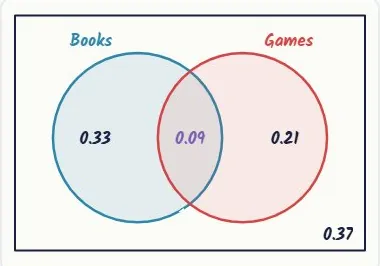
Q3: the given region
- Given G: the G circle.
- Not B: outside B.
- P(G) = 0.09 + 0.21 = 0.3the games circle
- P(B | G) = 0.09 ÷ 0.3both ÷ P(G)
- = 0.3
- P(not B) = 0.21 + 0.37outside books
- = 0.58
- P(G | not B) = 0.21 ÷ 0.58only G ÷ P(not B)
- = 0.36214 d.p.
Question 4 · Merit
- On school days in a town:
- P(rain) = 0.35, P(bus late) = 0.5,
- P(rain or bus late) = 0.65.
- Find P(bus late | rain).
Q4: P(L | R) from "or"
- Find "and" first.
- Then divide by P(R).
- P(R or L) = P(R) + P(L)addition rule
- − P(R and L)
- 0.65 = 0.35 + 0.5 − P(R and L)
- P(R and L) = 0.85 − 0.65 = 0.2
- P(L | R) = P(R and L) ÷ P(R)
- = 0.2 ÷ 0.35
- = 0.57144 d.p.
- P(R | L) = 0.2 ÷ 0.5 = 0.4wrong way round
Question 5 · Merit, in context
- At an airport, 4% of bags hold food.
- A dog flags 90% of bags with food
- and 6% of bags without.
- Find P(a bag is flagged).
Q5: build the tree
- First: food 0.04, none 0.96.
- Second branches are conditional.
- Each pair adds to 1.
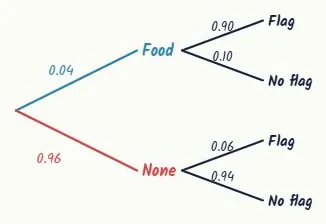
Q5: P(flag)
- Two paths end in a flag.
- Multiply, then add.
- food, flag: 0.04 × 0.9 = 0.036
- no food, flag: 0.96 × 0.06
- = 0.0576
- P(flag) = 0.036 + 0.0576both flag paths
- = 0.0936
- about 94 in every 1000 bags
Question 6 · Excellence
- Same dog. A bag has been flagged.
- Find P(it holds food | flagged).
- Claim: "A flagged bag almost always
- holds food." Judge the claim.
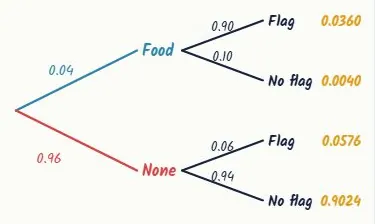
Q6: reverse the tree
- Given flag: flag paths.
- Path ÷ all flags.
- P(F | flag)
- = P(F and flag) ÷ P(flag)
- = 0.036 ÷ 0.0936food path ÷ all flags
- = 0.38464 d.p.
- P(flag | F) = 0.9wrong way round
- per 1000: 36 food, about 58 not
- claim not supported
Question 7 · Excellence
- In a city, 30% of homes have solar
- panels; 40% of those have a heat pump.
- Overall, 50% have a heat pump. Claim:
- "Solar homes are more likely to have one."
Q7: the missing branch
- Solar against no solar.
- Find the missing branch.
- P(S and H) = P(S) × P(H | S)
- = 0.3 × 0.4 = 0.12
- P(not S and H) = 0.5 − 0.12the rest of P(H)
- = 0.38
- P(not S) = 1 − 0.3 = 0.7
- P(H | not S) = 0.38 ÷ 0.7
- = 0.54294 d.p.
- 0.4 < 0.5429solar: less likely
- claim not supported
The method that solved all seven
- Given picks the group, and the group picks the denominator.
| Step | How |
|---|---|
| P(A | B) | A given B: B is the group |
| Table | divide by that row or column |
| Venn | divide by the given region |
| Tree | multiply along each path |
| Reverse | path ÷ all matching paths |
| Answer | notation, 4 d.p., context |
More in AS 91585
 Tables, trees and Venn diagrams from written information6 min
 Conditional probability from tables, trees and Venn diagrams6 min
 Independent or mutually exclusive? The two tests6 min
 Relative risk: times as likely, and when you need a ratio6 min
 True probability, model estimates and experimental estimates7 min
 Organising information: 7 exam questions solved step by step11 minConditional probability: 7 exam questions solved step by step10 min
 Independent or exclusive: 7 exam questions solved step by step10 min
 Relative risk: 7 exam questions solved step by step10 min
 Probability estimates: 7 exam questions solved step by step9 min
Is your child on track?
Take the free placement test