Organising information: 7 exam questions solved step by step
What this lesson covers
- Most probability questions become easy once the information is in a table, a tree or a Venn diagram.
- Choose the structure that matches how the information is given.
7 questions: organise, then solve
- 1. Two variables: a two-way table.
- 2. Overlaps: a Venn, middle first.
- 3. "Of those": a tree.
- 4. Every set totals 1 (or n).
Question 1 · Achieved, in context
- 300 campground guests: 180 from overseas,
- 210 booked online (the rest by phone),
- 140 were overseas and booked online.
- Find P(a guest is from NZ, by phone).
Q1: words into a table
- Two variables: where from, how booked.
- Place the givens, mark the gaps.
| Online | Phone | Total | |
|---|---|---|---|
| Overseas | 140 | ? | 180 |
| NZ | ? | ? | ? |
| Total | 210 | ? | 300 |
Q1: fill the gaps
- Each gap: total − known.
- Check one cell twice.
- NZ: 300 − 180 = 120row totals
- phone: 300 − 210 = 90column totals
- overseas, phone: 180 − 140 = 40
- NZ, online: 210 − 140 = 70
- NZ, phone: 120 − 70 = 50
- check: 90 − 40 = 50
- P(NZ and phone) = 50 ÷ 300
- = 0.16674 d.p.
Question 2 · Achieved
- X: the number of phones in a household.
- Find p, then P(X ≥ 3).
- Careful: "at least 3" includes 3.
| x | P(X = x) |
|---|---|
| 1 | 0.1 |
| 2 | 0.3 |
| 3 | p |
| 4 | 0.2 |
| 5 | 0.05 |
Q2: the table sums to 1
- Missing: 1 minus the rest.
- ≥ 3 means 3, 4 or 5.
- 0.1 + 0.3 + p + 0.2 + 0.05 = 1
- 0.65 + p = 1
- p = 1 − 0.65 = 0.35
- every value from 0 to 1
- P(X ≥ 3) = 0.35 + 0.2 + 0.05
- = 0.6
- P(X > 3) = 0.25leaves out X = 3
Question 3 · Merit
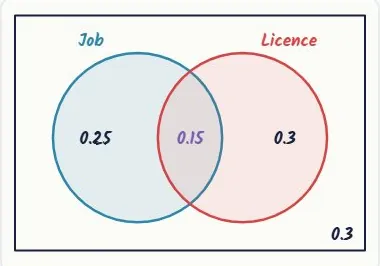
- Year 13 students at a Whangārei school:
- 40% have a part-time job, 45% have
- a driver licence, 15% have both.
- Find P(exactly one of the two).
Q3: each region
- Both goes in the middle.
- Circle minus the middle.
- both = 0.15the middle
- only job = 0.4 − 0.15 = 0.25
- only licence = 0.45 − 0.15 = 0.3
- neither = 1 − (0.25 + 0.15 + 0.3)
- = 1 − 0.7 = 0.3
- exactly one = 0.25 + 0.3only job or only licence
- = 0.55
- 0.4 + 0.45 = 0.85counts both twice
Q3: the finished Venn
- Middle first, then each circle.
- Four regions, total 1.
Question 4 · Merit
- Visitors to a Rotorua park: 60% see
- the geysers, 45% the mud pools, and
- 80% see at least one of them.
- Complete the Venn diagram and table.
- Careful: 80% is "or", not "both".
Q4: both from "or"
- Addition rule first.
- Then the regions.
- P(G or M) = P(G) + P(M)addition rule
- − P(G and M)
- 0.8 = 0.6 + 0.45 − P(G and M)
- P(G and M) = 1.05 − 0.8 = 0.25
- only G = 0.6 − 0.25 = 0.35
- only M = 0.45 − 0.25 = 0.2
- neither = 1 − 0.8 = 0.2outside both
- 0.35 + 0.25 + 0.2 + 0.2 = 1
Q4: the same regions as a table
- Four regions, four cells.
- Totals match P(G) and P(M).
| Mud pools | No mud pools | Total | |
|---|---|---|---|
| Geysers | 0.25 | 0.35 | 0.6 |
| No geysers | 0.2 | 0.2 | 0.4 |
| Total | 0.45 | 0.55 | 1 |
Question 5 · Merit, in context
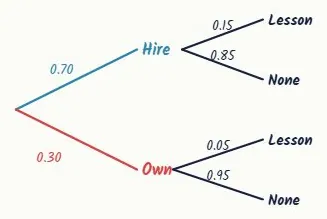
- At a ski field, 70% of visitors hire gear.
- Of those who hire, 15% book a lesson.
- Of the rest, 5% book a lesson.
- Expected lessons from 2000 visitors?
Q5: words into a tree
- First: hire 0.7, own gear 0.3.
- "Of those who hire": after hire.
- "Of the rest": after own.
Q5: multiply along, add across
- Two lesson paths.
- Then times 2000.
- hire, lesson: 0.7 × 0.15 = 0.105
- own, lesson: 0.3 × 0.05 = 0.015
- P(lesson) = 0.105 + 0.015both lesson paths
- = 0.12
- (0.15 + 0.05) ÷ 2 = 0.1ignores 70 : 30
- expected = 2000 × 0.12
- = 240
- about 240 lessons that day
Question 6 · Excellence
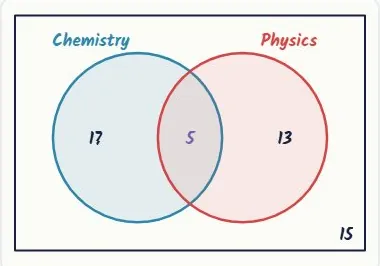
- 50 Year 13s: 22 take Chemistry and
- 18 take Physics. Three times as many
- take neither as take both.
- Find P(a student takes exactly one).
Q6: an unknown in the middle
- Let both = x.
- Four regions total 50.
- let x = number taking both
- only C = 22 − x, only P = 18 − x
- neither = 3x
- (22 − x) + x + (18 − x) + 3x = 50
- 40 + 2x = 50
- x = 52x = 10
- only C 17, only P 13, neither 15
- P(exactly one) = (17 + 13) ÷ 50
- = 30 ÷ 50 = 0.6
Q6: check with the Venn
- Circles: 17 + 5 = 22, 5 + 13 = 18.
- Regions total 50.
Question 7 · Excellence
- X: the number of days a student's bus
- is late in a school week.
- Find k, then P(X ≥ 2).
| x | 0 | 1 | 2 | 3 |
|---|---|---|---|---|
| P(X = x) | 0.3 | k | k² | 0.14 |
Q7: a quadratic in k
- Sums to 1: an equation.
- A probability is never < 0.
- 0.3 + k + k² + 0.14 = 1the table sums to 1
- k² + k − 0.56 = 0collect, then − 1
- (k − 0.4)(k + 1.4) = 0−0.4 × 1.4 = −0.56
- k = 0.4 or k = −1.4
- k = −1.4a probability is ≥ 0
- 0.3, 0.4, 0.16, 0.14total 1
- P(X ≥ 2) = 0.16 + 0.14
- = 0.3
The structures that solved all seven
- Organise the words first, then check every set totals 1.
| Step | How |
|---|---|
| Two-way | gaps: total − known |
| Venn | middle first, then the rest |
| Tree | "of those" is a 2nd branch |
| P table | sums to 1, each from 0 to 1 |
| Unknown | form an equation, then check |
| Check | every set totals 1 or n |
More in AS 91585
 Tables, trees and Venn diagrams from written information6 min
 Conditional probability from tables, trees and Venn diagrams6 min
 Independent or mutually exclusive? The two tests6 min
 Relative risk: times as likely, and when you need a ratio6 min
 True probability, model estimates and experimental estimates7 minOrganising information: 7 exam questions solved step by step11 min
 Conditional probability: 7 exam questions solved step by step10 min
 Independent or exclusive: 7 exam questions solved step by step10 min
 Relative risk: 7 exam questions solved step by step10 min
 Probability estimates: 7 exam questions solved step by step9 min
Is your child on track?
Take the free placement test