Independent or exclusive: 7 exam questions solved step by step
What this lesson covers
- Mutually exclusive events cannot happen together; independent events do not affect each other.
- Each has its own test, and each test must be written as a probability statement.
7 questions, two tests
- 1. Exclusive: P(A and B) = 0.
- 2. Independent: P(A and B) = P(A) × P(B).
- 3. Or: P(A | B) = P(A).
- 4. Explain it in context.
Question 1 · Achieved
- At a bakery: P(buys a pie) = 0.3,
- P(pays by card) = 0.8, P(both) = 0.24.
- Independent? Mutually exclusive?
Q1: both tests
- Multiply, then compare.
- Then test for 0.
- P(pie) = 0.3, P(card) = 0.8
- P(pie and card) = 0.24given
- P(pie) × P(card) = 0.3 × 0.8
- = 0.24
- P(pie and card) = P(pie) × P(card)
- pie and card are independent
- P(pie and card) = 0.24 ≠ 0not mutually exclusive
Question 2 · Achieved
- At a school: P(takes Art) = 0.25,
- P(Music) = 0.4, P(Art or Music) = 0.5.
- Are Art and Music mutually exclusive?
Q2: find "and" first
- Addition rule.
- Test: is "and" 0?
- P(A or M) = P(A) + P(M)addition rule
- − P(A and M)
- 0.5 = 0.25 + 0.4 − P(A and M)
- P(A and M) = 0.65 − 0.5 = 0.15
- 0.15 ≠ 0some take both
- not mutually exclusive
- exclusive: P(A or M) = 0.65but it is 0.5
Question 3 · Merit
- 400 shoppers at a supermarket:
- brought a bag (B), used self-checkout (S).
- Are B and S independent? Explain.
| Self | Staffed | Total | |
|---|---|---|---|
| Bag | 90 | 170 | 260 |
| No bag | 60 | 80 | 140 |
| Total | 150 | 250 | 400 |
Q3: the product test
- Counts into probabilities.
- Then explain with "given".
- P(B and S) = 90 ÷ 400 = 0.225
- P(B) = 260 ÷ 400 = 0.65
- P(S) = 150 ÷ 400 = 0.375
- P(B) × P(S) = 0.65 × 0.375
- = 0.24375
- 0.225 ≠ 0.24375product test fails
- B and S are not independent
- P(B | S) = 90 ÷ 150 = 0.6
- 0.6 < 0.65self-checkout: fewer bags
Question 4 · Merit
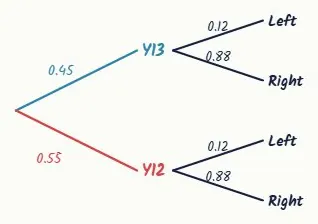
- Seniors at a college: 45% Year 13.
- 12% of Year 13s and 12% of Year 12s
- are left-handed. Is being left-handed
- independent of year level? Explain.
Q4: the conditional test
- Find P(L) overall.
- Compare with P(L | Y13).
- P(L | Y13) = 0.12from the tree
- P(L | Y12) = 0.12
- P(L) = 0.45 × 0.12 + 0.55 × 0.12
- = 0.054 + 0.066 = 0.12
- P(L | Y13) = P(L) = 0.12conditional test
- Y13 and L are independent
- knowing the year changes nothing
Question 5 · Merit, in context
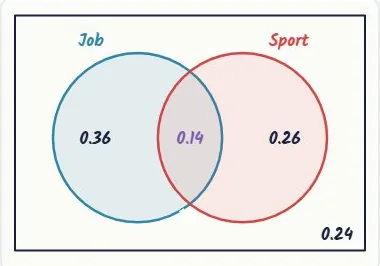
- Year 13s: P(part-time job) = 0.5,
- P(club sport) = 0.4, P(both) = 0.14.
- Test both ideas. Explain in context.
Q5: both tests, then context
- Two tests, two statements.
- Compare P(S | J), P(S).
- P(J and S) = 0.14 ≠ 0not mutually exclusive
- P(J) × P(S) = 0.5 × 0.4 = 0.2
- 0.2 ≠ 0.14product test fails
- J and S are not independent
- P(S | J) = 0.14 ÷ 0.5 = 0.28
- P(S | no job) = 0.26 ÷ 0.5 = 0.52
- 0.28 < P(S) = 0.4job: less club sport
Question 6 · Excellence
- Mere and Josh enter a speech contest.
- P(Mere places) = 0.4, P(at least one) = 0.7.
- Find P(Josh places) if the events are
- (a) independent, (b) mutually exclusive.
Q6 (a): independent
- Let P(J) = x.
- "And" = product.
- P(M) = 0.4, P(J) = x
- P(M or J) = 0.4 + x − P(M and J)
- P(M and J) = 0.4xindependent
- 0.7 = 0.4 + x − 0.4x
- 0.3 = 0.6x− 0.4, collect x
- x = 0.5
- P(M and J) = 0.4 × 0.5 = 0.2
- 0.4 + 0.5 − 0.2 = 0.7
Q6 (b): mutually exclusive
- "And" = 0 now.
- A different answer.
- P(M and J) = 0mutually exclusive
- 0.7 = 0.4 + x − 0
- x = 0.3
- independent 0.5, exclusive 0.3
Question 7 · Excellence
- 600 workers' main way to work.
- Claim: "Bus and drive are independent,
- because no worker does both."
- Evaluate the claim.
| Main way | Workers |
|---|---|
| Bus | 150 |
| Drive | 270 |
| Other | 180 |
| Total | 600 |
Q7: test the claim
- No overlap: exclusive.
- Now the product test.
- P(B) = 150 ÷ 600 = 0.25
- P(D) = 270 ÷ 600 = 0.45
- P(B and D) = 0 ÷ 600 = 0mutually exclusive
- P(B) × P(D) = 0.25 × 0.45
- = 0.1125
- 0 ≠ 0.1125product test fails
- P(D | B) = 0, but P(D) = 0.45
- claim not supported
Q7: why this always happens
- Any A and B with P > 0.
- Exclusive is dependent.
- P(A) > 0 and P(B) > 0
- so P(A) × P(B) > 0
- exclusive: P(A and B) = 0
- P(A and B) ≠ P(A) × P(B)
- exclusive means not independent
The two tests that solved all seven
- Two ideas, two tests, each a probability statement.
| Step | How |
|---|---|
| Exclusive | P(A and B) = 0 |
| Independent | P(A and B) = P(A) × P(B) |
| Or, given | P(A | B) = P(A) |
| Write it | as a probability statement |
| Explain | compare P(A | B) with P(A) |
| Never both | exclusive means dependent |
More in AS 91585
 Tables, trees and Venn diagrams from written information6 min
 Conditional probability from tables, trees and Venn diagrams6 min
 Independent or mutually exclusive? The two tests6 min
 Relative risk: times as likely, and when you need a ratio6 min
 True probability, model estimates and experimental estimates7 min
 Organising information: 7 exam questions solved step by step11 min
 Conditional probability: 7 exam questions solved step by step10 minIndependent or exclusive: 7 exam questions solved step by step10 min
 Relative risk: 7 exam questions solved step by step10 min
 Probability estimates: 7 exam questions solved step by step9 min
Is your child on track?
Take the free placement test