Optimisation: 7 exam questions solved step by step
What this lesson covers
- An optimisation problem is solved by writing the quantity as a function of one variable and finding its turning point.
- The answer must be shown to be a maximum or minimum, and must make sense in context.
7 questions, one method
- 1. Write the quantity in one variable.
- 2. Differentiate and set it to 0.
- 3. Show it is a max or a min.
- 4. Answer the question, with units.
Question 1 · Achieved, in context
- A school fundraiser sells tickets at $x.
- Profit: P = −5x² + 80x − 120 dollars
- Find the price for the greatest profit,
- and the greatest profit.
Q1: the best ticket price
- Set P′ = 0.
- The shape proves a max.
- P′ = −10x + 80differentiate
- −10x + 80 = 0, so x = 8stationary
- −5 < 0: opens downwardso a maximum
- P = −5(8)² + 80(8) − 120x = 8
- = −320 + 640 − 120 = 200
- $8 a ticket, profit $200
Question 2 · Achieved, in context
- Packhouse cost per tray, x workers:
- C = 2x² − 48x + 400 cents
- How many workers give the least cost?
- What is that cost, in dollars?
Q2: the cheapest tray
- Gradient either side.
- Cents to dollars.
- C′ = 4x − 48differentiate
- 4x − 48 = 0, so x = 12stationary
- C′(11) = 44 − 48 = −4 < 0falling
- C′(13) = 52 − 48 = 4 > 0rising
- − then +: a minimum
- C = 2(12)² − 48(12) + 400
- = 288 − 576 + 400 = 112
- 112 cents = $1.12answer in dollars
- 12 workers, $1.12 a tray
Question 3 · Merit, in context
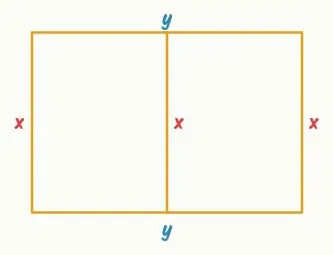
- A farmer has 120 m of fencing for a
- rectangular paddock, split into two pens
- by one more fence parallel to two sides.
- Find the greatest total area.
Q3: form the area
- Name both lengths.
- Then one variable only.
- 3x + 2y = 120three x, two y
- y = 60 − 1.5x− 3x, then ÷ 2
- A = xy = x(60 − 1.5x)length × width
- A = 60x − 1.5x²expand
Q3: the greatest area
- Check either side.
- Answer with units.
- A = 60x − 1.5x²
- A′ = 60 − 3xdifferentiate
- 60 − 3x = 0, so x = 20stationary
- A′(19) = 3 > 0, A′(21) = −3 < 0
- + then −: a maximum
- y = 60 − 1.5 × 20 = 30
- A = 20 × 30 = 600 m²
- 20 m by 30 m, area 600 m²
Question 4 · Merit, in context
- A Rotorua tour company runs x tours a week.
- Profit: P = −x³ + 6x² + 15x
- in hundreds of dollars.
- Find the greatest weekly profit.
Q4: the tour company
- Reject what cannot be.
- P is in hundreds.
- P′ = −3x² + 12x + 15differentiate
- = −3(x² − 4x − 5)take out −3
- = −3(x − 5)(x + 1) = 0factorise
- x = 5 or x = −1
- x = −1tours cannot be negative
- P′(4) = 15 > 0, P′(6) = −21 < 0
- P = −125 + 150 + 75 = 100x = 5
- 100 × $100 = $10,000hundreds of dollars
- 5 tours a week: $10,000 profit
Question 5 · Merit, in context
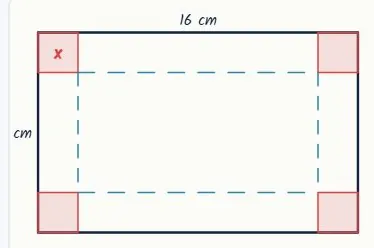
- A box is made from a 16 cm by 10 cm card
- by cutting a square of side x cm from
- each corner and folding up the sides.
- Find the greatest volume.
Q5: form the volume
- Base loses 2x each way.
- Expand fully.
- length 16 − 2x, width 10 − 2x
- height x
- V = x(16 − 2x)(10 − 2x)length × width × height
- (16 − 2x)(10 − 2x)
- = 160 − 32x − 20x + 4x²
- = 160 − 52x + 4x²collect
- V = 4x³ − 52x² + 160xmultiply by x
Q5: the greatest volume
- Reject the root that fails.
- Answer with units.
- V = 4x³ − 52x² + 160x
- V′ = 12x² − 104x + 160differentiate
- = 4(3x² − 26x + 40)take out 4
- = 4(3x − 20)(x − 2) = 0factorise
- x = 2 or x = 20/3 ≈ 6.67
- x = 20/3: 10 − 40/3 < 0negative width
- V′(1) = 68 > 0, V′(3) = −44 < 0
- V = 2 × 12 × 6 = 144 cm³x = 2
- cut 2 cm squares: 144 cm³
Question 6 · Excellence
- A wire frame for a box with a square base
- uses 60 cm of wire for its 12 edges.
- Find the largest volume the box can have.
Q6: form the volume
- Two unknowns: link them.
- Then one variable.
- base x by x, height h
- 8x + 4h = 608 base edges, 4 upright
- 4h = 60 − 8x
- h = 15 − 2x÷ 4
- V = x² × h = x²(15 − 2x)base area × height
- V = 15x² − 2x³expand
Q6: the largest volume
- Reject x = 0.
- Prove the maximum.
- V = 15x² − 2x³
- V′ = 30x − 6x²differentiate
- 6x(5 − x) = 0factorise
- x = 0 or x = 5
- x = 0no box at all
- V′(4) = 120 − 96 = 24 > 0rising
- V′(6) = 180 − 216 = −36 < 0falling
- h = 15 − 10 = 5, V = 5² × 5
- a 5 cm cube, 125 cm³
Question 7 · Excellence, in context
- A Wellington ferry charges $40 a ticket
- and sells 600 tickets a day. Each $1 rise
- in price loses 10 sales a day.
- What price gives the most revenue?
Q7: form the revenue
- x = number of $1 rises.
- Revenue = price × sales.
- price = 40 + x dollars
- tickets = 600 − 10x
- R = (40 + x)(600 − 10x)price × tickets
- = 24,000 − 400x + 600x − 10x²
- R = 24,000 + 200x − 10x²collect
Q7: the best price
- x is not the price.
- Answer the question asked.
- R = 24,000 + 200x − 10x²
- R′ = 200 − 20xdifferentiate
- 200 − 20x = 0, so x = 10stationary
- R′(9) = 20 > 0, R′(11) = −20 < 0
- + then −: a maximum
- price = 40 + 10 = $50x is not the price
- tickets = 600 − 100 = 500
- R = 50 × 500 = $25,000
- $50 a ticket, $25,000 a day
The method that solved all seven
- Form, solve, reject, prove, then answer the question.
| Step | How |
|---|---|
| Name | the variable, with units |
| Link | use the constraint |
| Form | one quantity, one variable |
| Solve | derivative = 0 |
| Reject | roots that cannot happen |
| Prove | gradient either side, or shape |
| Answer | the question asked, with units |
More in AS 91262
 The derivative: what the gradient function means6 min
 Differentiating polynomials, fractions and all7 min
 Equation of a tangent to a curve, step by step8 min
 Turning points: finding and proving max or min8 min
 Sketching the gradient graph of a function7 min
 Optimisation with calculus: the biggest box8 min
 Anti-differentiation and why you need + c7 min
 Kinematics: displacement, velocity and acceleration8 min
 The derivative: 7 exam questions solved step by step11 min
 Differentiating: 7 exam questions solved step by step11 min
 Tangents: 7 exam questions solved step by step11 min
 Turning points: 7 exam questions solved step by step12 min
 Gradient graphs: 7 exam questions solved step by step12 min
 Optimisation: 7 exam questions solved step by stepNotes
 Anti-differentiation: 7 exam questions solved step by step11 min
 Kinematics: 7 exam questions solved step by step11 min
Is your child on track?
Take the free placement test